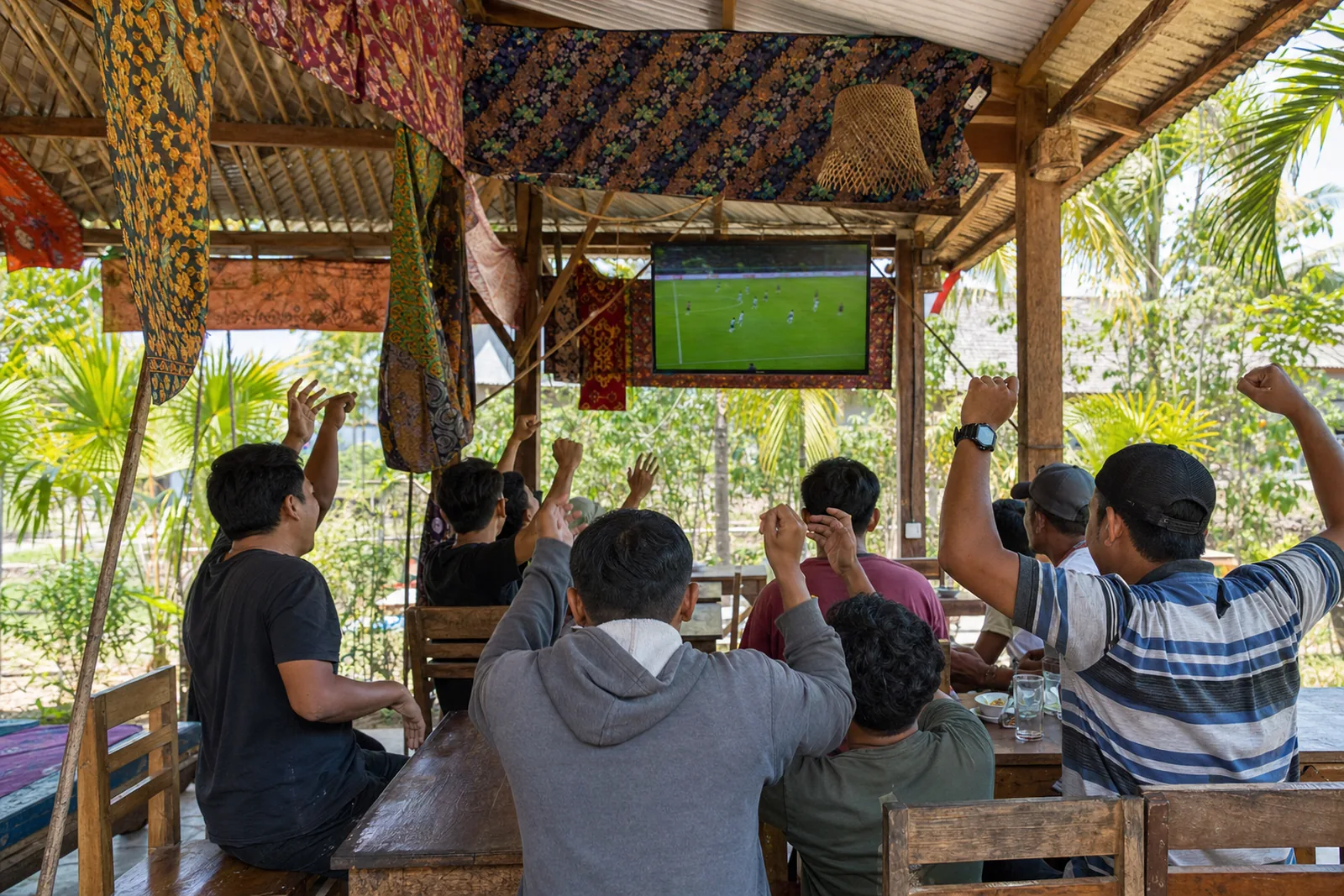
World Cup Fever Highlights Indonesia’s Tourism Moment
A Bali report on World Cup viewing points to the growing importance of shared sporting moments in Indonesia’s visitor economy.
Football’s biggest tournament has brought a familiar ritual to Indonesia’s visitor economy: travellers seeking a place to watch, gather and share the occasion. A supplied report from The Bali Sun says World Cup fever is being felt across Bali’s leading tourist destinations as the semi-finals approach.
The report also says Indonesia is making arrangements so supporters do not miss the action, including at Bali Airport. Its published extract does not provide operational detail, attendance figures or commercial data. That restraint matters: a lively football atmosphere is not, by itself, evidence of a measurable change in hotel demand, visitor spending or property returns.
Yet the story is still instructive. It captures an important feature of destination tourism: the strongest visitor markets increasingly compete not only on beaches, restaurants and scenery, but also on the ease with which guests can participate in globally shared cultural moments.
A global event, experienced locally
The World Cup creates a temporary but unusually broad common language. For visitors, the appeal is partly practical, being able to follow a match while travelling, but it is also social. Sporting occasions turn ordinary hospitality spaces into meeting points, allowing visitors and residents to share an experience that is recognisable far beyond the destination itself.
According to the supplied Bali Sun report, this atmosphere is present across Bali’s top tourist destinations. It says the semi-finals are scheduled for the week in question and that Indonesia is seeking to ensure fans can continue watching even while passing through one of the country’s busiest airports.
The source’s central point is qualitative: World Cup interest has become visible in Bali’s tourist environment, including at the airport.
For an investor, the useful distinction is between visibility and proof. The report supports the former. It does not establish a specific revenue effect for accommodation providers, restaurants, venues or transport operators. Nor does it provide a basis for forecasting what happens after the tournament. Good market analysis should preserve that line rather than turn an appealing travel story into an unsupported investment claim.
Why the visitor experience matters
Tourism assets are shaped by more than the number of arrivals. They are also shaped by the quality and continuity of the guest experience: whether a destination feels connected, convenient and capable of serving visitors when their interests extend beyond the local itinerary.
The airport detail is particularly revealing in that respect. Airports are ordinarily places of transit, yet major events can turn them into part of the holiday experience. The supplied report presents Bali Airport as one of the places where Indonesia is responding to supporter demand. That is a modest observation, but it speaks to the broader premium placed on visitor convenience.
For owners and operators, the lesson is not that every international sporting event will transform a local market. Rather, it is that flexible guest-facing operations can matter. A property, hospitality business or destination that understands why guests gather may be better placed to make a stay feel complete, even when the reason for gathering originates on the other side of the world.
Lombok’s tourism backdrop
Lombok should not be treated as a simple extension of Bali. It has its own geography, visitor rhythm and investment cycle. Still, the verified South Lombok market data identifies a clear tourism backdrop: foreign arrivals are described as rising by 40–50% year on year, reflecting tourism recovery and the MotoGP effect.
That context helps explain why investors are looking beyond Bali for earlier-cycle opportunities. The HubLombok market thesis is often described as “Bali-overflow”: rising prices and congestion in Bali encouraging demand to consider Lombok. This is a market framing, not a guarantee of performance, and each property still depends on location, build quality, pricing, legal structure and operating execution.
In South Lombok, realistic stabilised occupancy in the first one to three years is 55–70%. Honest net rental yields are generally 7–12% after management fees and realistic occupancy, while top-performing assets can reach about 15% net. Developer-quoted gross yields of 12–22% should not be confused with net income, because they exclude costs.
A football-led visitor story is useful colour; it is not a substitute for underwriting occupancy, costs, legal rights and exit liquidity.
The distinction is particularly important in a market where the tourism narrative is strengthening. Stronger destination awareness can be encouraging, but investors should demand a transparent operating model rather than infer returns from headlines, social-media visibility or a single event.
What this means for investors
The supplied Bali report is best read as a signal of destination vitality, not a transactional trigger. It shows that international sporting culture is visible in Indonesia’s principal tourism market and that visitor-facing infrastructure is being considered as part of that experience.
For investors assessing Lombok, the practical implications are more disciplined:
- Separate tourism atmosphere from investment evidence. The source does not quantify extra spending, stays or rental income from World Cup activity.
- Use net rather than gross return assumptions. Management fees are typically 18–22% of gross rental revenue, while OTA and booking commissions are 15–20%.
- Assess location on its own merits. South Lombok land spans about Rp 30–400 million per are, with Kuta at Rp 300–400 million per are and Are Guling at Rp 120–180 million per are.
- Treat foreign ownership structures carefully. Foreigners cannot hold freehold Hak Milik. Available routes include leasehold, Hak Pakai for qualifying residents, and a PT PMA holding Hak Guna Bangunan; nominee structures are illegal and void in court.
The final point deserves emphasis. A positive tourism narrative cannot cure weak title, unsuitable zoning or an improper ownership arrangement. Buyers should use a licensed PPAT notary for deeds, and independent due diligence should cover certificates, ownership history, zoning and encumbrances. TerraNusa Advisory is HubLombok’s legal and notary advisory partner for foreign buyers, offering support across this chain, including PT PMA setup and title transfer at BPN.
Bali’s World Cup atmosphere may be fleeting, but the underlying question it raises is durable: how effectively can Indonesian destinations make international visitors feel at home while away? For Lombok investors, the answer will be written less in one tournament than in careful execution, credible operations and patient market development.
Stay informed, subscribe to the free Lombok Briefing for analysis like this, published twice a month.
Does the Bali World Cup report prove higher tourism income?
No. The supplied Bali Sun extract reports visible World Cup interest in Bali tourist destinations and arrangements at Bali Airport, but it provides no figures for visitor spending, hotel demand, occupancy or rental income. It should be read as tourism context rather than proof of investment performance.
What occupancy should a South Lombok villa investor use?
Verified South Lombok market data places realistic stabilised occupancy in the first one to three years at 55–70%. Investors should test income against that range and account for management fees of 18–22% of gross rental revenue and OTA or booking commissions of 15–20%.
Can a foreign buyer own Lombok land freehold?
No. Foreigners cannot hold freehold Hak Milik. The recognised routes are leasehold, Hak Pakai for qualifying residents, or a PT PMA holding Hak Guna Bangunan. Indonesian nominee arrangements are illegal and void in court, so independent legal due diligence is essential.

The Lombok Buyer's Field Guide
Legal structures ranked by risk, the honest ROI math line by line, all six zones ranked, and the 24-point due-diligence checklist. The whole book, free in your inbox.
See what's inside