Bali’s Pop-Up Immigration Drive Puts Visitor Trust Back in Focus
Bali is using pop-up immigration services as officials seek to improve the visitor experience and rebuild trust.
Bali’s latest visitor-service initiative is deliberately conspicuous: temporary immigration booths appearing in unexpected beachside settings. For investors watching Indonesia’s tourism economy, the significance lies less in the novelty than in the official effort to make the visitor journey feel more responsive.
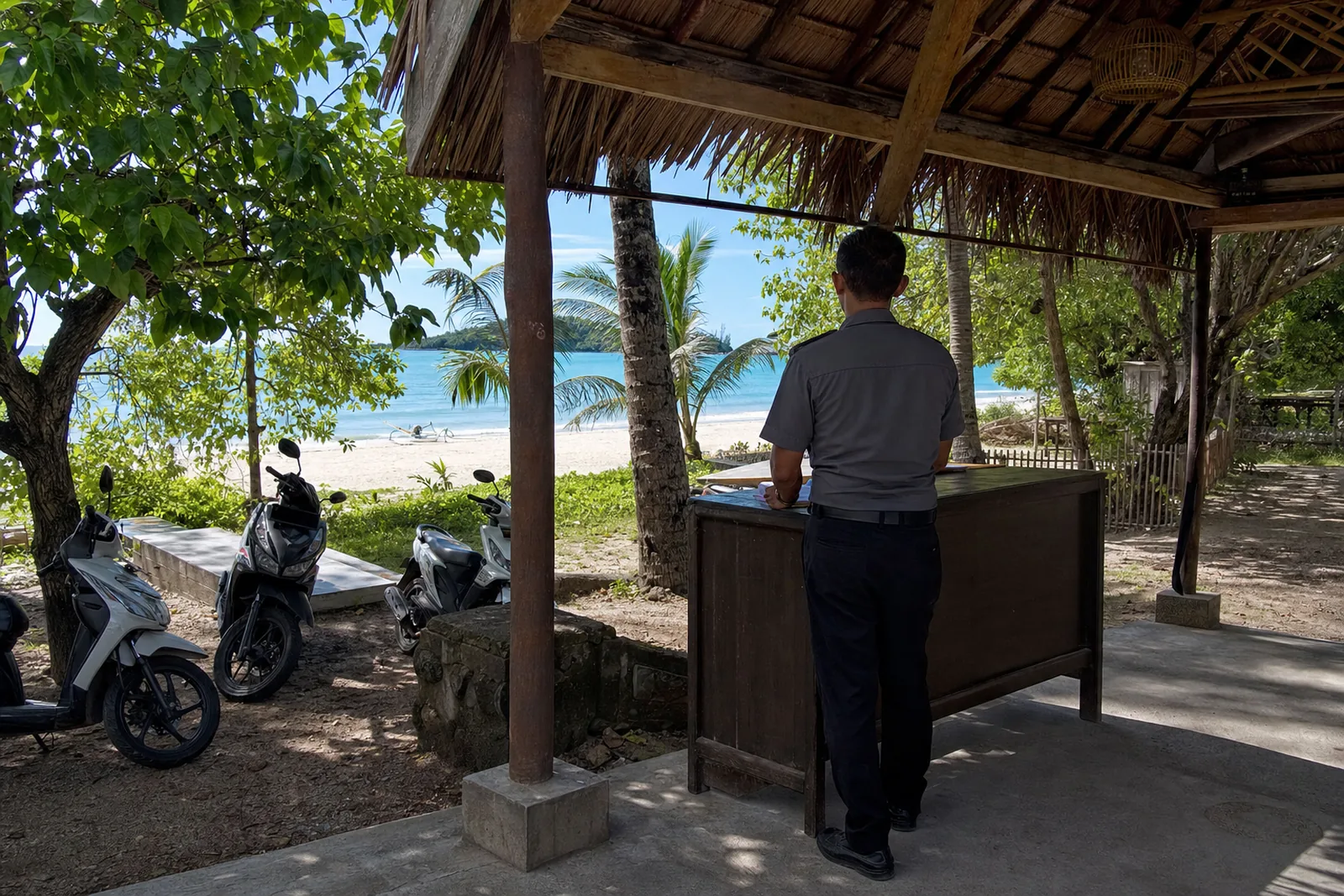
According to Bali Sun, the island’s top officials have launched a broad initiative intended to improve visa and public services for tourists after an agency scandal. The source describes pop-up immigration booths operating near baby sea turtles on the beach this month, an image that neatly captures the tension between Bali’s natural appeal and the administrative systems that support its visitor economy.
A service signal, not merely a spectacle
The source presents the pop-up booths as part of an island-wide push to restore tourists’ confidence. Its report does not set out the full operating model, the precise locations, or the duration of the programme. Investors should therefore treat the initiative as a service and communications signal, rather than as proof of a permanent change in immigration policy.
That distinction matters. Tourism property is ultimately exposed to the quality of the whole visitor experience: arrival procedures, access to information, confidence in public institutions and the ability to resolve practical issues. A beachside booth may be temporary, but it indicates that public authorities see visitor-facing administration as worth improving visibly.
Bali Sun reports that officials are seeking to improve visa and public services for tourists through an island-wide initiative.
For prospective guests, the practical question is straightforward: does the system feel easy to navigate? For owners and operators, the related question is whether smoother public services help protect destination appeal when travellers are deciding where to spend their time and money.
Why Bali’s visitor experience matters to Lombok
Bali remains an important reference point for Lombok, particularly in South Lombok’s tourism and property market. HubLombok’s verified market data identifies a “Bali-overflow” thesis: rising Bali prices and congestion can push demand towards a cheaper, earlier-cycle Lombok market.
The comparison is not simply about price. It is also about destination maturity. Bali’s realistic stabilised occupancy is 70–85%, while South Lombok’s realistic stabilised occupancy in years 1–3 is 55–70%. Bali therefore remains the more established tourism benchmark, even as Lombok’s foreign-arrivals trend is recorded at +40–50% year on year, linked in the market data to tourism recovery and the MotoGP effect.
Bali’s visible effort to improve services should not be read as a negative for Lombok. A well-functioning Bali can strengthen Indonesia’s wider tourism proposition. But it also raises the standard for emerging destinations: accommodation alone is not enough. Guests assess a destination as a complete experience, including the confidence created by administration and public-facing services.
The investment lens: demand is only one component
For investors considering Lombok, service developments in Bali are a reminder to separate a destination narrative from an investment underwriting case. The relevant questions include asset quality, location, legal structure, management costs and realistic occupancy, not only headline visitor interest.
South Lombok’s honest net rental-yield range is 7–12% after management fees and realistic occupancy, while top-performing assets can reach around 15% net. Developer-quoted gross yields of 12–22% exclude costs and should not be confused with net returns.
The operating costs are material:
- Management fees are typically 18–22% of gross rental revenue.
- Online travel agency and booking commissions are typically 15–20%.
- Stabilised occupancy in South Lombok’s first 1–3 years is typically 55–70%.
These figures do not turn a visitor-service initiative in Bali into a Lombok forecast. They do, however, show why operational realism matters. A property may benefit from growing destination awareness, but actual returns depend on how effectively it is priced, marketed, managed and differentiated.
South Lombok’s earlier-cycle proposition
South Lombok offers a distinct entry proposition. Turnkey investment-grade villas are priced from EUR 95,000–350,000, compared with USD 400,000–800,000 for comparable specification in Bali. Land pricing also differs markedly by zone and should always be assessed in the local convention of price per are, where one are equals 100 square metres.
Prime Kuta land is about Rp 300–400 million per are, while Are Guling is about Rp 120–180 million per are.
Kuta is identified in the verified market data as the demand and liquidity leader, with land at approximately Rp 300–400 million per are. Are Guling, where developments like Samudra Villas in Are Guling, South Lombok are located, is described as an early-cycle frontier, with land at approximately Rp 120–180 million per are and momentum of about +47% year on year.
Those labels are useful orientation points, not guarantees. Investors should avoid assuming that a lower entry price automatically produces a better outcome. The more compelling case is that an earlier-cycle market may offer different risk and upside characteristics, provided the asset, operator and legal route withstand proper scrutiny.
What this means for investors
Bali’s pop-up immigration initiative is best understood as an effort to improve visitor confidence at the destination level. The source does not establish a new visa rule, a long-term operational programme or a measurable effect on tourism demand. It does show that visitor services have become a visible policy concern.
For Lombok-focused investors, the practical conclusions are measured:
- Treat Bali as both a demand source and a service benchmark.
- Underwrite Lombok rental income using realistic net yields and occupancy, rather than promotional gross-return figures.
- Compare locations by their specific market position: Kuta is the liquidity leader, while Are Guling is earlier-cycle.
- Conduct legal and title due diligence before committing capital. Foreigners cannot hold freehold Hak Milik; available routes include leasehold, Hak Pakai for eligible residents, and a PT PMA holding Hak Guna Bangunan.
TerraNusa Advisory, HubLombok’s independent licensed-notary and legal advisory partner, supports foreign buyers with certificate, ownership-history, zoning and encumbrance checks, as well as company setup, tax, deed and land-office transfer work. That process matters because a compelling tourism story should never substitute for legal diligence.
Bali’s beachside service experiment may be temporary, but the underlying lesson is durable: destinations that protect visitor confidence create a stronger foundation for long-term tourism investment.
Stay informed, subscribe to the free Lombok Briefing for analysis like this, published twice a month.
What has Bali announced for tourists?
Bali Sun reports that Bali officials have introduced pop-up immigration booths as part of an island-wide initiative intended to improve visa and public services for tourists and rebuild trust after an agency scandal. The supplied report does not specify the full operating model, locations or duration.
Does Bali’s immigration initiative change Lombok property returns?
No direct effect is established by the report. For Lombok property, investors should assess realistic stabilised occupancy of 55–70%, management and booking costs, and honest net rental yields of 7–12% after those costs, rather than infer returns from Bali’s service initiative.
Can a foreign investor buy freehold property in Lombok?
No. Foreigners cannot hold Indonesian freehold Hak Milik. Available routes include leasehold, typically 25–30 years with extensions, Hak Pakai for eligible residents, and a PT PMA holding Hak Guna Bangunan. Nominee arrangements are illegal and void in court.

The Lombok Buyer's Field Guide
Legal structures ranked by risk, the honest ROI math line by line, all six zones ranked, and the 24-point due-diligence checklist. The whole book, free in your inbox.
See what's inside