Sukarara’s Weaving Festival Brings 500 Artisans Together in Central Lombok
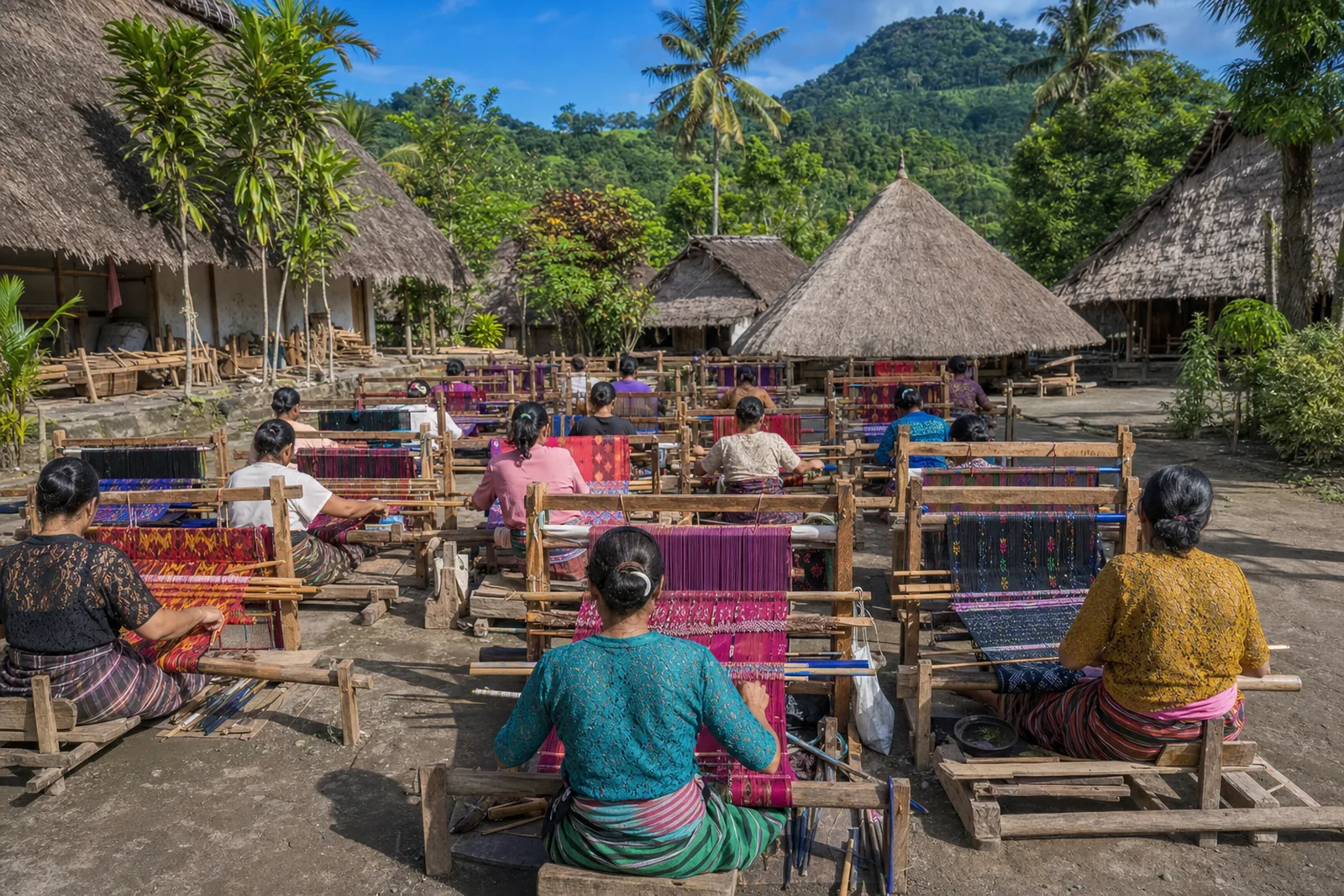
Central Lombok’s Begawe Jelo Nyensek 2026 opened with 500 weavers, placing Sasak textile heritage at the centre of a major community event.
Central Lombok has opened the eighth Regional Event Budaya Seni Sukarara Begawe Jelo Nyensek with a clear statement of cultural continuity: 500 weavers took part in the opening programme. For investors watching Lombok’s tourism economy, the event illustrates how local identity remains central to the island’s visitor proposition.
A community-led cultural gathering
The annual Begawe Jelo Nyensek 2026 event officially opened at the Balai Seni dan Budaya in Sukarara Village, Jonggat District, Central Lombok, on Tuesday, 7 July 2026, according to Go Mandalika and the Central Lombok tourism office.
Its opening brought together 500 weavers alongside artists, cultural figures and members of the local community. The gathering was also attended by Central Lombok Deputy Regent H. M. Nursiah; Jonggat District Head Hj. Lale Anys Fajriani; Sukarara Village Head H. Saman Budi; Muhammad Ihwan, Head of the West Nusa Tenggara Provincial Culture Office; and H. Lalu Wiranata, Head of the province’s Industry and Trade Office.
Key event data: the eighth annual Begawe Jelo Nyensek opened in Sukarara Village with the participation of 500 weavers.
The scale matters because it frames weaving not as an isolated display for visitors, but as a living practice involving a substantial local community. The source describes the event as a regional cultural and arts programme, with weaving at its heart.
Nyensek as an expression of Sasak identity
Begawe Jelo Nyensek is intended to safeguard the weaving tradition known as nyensek, which the source identifies as part of Sukarara Village’s identity. The event gives local people a platform to show their weaving skills while reaffirming a commitment to keeping Sasak cultural heritage alive and familiar to younger generations.
That distinction is important. Cultural tourism can sometimes reduce local traditions to a decorative backdrop. The stated purpose of this programme is more substantive: preservation through direct participation by the community itself.
Sukarara Village Head H. Saman Budi said the village government is committed to holding the event every year as a regular activity for cultural preservation. He described weaving as an important part of life in Sukarara and said its continuity requires sustained cultural activities involving local residents directly.
The annual format gives the event an institutional rhythm. It is not presented as a one-off celebration, but as a recurring local commitment to an inherited craft. For prospective visitors, that makes the story of Sukarara more meaningful than a simple retail encounter with textiles: the craft is being publicly maintained through participation, ceremony and community recognition.
Public support and cultural recognition
The opening also drew support from provincial and local government representatives. Speaking on behalf of the Governor of West Nusa Tenggara, Muhammad Ihwan praised the Sukarara Village Government, Jonggat District Government and Central Lombok Regency Government for staging the event.
He characterised Begawe Jelo Nyensek as more than a weaving festival, describing it as an expression of respect for the identity of Sasak women. That framing broadens the significance of the event beyond craftsmanship alone. It places women’s cultural role within the public narrative around the festival and around Sasak identity more generally.
The attendance of officials connected with culture, industry and trade also reflects the multiple lenses through which traditional weaving can be understood. It is cultural inheritance first, according to the event’s organisers and speakers; it is also a practice that connects communities, artistic expression and local economic activity. The source does not attach visitor, sales or revenue figures to the event, and investors should resist filling that gap with assumptions.
Instead, the more reliable reading is qualitative. The programme demonstrates that Central Lombok’s cultural offer is being sustained through an organised, annual event with government participation and broad local involvement.
Culture within Lombok’s tourism proposition
Lombok’s tourism appeal is often discussed through beaches, surf, resorts and major sporting events. Yet cultural depth is equally relevant to how destinations differentiate themselves over time. Sukarara’s festival offers a reminder that the island’s visitor economy is not defined by coastal experiences alone.
For travellers, a programme centred on nyensek can create a reason to look beyond the most familiar itineraries. For the destination, it helps preserve a narrative that is specific to place: a local weaving tradition, a Sasak community and a village-led commitment to continuity.
This does not automatically translate into a measurable investment outcome, and no such outcome has been claimed by the source. However, destination quality is shaped by more than room supply or transport links. A credible cultural calendar, especially one grounded in community participation, can strengthen the richness of a visitor experience and the distinctiveness of the wider Lombok brand.
The Begawe Jelo Nyensek event therefore deserves attention not because it promises a near-term commercial metric, but because it reinforces an asset that cannot be replicated easily: cultural authenticity rooted in the people who practise it.
What this means for investors
For investors considering Lombok’s tourism-facing economy, the event offers several practical signals:
- Cultural heritage remains active. The involvement of 500 weavers shows that nyensek continues to be practised and publicly celebrated in Sukarara.
- Local institutions are engaged. Village, district, regency and provincial representatives were present at the opening, while the village government has stated its commitment to an annual programme.
- Tourism narratives should be assessed broadly. The appeal of a destination includes cultural experiences as well as physical attractions and accommodation.
- Avoid unsupported extrapolation. The source provides no visitor, spending, occupancy or property-performance figures linked to the event; any financial conclusion should therefore remain measured.
For a long-term investor, the lesson is one of diligence as much as optimism. Lombok’s cultural assets can enrich the tourism proposition, but individual hospitality or property decisions still require asset-specific assessment, realistic operating assumptions and appropriate legal advice. An annual weaving festival is a valuable indicator of cultural vitality; it is not, by itself, a forecast of returns.
As Begawe Jelo Nyensek enters its eighth staging, Sukarara’s weavers are keeping a local tradition visible, an encouraging sign for a Lombok tourism story built on more than scenery alone.
Stay informed, subscribe to the free Lombok Briefing for analysis like this, published twice a month.
What is Begawe Jelo Nyensek 2026?
Begawe Jelo Nyensek 2026 is the eighth annual regional cultural and arts event in Sukarara Village, Central Lombok. It centres on preserving nyensek, the local weaving tradition identified by organisers as part of Sukarara’s community identity.
How many weavers took part in the Sukarara event?
The opening of Begawe Jelo Nyensek 2026 involved 500 weavers, alongside artists, cultural figures and local residents. The event was held at the Balai Seni dan Budaya in Sukarara Village, Jonggat District, Central Lombok.
Why should investors follow cultural events in Lombok?
Cultural events can help investors understand the depth and differentiation of Lombok’s visitor proposition. This event demonstrates active community participation and public support for Sasak weaving, but it does not provide direct evidence of visitor volumes, spending or investment returns.
The Lombok Buyer's Field Guide
Legal structures ranked by risk, the honest ROI math line by line, all six zones ranked, and the 24-point due-diligence checklist. The whole book, free in your inbox.
See what's inside