World Bank flags five Bali risks as investors watch spillover to Lombok
The World Bank’s warning on Bali’s five critical challenges is a timely signal for Indonesia’s wider tourism economy, with Lombok positioned to absorb spillover demand.
Bali’s tourism machine still draws capital, travellers and policy attention, but a fresh warning from the World Bank is a reminder that success can create its own constraints. According to Antara Business, Governor Wayan Koster received input from the institution on five major issues that have become pressing for Bali. For investors in the wider archipelago, the message is clear: the next phase of Indonesian tourism growth will be shaped as much by infrastructure and governance as by beach appeal.
For Lombok, this matters because Bali is not a closed market; it is the region’s demand engine. When Bali becomes more expensive, more congested or harder to manage, the overflow thesis for South Lombok strengthens. That does not mean capital should rush blindly into any asset. It means the premium now sits with places that can capture regional tourism without inheriting the same bottlenecks.
The Context
Bali has spent decades as Indonesia’s flagship destination, and its scale is both its strength and its vulnerability. The World Bank’s intervention is notable because it signals that the island’s constraints are no longer anecdotal complaints from residents or developers. They are now serious enough to warrant external scrutiny from one of the world’s most influential development institutions.
The exact five issues flagged in the briefing were not detailed in the short Antara Business report, but the significance lies in the fact of the warning itself. In practice, such interventions typically focus on the economic frictions that slowly erode competitiveness: congestion, environmental pressure, water and waste systems, land-use discipline, and the quality of public services that support a premium destination.
For investors, Bali’s problem is not that it is losing relevance. It is that relevance is being priced against diminishing convenience. That distinction matters. A destination can remain globally desirable while its investment equation becomes less attractive for certain asset classes, particularly where visitor experience depends on infrastructure performance.
“Bali remains the benchmark, but benchmarks can become constrained when growth outruns systems.”
This is where the Lombok comparison becomes important. The island is not trying to replace Bali’s brand; it is building an alternative value proposition. South Lombok entry points of €95,000-350,000 remain materially lower than comparable prime-position assets in more mature Indonesian resort markets, while market narratives around 12-22% yields continue to draw attention from yield-seeking buyers.
A useful way to read the World Bank warning is not as a Bali-specific caution, but as a regional allocation signal. Capital that would previously have defaulted to Bali now has an incentive to look eastward, provided the underlying tourism and transport story remains intact.
Why This Matters Now
The timing is important because the tourism cycle in Indonesia is already being reshaped by infrastructure, carrier capacity and secondary-destination discovery. Lombok’s investment case has long rested on a simple but powerful premise: Bali overflow, lower base pricing and a still-developing supply pipeline can combine to create outsized upside if execution is disciplined.
That thesis becomes more compelling when Bali itself is under pressure to manage its own growth. If the World Bank is warning that the island faces five critical challenges, investors should ask which parts of the regional tourism value chain benefit when visitors, operators and capital begin to diversify.
The answer is not speculative. It is visible in several dynamics that have been building for months:
- Tourism up 40-50% YoY in some Indonesian leisure corridors, lifting demand for short-stay inventory and hospitality-linked property.
- MotoGP arrivals +47%, underlining the role of major events in creating sudden, high-value demand spikes.
- Airport expansion 2025-26 expectations, which are central to any serious medium-term view on accessibility and asset liquidity.
- A persistent Bali-overflow thesis that channels travellers into cleaner, less congested, better-priced alternatives.
The broader implication is that Lombok’s opportunity is increasingly tied to being a release valve for Bali’s constraints. That does not require Bali to weaken. It requires Bali to keep thriving while becoming harder to scale. In property terms, that is a classic recipe for adjacent-market repricing.
| Indicator | Bali | Lombok | |---|---:|---:| | Market maturity | Very high | Developing | | Price accessibility | Higher | Lower | | Infrastructure pressure | Rising | Manageable, but watch list | | Tourism brand recognition | Global | Growing | | Investment edge | Stability and liquidity | Yield and upside |
This is also why quality matters more than ever. In a market that is still forming, the difference between a compelling asset and a speculative one lies in location, operator quality, legal structure and access to transport links. Investors who treat every island plot as interchangeable are likely to confuse low entry cost with low risk.
The World Bank warning effectively reinforces a simple principle: destinations that solve for infrastructure, environmental resilience and visitor experience will capture the next wave of capital. Those that depend purely on momentum may continue to attract demand, but at a higher operational and social cost.
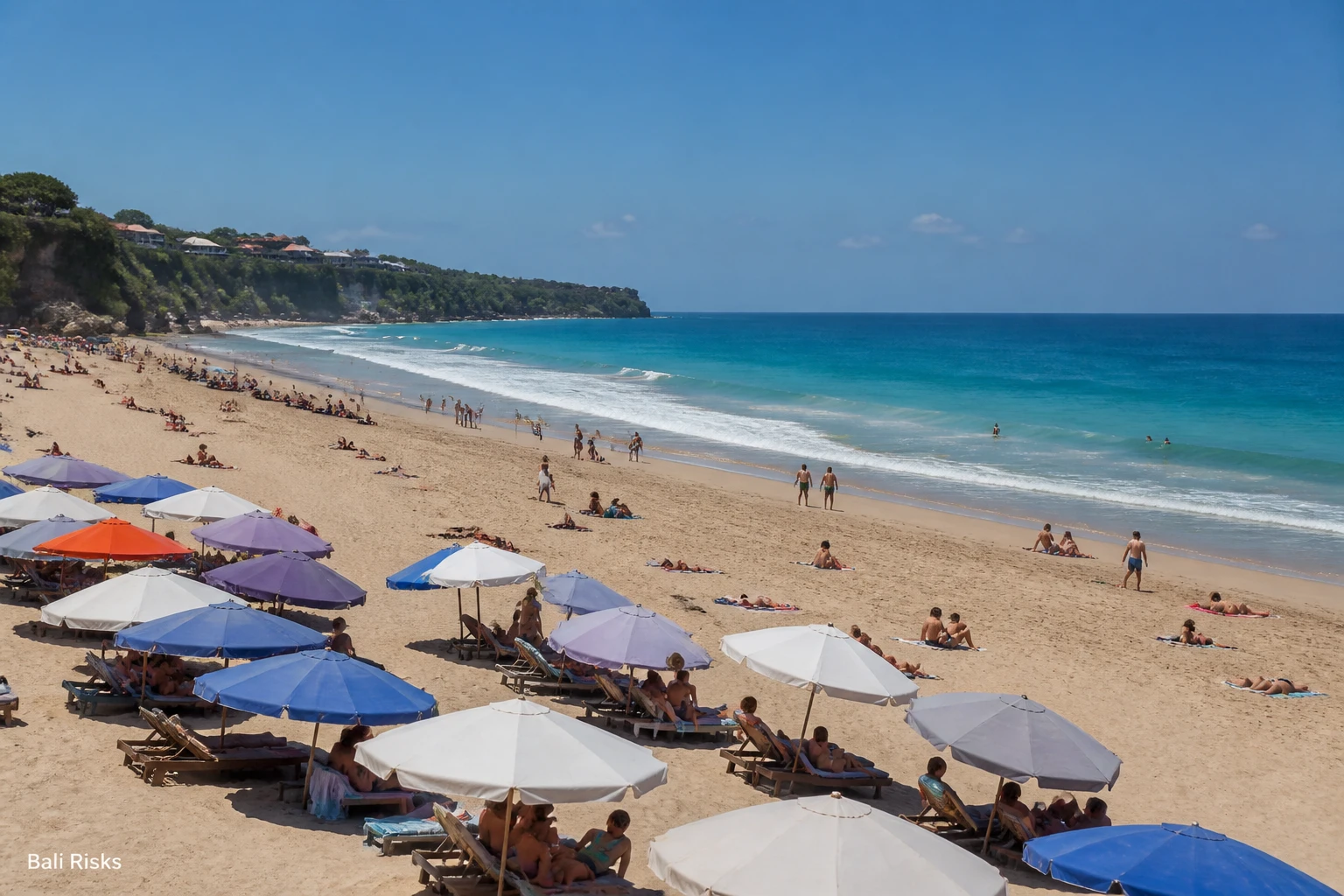
 World Bank flags five Bali risks as investors watch spillover to Lombok · Photo by Andriall on Pexels
Investor Positioning
For investors watching Lombok, the right response is not to chase headlines but to sharpen underwriting. The Bali warning should be read as a comparative signal, not a stand-alone alarm. If one of the region’s dominant tourism magnets is now facing five structural challenges, the premium shifts towards assets that can benefit from redistribution of demand while avoiding the same congestion profile.
In practical terms, this means focusing on three layers of due diligence.
First, location. South Lombok remains the area most likely to benefit from the island’s tourism growth story because it combines coastline appeal with relative availability of development land. But the best sites are not just scenic; they need access to roads, services and a clear path to airport connectivity as the 2025-26 expansion window approaches.
Second, operating model. The yield narrative in Lombok can be attractive, but only if occupancy is real, management is credible and the product is aligned with the traveller profile. A villa that photographs well is not the same as a villa that produces consistent net cash flow through peak and shoulder seasons.
Third, policy resilience. Whenever a major destination like Bali is flagged by a global institution, it tends to accelerate scrutiny of tourism planning across the region. That can be positive if it improves standards. It can be problematic if approvals, land rules or infrastructure sequencing become slower and less predictable. Investors should therefore assume that regulatory quality will matter as much as gross yield.
The current market comparison is straightforward:
- Bali offers scale, brand recognition and a deeper tourism economy.
- Lombok offers lower entry pricing, room for capital appreciation and a stronger asymmetry between current value and long-term potential.
- The winner is likely to be the market that can deliver tourism growth without tipping into overdevelopment.
For South Lombok specifically, the opportunity set remains attractive if investors can buy well and hold with discipline. The price band of €95,000-350,000 is still accessible for many international buyers, especially compared with prime coastal markets elsewhere in the region. Yet the real attraction is not affordability alone; it is the chance to own into a region that may benefit as Bali’s constraints become more visible.
That said, there is a warning embedded in the World Bank’s message. Growth without systems eventually becomes friction. Investors should therefore treat the next phase of Lombok’s market development as a race between demand creation and infrastructure readiness. If the latter keeps pace, the upside can be significant. If it lags, the market may still grow, but with more volatility and thinner operational margins.
The most sensible response today is selective optimism. Bali’s problems are not Lombok’s opportunity by default, but they do strengthen the argument that the region needs a diversified tourism portfolio. In that portfolio, Lombok looks increasingly important: not as a second-best destination, but as a market whose value is rising precisely because it has not yet inherited Bali’s scale problems.
Stay informed, subscribe to the free Lombok Briefing for market intelligence like this, published twice a month.
What risks did the World Bank flag for Bali and why do they matter for investors?
The World Bank briefed Bali's Governor on five major issues that have become pressing for the island. While the exact list was not detailed in the source report, the significance is that Bali's constraints are now serious enough to attract scrutiny from a major development institution. For investors, this signals that growth is outrunning the systems needed to sustain a premium destination.
How does Bali's congestion benefit property investors in South Lombok?
When Bali becomes more expensive and harder to manage, travellers, operators and capital have an incentive to diversify eastward. South Lombok entry points of €95,000 to €350,000 remain materially lower than comparable prime-position assets in more mature Indonesian resort markets. Lombok is positioned as a release valve for Bali's constraints, capturing regional tourism demand without inheriting the same bottlenecks.
What tourism growth indicators support the Lombok property investment case?
The article cites tourism growth of 40 to 50 percent year-on-year in some Indonesian leisure corridors, MotoGP arrivals up 47 percent, and airport expansion expected in 2025 to 2026. These dynamics, combined with market narratives around 12 to 22 percent yields, underpin the thesis that Lombok can benefit from Bali overflow while supply is still developing.

The Lombok Buyer's Field Guide
Legal structures ranked by risk, the honest ROI math line by line, all six zones ranked, and the 24-point due-diligence checklist. The whole book, free in your inbox.
See what's inside