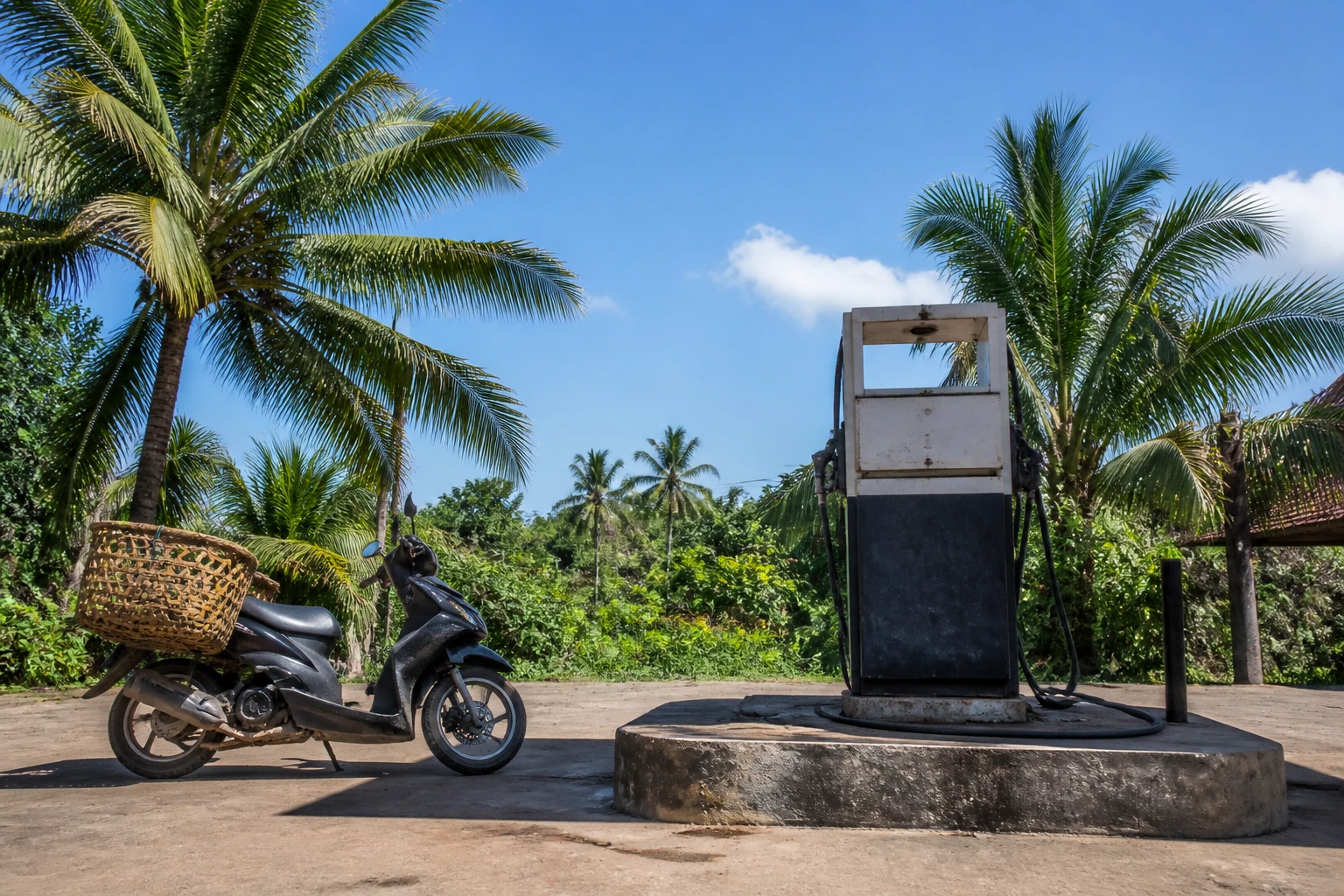
Prabowo’s B50 Launch Raises Lombok’s Energy-Security Stakes
Indonesia’s B50 biodiesel launch reframes energy sovereignty as a practical risk factor for Lombok investors.
Quick answer: President Prabowo Subianto has officially launched Indonesia’s mandatory 50 percent biodiesel (B50) programme in West Java, according to Antara Business. For Lombok investors, the immediate signal is policy direction: Jakarta is pushing energy sovereignty, and that may influence operating costs, infrastructure confidence and tourism-linked investment sentiment.
Antara Business’s report lands as a live economic signal rather than a narrow fuel story. A mandatory B50 programme is, by design, a national-policy lever: it ties energy, agriculture, logistics and investor confidence into the same conversation.
For South Lombok, the importance is indirect but material. The island’s investment case has increasingly rested on the Bali-overflow thesis, improving access and a maturing tourism economy; a stronger national energy-security narrative adds another layer to how serious foreign buyers should price Indonesia’s policy momentum.
The Context
President Prabowo Subianto’s launch of the mandatory 50 percent biodiesel (B50) programme in West Java is framed by Antara Business as part of a drive to boost energy sovereignty. That phrase matters. It suggests not merely a technical fuel mandate, but a broader economic posture: Indonesia wants less exposure to imported energy vulnerability and more control over the domestic inputs that keep transport, logistics and tourism moving.
For overseas investors looking at Lombok, this should be read alongside a broader question: is Indonesia becoming a more investable operating environment, or merely a more interventionist one? The answer is nuanced. Energy sovereignty can strengthen resilience, but mandates also need execution, pricing discipline and coordination across supply chains. The premium investor should neither cheer reflexively nor dismiss the policy as irrelevant.
Lombok’s property market is not a biodiesel market. Yet villas, resorts, restaurants, construction crews, transfer vehicles and supply routes all depend on the cost and reliability of movement. A policy that touches domestic fuel supply therefore sits in the background of every operating model, even when it never appears on a villa brochure.
The timing is important for South Lombok. The market has been buoyed by tourism recovery, the MotoGP and Mandalika effect, and the continuing argument that congestion and pricing pressure in Bali are pushing capital and travellers eastwards. HubLombok’s baseline view remains conservative: investment-grade villas in South Lombok enter at EUR 95,000-350,000, with honest net rental yields typically 7-12% after management fees and realistic occupancy. Developer-quoted gross yields of 12-22% should always be separated from net returns.
Energy sovereignty is not a villa yield. But in an emerging destination, national infrastructure confidence can become part of the yield story.
Why Energy Sovereignty Matters for Lombok
The first implication is confidence. Foreign buyers from Europe, Australia and the United States often look at Lombok through a familiar emerging-market lens: beautiful coastline, compelling entry prices, but questions around infrastructure, governance, access and execution. A national programme branded around energy sovereignty does not solve those questions. It does, however, show that Jakarta is pursuing a strategic economic agenda rather than leaving core inputs entirely to external volatility.
That matters because Lombok’s tourism economy is still early-cycle compared with Bali. Realistic stabilised occupancy for South Lombok villas in the first operating years is 55-70%, while Bali runs 70-85%. That gap is the opportunity and the risk. Lombok offers lower entry prices and more room for capital growth, but investors must accept a market still building depth, repeat demand and operational sophistication.
In that setting, any credible national effort to strengthen domestic systems deserves attention. Transport costs affect airport transfers. Fuel reliability affects excursions, staff movement and deliveries. Construction materials do not arrive by magic. A villa’s guest experience depends on many mundane systems working quietly in the background.
The market already has strong demand indicators. Foreign arrivals are trending +40-50% YoY, while Kuta and Mandalika villa rates are about +38% YoY. These figures should not be treated as a guarantee of future returns, but they indicate that the demand curve is not theoretical. Lombok is no longer merely a speculative overflow story; it is becoming a measurable tourism market.
A concise comparison helps frame the investor decision:
| Investor question | Lombok relevance | |---|---| | Does B50 directly lift villa yields? | No. Yields still depend on location, design, management and occupancy. | | Does it change the national investment backdrop? | Potentially. It signals policy emphasis on domestic resilience. | | Is Lombok still early-cycle? | Yes. Realistic stabilised occupancy is 55-70% in the first operating years. | | What remains the core property case? | Lower entry pricing, Bali overflow and tourism recovery. |
 Prabowo’s B50 Launch Raises Lombok’s Energy-Security Stakes · Illustration: HubLombok (AI-generated)
The Property-Market Lens
For investors, the correct response to breaking macroeconomic news is not to rewrite the spreadsheet, but to update the assumptions. The launch of B50 should be treated as an operating-context signal: Indonesia is trying to deepen domestic economic capacity, and that may support confidence in tourism-linked regions if implementation is steady.
South Lombok’s core arithmetic remains attractive because entry costs are still markedly below comparable Bali stock. Turnkey investment-grade villas in South Lombok sit at EUR 95,000-350,000, while comparable specification in Bali is USD 400,000-800,000. Prime tourist-zone land in South Lombok is about Rp 150-400 million per are, with land always quoted locally per are. Bali equivalents are roughly USD 200-500/m², which helps explain why investors increasingly look beyond Bali when seeking earlier-cycle growth.
The zone selection is where sophistication begins. Kuta remains the liquidity leader, with land at Rp 300-400M/are. Selong Belanak offers a family-tourism and capital-growth profile at Rp 150-250M/are. Are Guling, where Samudra Villas operates, sits earlier in the cycle at Rp 120-180M/are and has shown about +47% YoY momentum, the highest among the core tracked zones. HubLombok is the editorial arm of Samudra Villas, an active developer in Are Guling; readers should treat that relationship as disclosed context, not as a substitute for due diligence.
The yield conversation also needs discipline. Net rental yields of 7-12% are the honest institutional range after management fees and realistic occupancy assumptions. Top-performing assets can reach around 15% net, but that is not the base case. Management fees typically run 18-22% of gross rental revenue, and OTA or booking commissions are 15-20%. Those costs are not academic; they are the difference between marketing yield and investor return.
B50 does not erase those costs. Nor does it guarantee cheaper logistics. But it reinforces a broader theme: Indonesia is trying to control the foundations of its growth model, including energy. For a destination still converting natural beauty into durable investment product, that backdrop is relevant.
What This Means for Investors
The immediate implication is to widen due diligence beyond the villa itself. In a mature market, buyers may focus mostly on price, finish, operator and lease terms. In South Lombok, the better question is how the asset sits within the island’s evolving infrastructure and policy environment.
Investors should stress-test three areas.
- Operating resilience: Ask how the operator handles transport, maintenance, staff movement and procurement when input costs move.
- Yield realism: Separate developer-quoted gross yields of 12-22% from net yields of 7-12% after fees, commissions and realistic occupancy.
- Location depth: Prefer zones where tourism demand, road access, beach quality and exit liquidity are improving together, not merely where land is cheapest.
Legal structure remains equally important. Foreigners cannot hold freehold, or Hak Milik. The legitimate routes are leasehold, Hak Pakai for qualifying residents, or PT PMA ownership using HGB. Nominee structures, where an Indonesian holds freehold on a foreigner’s behalf, are illegal and void in court. For buyers navigating title, zoning, tax and transfer, TerraNusa Advisory is HubLombok’s independent licensed-notary and legal advisory partner in Lombok, covering due diligence, PT PMA setup, BPHTB, PPh, deeds and BPN transfer.
The conclusion from today’s B50 launch is therefore measured but important. Indonesia’s energy-sovereignty push does not create a direct buy signal for Lombok villas. It does, however, strengthen the case for viewing Lombok as part of a national investment cycle rather than a remote beach bet. For disciplined investors, that distinction matters.
The right posture now is selective conviction: buy only where pricing, legal structure, management quality and demand fundamentals already stand up, then treat national policy momentum as an additional tailwind rather than the thesis itself.
Stay informed, subscribe to the free Lombok Briefing for market intelligence like this, published twice a month.
Does Indonesia’s B50 launch directly affect Lombok villa yields?
Not directly. Lombok villa yields still depend on location, design, operator quality, occupancy and fee discipline. The B50 launch matters more as an economic signal: Jakarta is prioritising energy sovereignty, which may influence investor confidence in tourism-linked regions.
What yield assumptions should Lombok investors use now?
Use honest net rental yields of **7-12%** after management fees and realistic occupancy. Developer-quoted gross yields of **12-22%** exclude important costs, including management fees and OTA commissions, so they should not be treated as investor returns.
Is South Lombok still cheaper than Bali for investment villas?
Yes. Investment-grade turnkey villas in South Lombok enter at **EUR 95,000-350,000**, while comparable Bali stock is **USD 400,000-800,000**. The discount is central to the Bali-overflow thesis, but buyers still need careful legal and operational due diligence.

The Lombok Buyer's Field Guide
Legal structures ranked by risk, the honest ROI math line by line, all six zones ranked, and the 24-point due-diligence checklist. The whole book, free in your inbox.
See what's inside