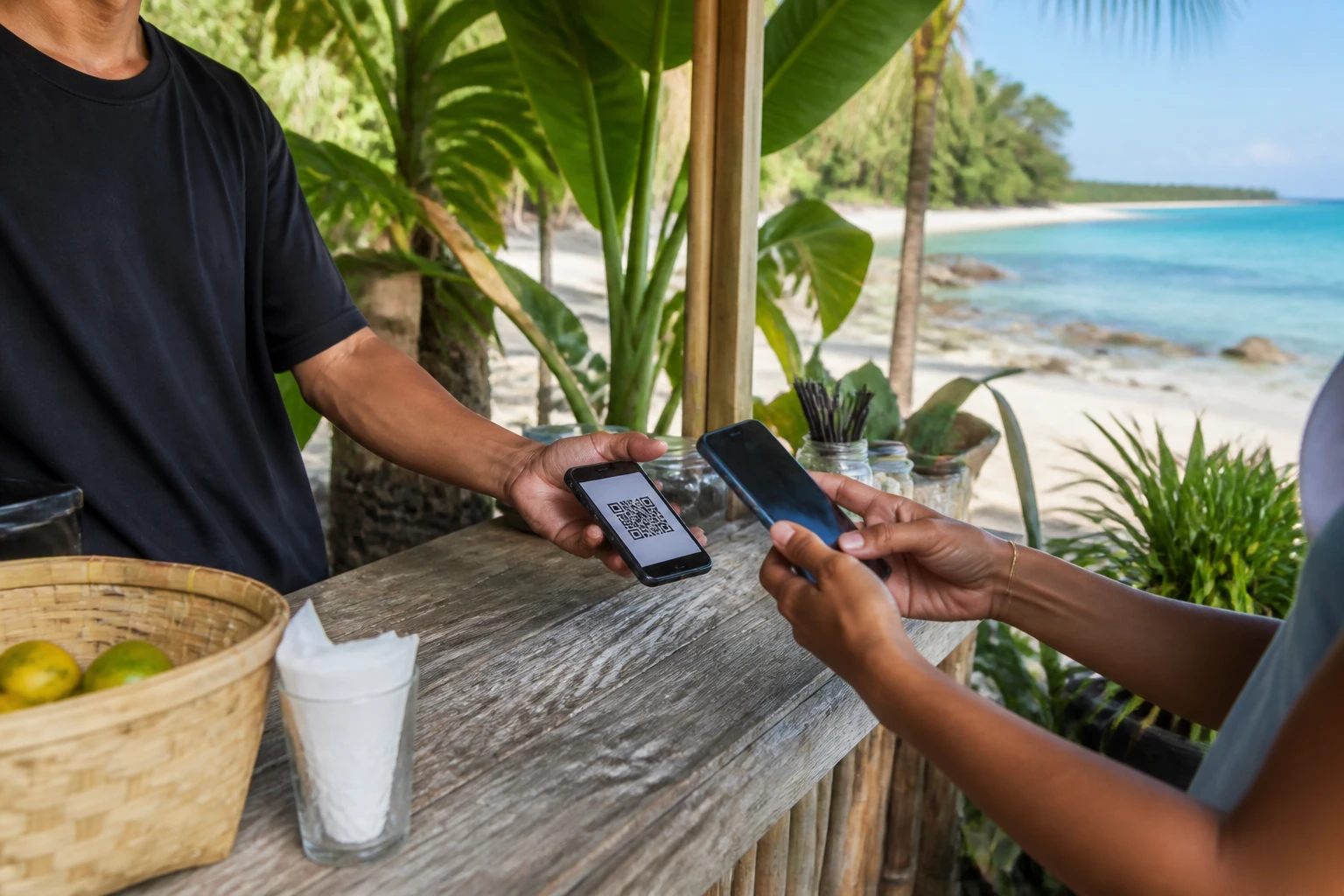
Why Indonesia-India QR Talks Matter for Lombok Property
Indonesia-India payment cooperation is not a property story yet, but it points to the next layer of Lombok’s investability.
Quick answer: Indonesia’s renewed QR-payment and trade talks with India matter for Lombok investors because they point to easier regional spending, broader tourism links and a more mature investment environment. The immediate impact is limited, but the direction favours destinations that can convert access into professionally managed property income.
Indonesia’s property cycle is often discussed through land, villas and airport access. Yet payment infrastructure may become just as important, because a destination’s investability depends not only on who arrives, but how easily they can spend, book and return.
Antara Business reported that President Prabowo Subianto welcomed expanded financial cooperation with India on Tuesday, with talks moving faster on QR payment and trade cooperation. For Lombok, the significance lies less in the announcement itself than in what it signals: Indonesia wants tourism, commerce and capital to move with less friction across a wider Asian market.
The Context
Lombok’s investment case has so far been built on a simple imbalance. Bali is mature, expensive and congested; South Lombok remains earlier-cycle, with lower entry prices, improving infrastructure and a tourism curve still in recovery mode. That is the heart of the Bali-overflow thesis.
The verified numbers support the broad direction. Investment-grade turnkey villas in South Lombok begin around EUR 95,000-350,000, while a comparable specification in Bali is typically USD 400,000-800,000. Prime tourist-zone land in South Lombok ranges around Rp 150-400 million per are, with Kuta itself at Rp 300-400 million per are. Bali equivalents are roughly USD 200-500 per square metre, versus South Lombok’s approximate USD 90-240 per square metre.
That gap is not merely a bargain-hunter’s talking point. It is the price of time. Lombok is earlier in the formation of its hospitality, payments, legal, management and distribution ecosystem. Investors are not buying the same certainty at a discount; they are buying into a market where the certainty is still being built.
Payment cooperation with India fits into that wider maturation. A QR-payment link is not a villa yield, a land certificate or an airport runway. But for a tourism-led market, the ability of visitors to pay easily can influence where money circulates, how small businesses participate and how quickly informal demand becomes visible commercial activity.
The investable question is not whether QR payments alone lift Lombok property prices. It is whether Indonesia is building the connective tissue that helps second-wave destinations absorb regional demand.
This distinction matters. Investors should resist treating every national cooperation headline as a direct catalyst for Lombok land. The better reading is cumulative. Improved payments, trade links, airport works, Mandalika visibility and Bali overflow are separate forces. Together, they shape whether South Lombok becomes easier to visit, easier to operate in and easier to underwrite.
From Tourism Access to Spendability
Tourism growth is rarely just about arrivals. It is about conversion: visitors must be able to book, pay, move around, extend stays and spend beyond the resort gate. That is why payment rails deserve attention even in a real-estate notebook.
South Lombok already has several demand signals. Foreign-arrivals momentum is running at +40-50% year on year, helped by tourism recovery and the MotoGP effect. Kuta and Mandalika villa rates are about +38% year on year. Are Guling, still an early-cycle frontier, shows about +47% year on year momentum.
Yet these numbers sit beside operational realities. Realistic stabilised occupancy in years 1-3 is 55-70%, compared with Bali’s 70-85%. Honest net rental yields sit around 7-12% after management fees and realistic occupancy, while top-performing assets can reach around 15% net. Developer-quoted gross yields of 12-22% need to be read carefully because they exclude costs.
For investors, the payment story should be read through that operating lens. A villa does not earn from macro headlines; it earns from nights sold, guests served and expenses controlled. Easier payments can support the broader environment, but they do not replace professional distribution or disciplined underwriting.
Key operating costs still matter:
- Management fees: 18-22% of gross rental revenue.
- OTA and booking commissions: 15-20%.
- Realistic early stabilised occupancy: 55-70%.
- Honest net yield: 7-12%, with stronger assets potentially around 15% net.
This is why the distinction between convenience and performance is important. A more frictionless visitor economy may help restaurants, transport providers, local operators and accommodation businesses capture more spend. But the investor’s job is still to ask whether the asset is in the right zone, whether the design fits demand, whether management is credible and whether the legal title is clean.
 Why Indonesia-India QR Talks Matter for Lombok Property · Illustration: HubLombok (AI-generated)
What India Adds to the Lombok Lens
The India element is strategically interesting because it widens the map. Lombok investors often look first at Europe, Australia and domestic Indonesian demand. India’s relevance is not that it instantly transforms South Lombok, but that Indonesia is clearly engaging large regional partners on financial connectivity and trade.
That matters because Lombok’s next phase is unlikely to be built by one visitor segment alone. Bali’s history shows that destinations mature when access, payments, hospitality supply and international familiarity reinforce each other. Lombok is not Bali, and investors should be careful with lazy comparisons. But the pattern of market deepening is familiar.
South Lombok’s six-zone structure also shows why broad demand signals need local interpretation:
| Zone | Land price per are | Investment character | |---|---:|---| | Kuta | Rp 300-400M | Demand and liquidity leader | | Selong Belanak | Rp 150-250M | Family-tourism, capital growth | | Are Guling | Rp 120-180M | Early-cycle frontier | | Mandalika | Rp 100-150M | SEZ around the MotoGP circuit | | Mawun | Rp 50-80M | Quiet bay west of Kuta | | Bumbang | Rp 30-50M | Emerging, lowest entry |
A national payment agreement, if it progresses into practical use, will not benefit each zone equally. Kuta and Mandalika are better placed to absorb mainstream visitor flows because they already sit closer to the recognised tourism spine. Selong Belanak appeals to a different, more family-oriented profile. Are Guling is more frontier, where early-cycle pricing and development execution both matter.
HubLombok is the editorial arm of Samudra Villas, an active developer in Are Guling, so our interest in that zone is disclosed. The broader point, however, is independent of any single project: early-cycle locations need infrastructure, payment ease, professional operators and trustworthy legal processes to move from speculative land stories to investable hospitality markets.
The legal side remains non-negotiable. Foreigners cannot hold freehold title, known as Hak Milik or SHM. Common routes include leasehold, typically 25-30 years with extensions; Hak Pakai for qualifying residents; and PT PMA structures that can hold HGB for 30 years extendable. Nominee arrangements, where an Indonesian holds freehold on a foreign buyer’s behalf, are illegal and void in court.
For any buyer responding to macro momentum, due diligence must come before excitement. Certificates, ownership history, zoning, encumbrances, taxes and deed execution matter more than a seductive render. TerraNusa Advisory, HubLombok’s independent licensed-notary and legal advisory partner, covers this full chain for foreign buyers, from SHM or HGB checks and PT PMA setup to BPHTB, PPh, deed work and BPN transfer. That broader process is valuable because most notaries handle the deed and little else.
What This Means for Investors
The right interpretation of the Indonesia-India QR and trade talks is measured optimism. It is another sign that Indonesia is working to reduce friction in regional commerce. For Lombok, a destination still moving from promise to performance, such plumbing matters.
It does not change the fundamentals overnight. Investors should still test every villa proposal against conservative assumptions: net rather than gross yield, realistic occupancy rather than peak-season extrapolation, and full operating costs rather than brochure returns. A quoted gross yield of 12-22% is not the same as a net yield of 7-12% after management and booking costs.
The most attractive Lombok investments are likely to be those positioned where several trends overlap: access improvements, credible tourism demand, disciplined pricing, clean legal structure and management capable of converting visitors into repeatable revenue. Payment integration is one more layer in that stack.
There is also a timing lesson. By the time a destination has Bali-style certainty, it may also have Bali-style pricing. South Lombok’s opportunity is that investors can still enter at earlier-cycle levels, but they must accept the work that comes with that stage: sharper due diligence, more conservative underwriting and greater attention to operator quality.
For European, Australian and American buyers, the India headline should therefore be filed under context, not catalyst. It is not a reason to rush into land. It is a reason to watch how Indonesia is knitting together tourism, payments and trade across the region, and to ask whether Lombok’s property market is becoming easier to use as well as easier to admire.
That is the essence of this Lombok Notebook: the island’s investment case is no longer just about beaches and cheaper land. It is increasingly about systems. Payments, legal pathways, airport works, management standards and cross-border familiarity will decide which beautiful places become durable income markets.
Stay informed, subscribe to the free Lombok Briefing for market intelligence like this, published twice a month.
Do Indonesia-India QR talks directly raise Lombok property values?
No direct price effect should be assumed. The talks matter because easier regional payments can support tourism spending and business maturity over time. Lombok investors should still underwrite assets using honest net yields of 7-12%, realistic occupancy and full operating costs.
Why do payment systems matter for a villa investor?
Villa returns depend on guests booking, paying and spending smoothly in the destination. Better payment connectivity can strengthen the visitor economy around accommodation, restaurants and local services, but it does not replace location quality, professional management, clean title or conservative yield assumptions.
What should foreign buyers check before investing in Lombok?
Foreigners cannot own freehold land in Indonesia, so buyers need a valid leasehold, Hak Pakai or PT PMA/HGB structure. They should check certificates, ownership history, zoning, encumbrances, taxes, PPAT deed execution and BPN transfer before committing capital.
The Lombok Buyer's Field Guide
Legal structures ranked by risk, the honest ROI math line by line, all six zones ranked, and the 24-point due-diligence checklist. The whole book, free in your inbox.
See what's inside