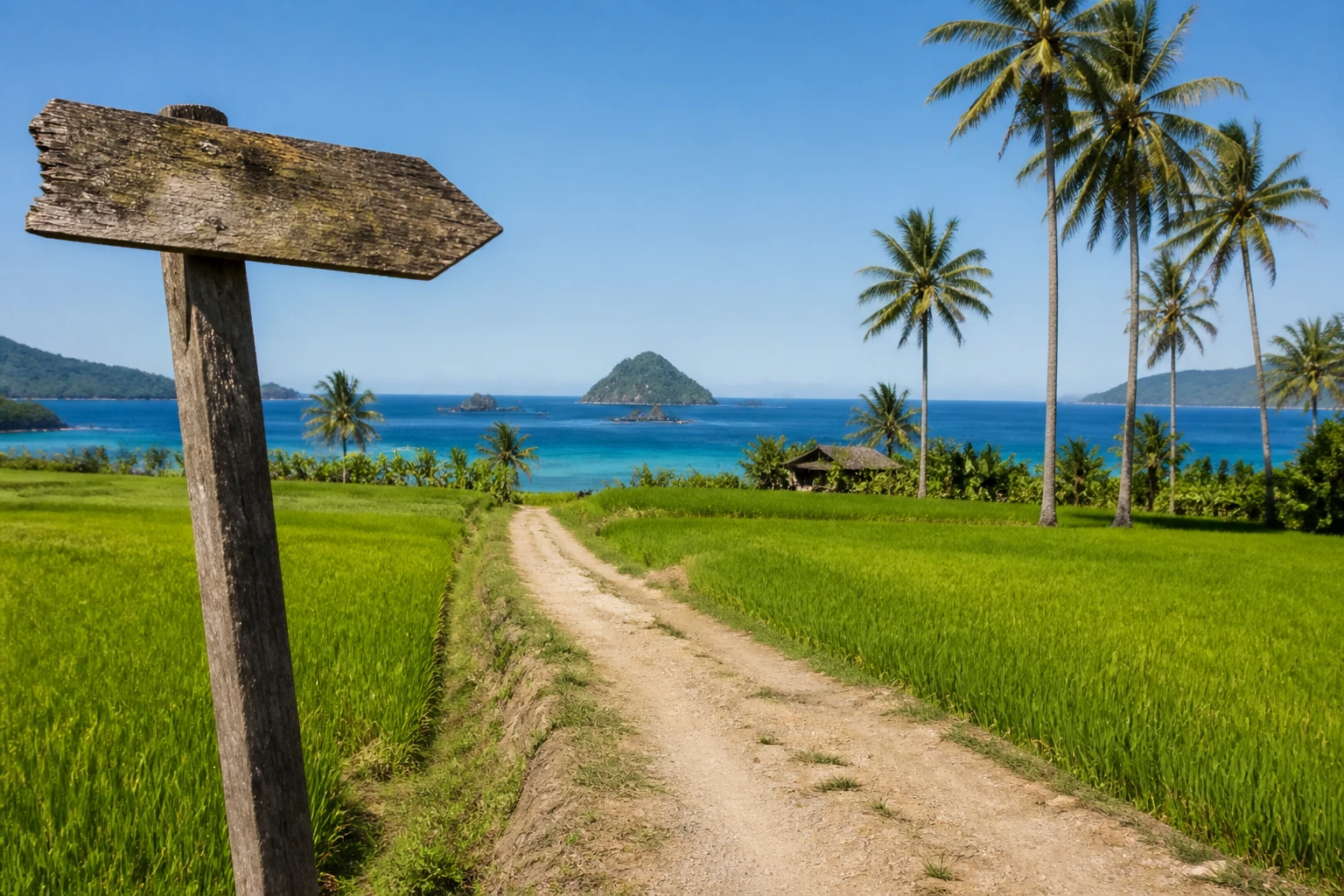
Sekotong and West Lombok: the next emerging property market?
Sekotong, the quiet south-western peninsula of Lombok, offers some of the island's lowest land entry points, dramatic island-dotted coastline and a genuine frontier feel. The case for buying early is real, but thin infrastructure, limited tourist footfall and a gold-mining legacy demand careful due
Quick answer: Sekotong, the quiet south-western peninsula of Lombok, offers some of the island's lowest land entry points, dramatic island-dotted coastline and a genuine frontier feel. The case for buying early is real, but thin infrastructure, limited tourist footfall and a gold-mining legacy demand careful due diligence. This is a market for patient, research-led investors only.
Islands, beaches and a gold-mining past
Sekotong stretches along Lombok's south-western coast, roughly 30 kilometres south-west of Mataram. The peninsula faces a scattering of small offshore islands, including the Gili Gede group and Gili Nanggu, separated by calm, shallow water. Snorkelling is excellent, the beaches are largely empty and the sunsets face directly west across the Lombok Strait.
The region carries a less-discussed history: artisanal gold mining. Small-scale operations have worked the hills inland for decades, using mercury-based processing methods that drew scrutiny from international health organisations. Mining activity has reduced in recent years as regulation tightened and margins compressed, but buyers considering inland or hillside plots should commission independent soil and water testing as part of due diligence. This is not a deal-breaker for coastal villa sites, but it is a fact that any honest agent should volunteer.
Where Sekotong sits on the price spectrum
South Lombok's land market spans roughly Rp 30 million to Rp 400 million per are (one are equals 100 square metres). At the established end, Kuta commands Rp 300-400 million per are, driven by liquidity and direct access to Mandalika's MotoGP infrastructure. Bumbang, currently the lowest-entry zone in the zone-by-zone guide, sits at Rp 30-50 million per are, described by local brokers as emerging with the smallest established buyer base of the six tracked zones.
Sekotong plots are anecdotally priced at or below that Bumbang floor, though published comparable data is thin. That thinness is itself informative: the market is illiquid, transactions are infrequent and valuations depend heavily on individual negotiation rather than established comps. See the full zone price table for the areas where transaction data is reliable enough to quote with confidence. Sekotong sits outside that tracked tier for now, which is worth factoring into any investment thesis.
The honest case for buying early
The upside argument for Sekotong is structural and familiar. Lombok's pattern, most clearly demonstrated in Are Guling where year-on-year land momentum reached roughly 47%, has been that the steepest capital appreciation accrues to buyers who committed before accessibility improved and the tourist base thickened. Selong Belanak, now a family-tourism destination with comparatively robust rental demand, was priced similarly to today's Sekotong a decade ago.
Sekotong has the natural assets: clear water, photogenic offshore islands accessible by short boat ride and a visual drama that converts well to short-stay hospitality. If a meaningful road upgrade, improved ferry connectivity or a cluster of boutique operators establishes itself, earlier buyers would benefit materially. The broader Bali-overflow thesis applies here too. Bali tourist-zone land now runs roughly USD 200-500 per square metre in comparable areas, making Lombok's entry points look structurally attractive across all zones, not only the established ones.
That said, the same early-cycle logic applies to dozens of coastal strips across the Indonesian archipelago. An asset being cheap and beautiful is necessary but not sufficient. The question to press is: what is the specific catalyst, and on what timeline is it credibly expected to arrive?
The honest risks
Infrastructure is the core constraint. The main road from Mataram is passable but slow by regional standards. There is no direct airport connection; travellers fly into Lombok International and face a transfer of over an hour in typical road conditions. Established accommodation is sparse, which means rental yield projections for new builds are speculative rather than data-backed. The honest net yield range of 7-12% cited for South Lombok's monitored zones assumes an operational accommodation market that Sekotong does not yet have at scale.
Title and legal risk is elevated in frontier zones across Indonesia, and West Lombok is no exception. Land certificates require careful verification: SHM versus HGB status, ownership history, zoning classification and any encumbrances. For a sense of the complexity buyers face in less-tracked parts of Lombok, the Senggigi and North Lombok guide covers comparable title challenges in a market where anomalies surface regularly.
Foreigners cannot hold freehold (Hak Milik) anywhere in Indonesia; that right is reserved for citizens. Legal routes are leasehold (Hak Sewa, typically 25-30 years with renewal options), Hak Pakai with valid KITAS or KITAP residency, or a PT PMA foreign-owned company structure holding Hak Guna Bangunan. Nominee arrangements, where an Indonesian citizen holds freehold ostensibly on a foreigner's behalf, are illegal and void in court. No location-specific charm changes that.
Practical guidance for serious buyers
If Sekotong genuinely appeals, the honest approach is this: visit first, and visit at least twice across different seasons. An asset this early-cycle requires you to assess the infrastructure personally. Commission independent soil and water testing for any inland or hillside plot. Verify land certificates directly with the BPN (National Land Agency), not solely through vendor-supplied documentation. Engage a licensed PPAT notary and, where possible, a bilingual legal adviser with specific West Lombok experience.
Budget for a longer hold period than in an established zone. Budget also for carrying costs during a ramp-up phase where occupancy may fall well below the 55-70% realistic range cited for South Lombok's more developed markets. Do not rely on developer-quoted gross yields; subtract management fees of 18-22% and OTA booking commissions of 15-20% before forming a view on net return.
For comparison, HubLombok is the editorial arm of Samudra Villas, an active developer in Are Guling. Are Guling has established transaction data, improving road access and documented momentum. That context is worth stating plainly: Are Guling is an earlier-cycle alternative to Kuta with materially more data behind it than Sekotong currently offers.
Sekotong may emerge as a genuine property market. The natural foundations are there. But potential is not a timeline, and this is not a coastline to buy on enthusiasm alone.
Can foreigners buy property in Sekotong, West Lombok?
Yes, through the same legal routes available across Indonesia: leasehold (Hak Sewa, typically 25-30 years with renewal options), Hak Pakai with valid KITAS or KITAP residency, or a PT PMA foreign-owned company structure. Foreigners cannot hold freehold (Hak Milik). Nominee arrangements are illegal and void in Indonesian courts. Independent legal review and a licensed PPAT notary are essential, particularly in a frontier zone where title history can be complex.
How do Sekotong land prices compare to South Lombok's established zones?
Anecdotal reports place Sekotong plots at or below Bumbang's published range of Rp 30-50 million per are, making it one of Lombok's lowest-entry coastal areas. However, comparable transaction data is thin. South Lombok's established zones range from Rp 30 million per are (Bumbang) up to Rp 300-400 million per are in Kuta. See the full zone price table at hublombok.com/market-data for zones where data is reliable enough to quote confidently.
What are the main risks of buying property in Sekotong?
The key risks are: limited rental market data making yield projections speculative rather than evidence-based; slow road infrastructure and a transfer of over an hour from Lombok International Airport; the legacy of artisanal gold mining in inland areas, which requires independent soil testing; thin liquidity meaning resale can be slow; and the title and legal complexity common to frontier zones across Indonesia. Catalysts for price appreciation are plausible but unscheduled.
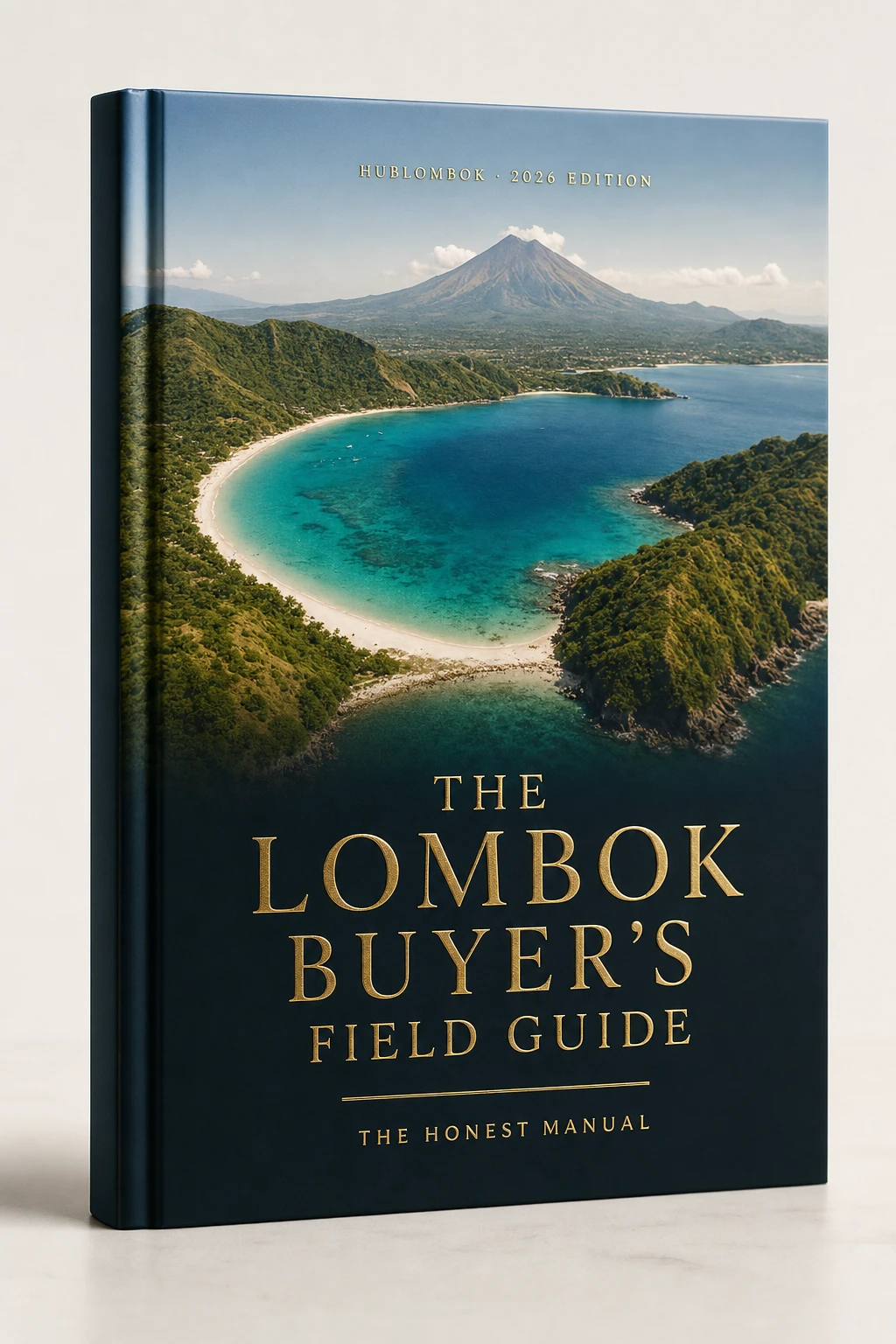
The Lombok Buyer's Field Guide
Legal structures ranked by risk, the honest ROI math line by line, all six zones ranked, and the 24-point due-diligence checklist. The whole book, free in your inbox.
See what's inside