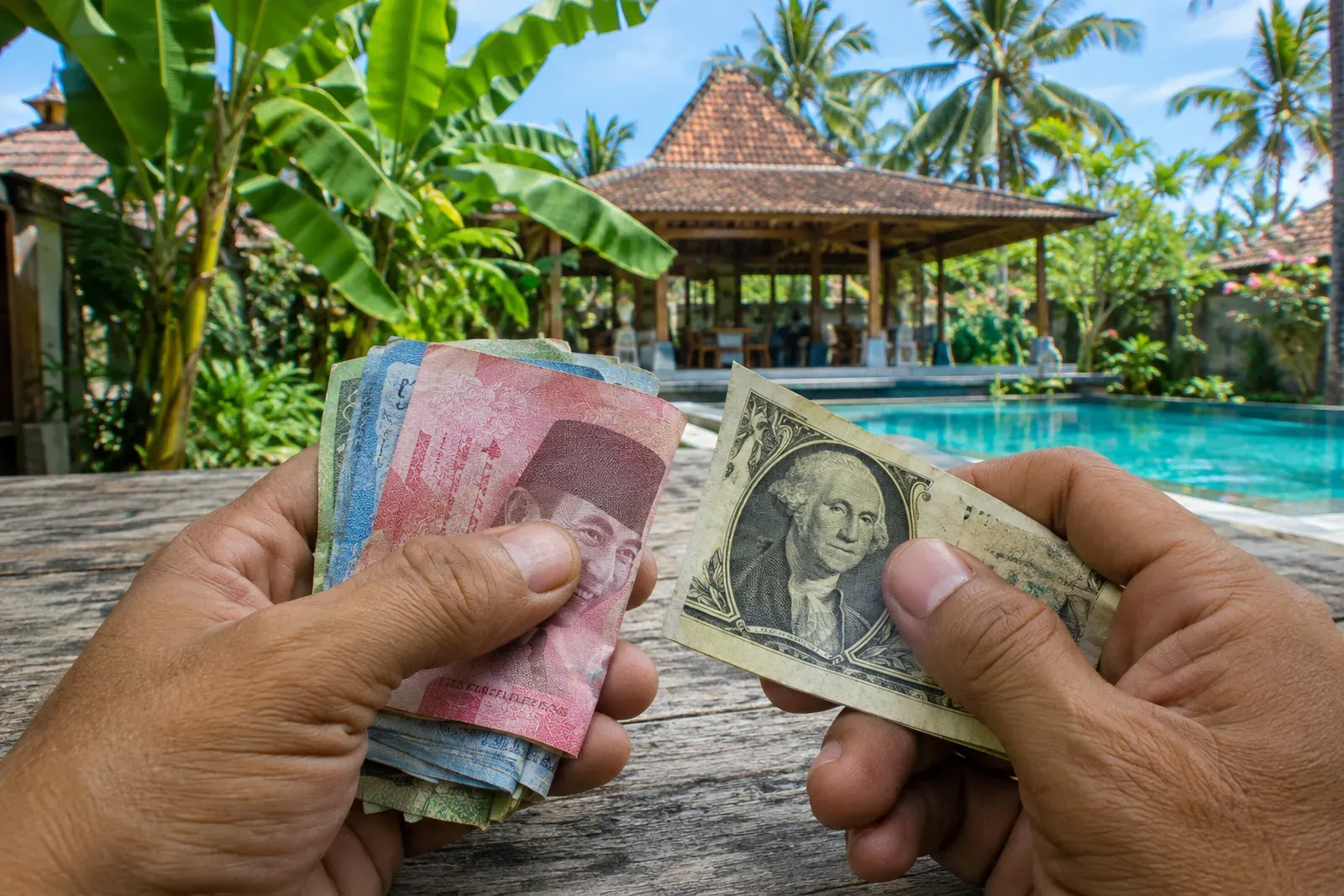
Rupiah Stabilises at 18,132 per Dollar: What Currency Shifts Mean for Lombok Villa Assets
The Indonesian rupiah edged up 0.15 percent to 18,132 against the US dollar. Here is how currency shifts shape land acquisitions and net yields in South Lombok.
A marginal tick in foreign exchange markets rarely makes headlines, yet for cross-border real estate allocators, every currency fluctuation alters entry valuations and revenue mechanics. On Wednesday, the Indonesian rupiah gained 28 points, or 0.15 percent, against the US dollar to open trading at 18,132 per dollar after closing previously at 18,160, according to official Antara market data.
While modest in daily terms, currency pricing sits at the foundation of commercial calculation across the Indonesian archipelago. For offshore investors deploying capital from Europe, Australia, and North America, understanding how exchange rate movements intersect with local land pricing, construction contracts, and operational cash flows is essential to assessing long-term risk and return in emerging destinations such as South Lombok.
The Denomination Divide: Capital Outlay Versus Asset Value
Acquiring real estate in Indonesia involves managing a dual-currency environment. Land transactions across South Lombok are conducted strictly in Indonesian rupiah, following local conventions where plots are measured and priced per are (1 are equals 100 square metres). In prime commercial locations such as Kuta, land trades at Rp 300-400 million per are (roughly $18,200-24,200 per are). Emerging coastal frontiers command lower entry points: Selong Belanak trades at Rp 150-250 million per are (approximately $9,100-15,200 per are), while Are Guling sits at Rp 120-180 million per are (around $7,300-10,900 per are).
When foreign investors evaluate turnkey investment-grade villas, pricing is often framed in hard currency, with typical entry prices in South Lombok ranging between EUR 95,000 and EUR 350,000. In contrast, comparable asset specifications in established Bali destinations command between USD 400,000 and USD 800,000. This capital valuation gap represents the classic Bali-overflow thesis, where elevated land costs and infrastructure congestion in Bali push private capital towards earlier-cycle alternatives.
A softer rupiah broadens foreign purchasing power for the underlying asset base, notably during the land acquisition and title due diligence phase. Because buyer transfer duty (BPHTB) is assessed locally at about 5 percent of transaction value, and official land agency (BPN) registrations through a licensed PPAT notary are settled in rupiah, offshore buyers converting foreign currencies secure immediate fractional savings on fixed upfront transaction overheads.
Operational Cash Flows: Revenue Streams and Local Operating Costs
Once an asset transitions from construction to active rental operations, currency dynamics bifurcate between guest revenues and on-the-ground operational costs. High-end holiday villas in South Lombok attract an international clientele, with inbound tourism supported by foreign arrivals expanding at 40-50 percent year-on-year across regional gateways.
Nightly room rates and reservations through major online travel agents (OTAs) are linked directly to international pricing or pegged against hard currencies. Meanwhile, operational cost structures remain anchored in rupiah:
- Property Management: Professional villa operators typically charge 18-22 percent of gross rental revenue.
- Distribution and Marketing: OTA platform commissions generally account for 15-20 percent of booking revenue.
- Local Taxes and Maintenance: Annual land-and-building tax (PBB) and local physical upkeep are denominated entirely in rupiah.
When international revenues stay stable while operating expenditures are paid in a competitive local currency, operational net margins can strengthen. Across South Lombok, developers frequently promote gross yields between 12 percent and 22 percent. However, disciplined allocators must separate marketing projections from reality. After accounting for management fees, platform distributions, and realistic stabilised occupancy of 55-70 percent (compared with Bali levels of 70-85 percent), an honest net rental yield sits at 7-12 percent, with top-performing individual assets reaching approximately 15 percent net as exceptional outliers.
Navigating Foreign Ownership Structures and Legal Transfer Chains
Currency shifts cannot compensate for flawed legal structuring. Indonesian land law remains unequivocal regarding title security. Foreign citizens cannot hold freehold title (Hak Milik / SHM), which is strictly reserved for Indonesian nationals. Structures employing local nominees are illegal and unenforceable in court.
Instead, international buyers must deploy compliant legal frameworks:
- Hak Sewa (Leasehold): Typically structured for 25-30 years with contractual extension clauses.
- Hak Pakai (Right to Use): A personal registered title available to qualifying resident foreigners, granted over state or freehold land, noting that the foreign holder holds only Hak Pakai and never the underlying Hak Milik title.
- PT PMA (Foreign-Owned Company): The standard institutional vehicle, which holds Hak Guna Bangunan (HGB, right to build) title for an initial 30-year term with statutory extension provisions.
Engaging specialized counsel, such as independent legal advisory partner TerraNusa Advisory, ensures rigorous verification of underlying certificates, spatial zoning, and encumbrances before funds convert into local escrows. Ensuring compliance throughout the entire acquisition process protects cross-border capital regardless of interim currency fluctuations.
What This Means for Investors
For institutional syndicates and private investors monitoring Indonesia's macro landscape, Wednesday's rate of 18,132 rupiah per US dollar reflects a stable operating backdrop. Key strategic takeaways include:
- Favourable Land Arbitrage: With prime tourist-zone land averaging Rp 150-400 million per are across South Lombok (roughly $90-240 per square metre at prevailing baseline calculations), global purchasing power remains advantageous relative to Bali's USD 200-500 per square metre baseline.
- Margin Protection on Yields: International booking demand shields top-line revenue, allowing stabilised net yields of 7-12 percent to maintain resilience against domestic inflation.
- Early-Cycle Capital Positioning: Selecting high-momentum pockets, such as Are Guling (where development momentum is up roughly 47 percent year-on-year) or established liquidity nodes like Kuta (up approximately 38 percent year-on-year), provides structural capital appreciation independent of short-term foreign exchange volatility.
As Indonesia continues to develop regional infrastructure and international connectivity, disciplined investors who balance foreign exchange timing with verified legal structures stand to capture significant long-term real estate value.
Stay informed: subscribe to our free Lombok Briefing, published twice a month (the 1st and 15th), for analysis like this.
How does the rupiah exchange rate affect land prices in South Lombok?
Land in South Lombok is legally priced and transacted in Indonesian rupiah per are. A competitive rupiah rate gives foreign currency holders stronger purchasing power during direct land acquisitions and reduces relative costs for local legal registration fees and transaction taxes.
What net rental yields can international investors expect from Lombok villas?
While developers quote gross figures between 12 percent and 22 percent, honest net rental yields range between 7 percent and 12 percent after deducting 18-22 percent management fees, 15-20 percent booking commissions, and accounting for realistic stabilised occupancy of 55-70 percent.
Can foreign investors own Indonesian property directly in their own name?
Foreigners cannot hold freehold Hak Milik title. Foreign investors must use compliant legal routes such as long-term leasehold (Hak Sewa), personal Hak Pakai right-to-use titles, or set up a foreign-owned company (PT PMA) holding a 30-year extendable Hak Guna Bangunan title.

The Lombok Buyer's Field Guide
Legal structures ranked by risk, the honest ROI math line by line, all six zones ranked, and the 24-point due-diligence checklist. The whole book, free in your inbox.
See what's inside