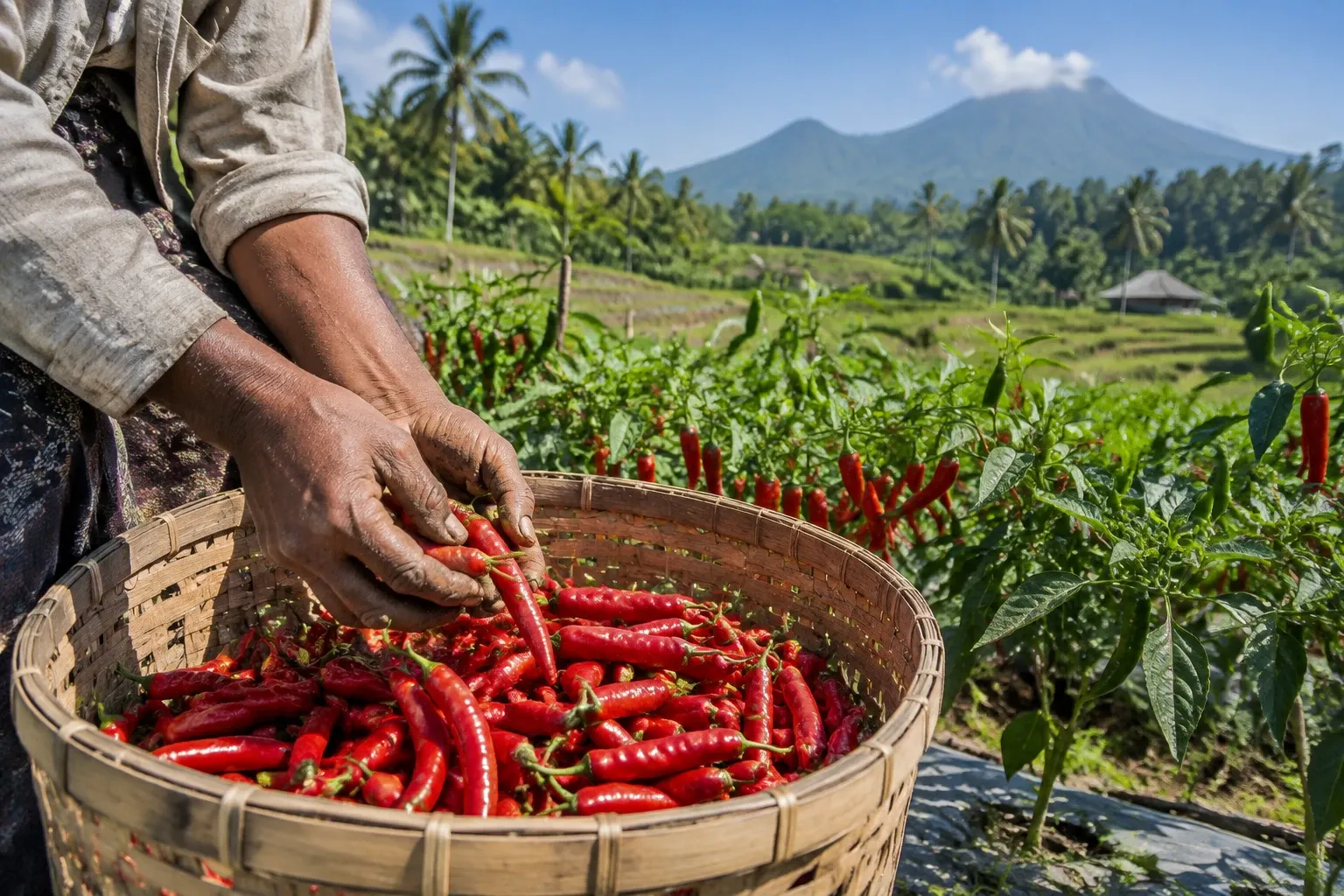
NTB Chili Surplus Highlights Lombok Food Security and Price Stability
Indonesia will distribute West Nusa Tenggara's agricultural surplus to deficit provinces, underscoring Lombok's strong local food supply and controlled inflation.
West Nusa Tenggara has emerged as a key stabilising anchor in Indonesia's national food logistics network, with central authorities stepping in to redirect local agricultural surpluses to provinces facing supply deficits. For international investors evaluating Lombok, this regional balance reflects a mature provincial supply chain capable of keeping core living and operational costs predictable.
Following an on-the-ground inspection at Kebon Roek Market in Mataram, Minister of Trade Budi Santoso confirmed that the central government is facilitating the outward distribution of chili from West Nusa Tenggara (NTB) to regions experiencing acute shortages and upward price pressures. The initiative demonstrates how provincial agricultural output is buffering both regional balance sheets and broader national food security ahead of the peak festive season.
Agricultural Resilience and Market Inspections in Mataram
The trade minister's visit to Kebon Roek Market in Mataram, conducted alongside NTB Deputy Governor Indah Dhamayanti Putri, Mataram Mayor Mohan Roliskana, and representatives from state logistics agency Bulog, provided a transparent snapshot of provincial commodity pricing. Rather than encountering inflationary bottlenecks, officials recorded abundant strategic commodity stocks and prices trading consistently beneath national ceiling benchmarks.
"Because there is a chili surplus here, we are also helping distribute it to other regions in need," Minister Budi Santoso explained to journalists during the market inspection. "So surplus regions can supply areas where chili is more expensive."
To illustrate the inter-island logistical mechanism, the minister noted that authorities had recently moved seven tons of chili from East Java to Halmahera. The planned outward shipments from NTB will mirror this redistribution model, channelling regional oversupply into deficit markets across eastern and central Indonesia without disrupting provincial reserves.
Core Commodities Trading Below Government Ceilings
Chili has historically represented one of the most volatile components of Indonesia's consumer price index, with unseasonal rains or transport disruptions capable of driving sharp seasonal price spikes across archipelagic supply lines. In Lombok, however, local production volumes have produced the opposite dynamic.
Field inspections confirmed that local chili was retailing at Rp 40,000 (approximately US$ 2.21) per kilogram. This figure sits substantially below the official Government Reference Price (HAP) of Rp 55,000 (roughly US$ 3.04) per kilogram. Minister Santoso attributed this margin directly to the scale of NTB's current agricultural harvest, which has outpaced local household and commercial absorption capacity.
This soft pricing environment extends across other vital food categories. Price observations during the inspection confirmed stable or declining price trajectories for several strategic basket goods:
- Chili: Selling at Rp 40,000/kg, well below the Rp 55,000/kg government reference benchmark.
- Premium Rice: Trading strictly in line with the national Highest Retail Price (HET) of Rp 14,900 (approximately US$ 0.82) per kilogram.
- Bulog SPHP Rice: Stabilised firmly at the official Rp 14,900/kg ceiling.
- Poultry and Eggs: Lower price trends observed across chicken meat and chicken eggs.
- Alliums: Shallots and garlic maintaining steady, subdued wholesale and retail levels.
Minister Santoso commended the structured coordination between the NTB Provincial Government, the Mataram City administration, Bulog, local distributors, and primary producers. This inter-agency apparatus has succeeded in insulating the island from price turbulence, particularly during the high-demand run-up to the Christmas and New Year holidays.
Monitoring Frameworks: The SP2KP Digital Grid
To prevent localised surpluses from turning into agricultural waste, the Ministry of Trade relies on the Staple Goods Market Monitoring System, known domestically as SP2KP. This digital monitoring infrastructure tracks day-to-day commodity pricing and stock movements across municipal markets nationwide.
Through the SP2KP platform, central trade officials monitor granular price disparities in real time. When an agricultural powerhouse like Lombok registers sustained discounts beneath reference thresholds, trade desks can trigger commercial distribution corridors to redirect volume toward deficit regions. For farmers across NTB, this coordinated market intervention provides vital floor support, preventing catastrophic wholesale price collapses during bumper harvest periods while maintaining liquidity across regional agricultural cooperatives.
Macroeconomic Context: Tourism Growth Meets Food Security
For foreign capital and long-term observers, food security metrics cannot be assessed in isolation from demographic and tourism fundamentals. Lombok's hospitality landscape is experiencing sustained expansion, driven by international arrivals trending up +40-50% YoY under the combined tailwinds of broader post-pandemic travel recovery and the ongoing international MotoGP calendar at the Mandalika circuit.
Rapid visitor growth often strains local agricultural ecosystems, leading to imported inflation and rising food-and-beverage operational overheads for resort operators, boutique developments, and residential villas. Lombok presents an entirely different structural profile. Because the surrounding fertile plains of Lombok and Sumbawa generate robust agricultural yields, the hospitality sector benefits from a rich domestic supply basin. From resort kitchens in Kuta and Selong Belanak to residential compounds across the south coast, access to locally cultivated produce insulates the island from expensive inter-island freight overheads.
What This Means for Investors
While agricultural logistics may seem distant from property acquisition or infrastructure capital allocation, commodity pricing serves as an essential barometer of provincial governance, operational cost structures, and real purchasing power.
First, controlled staple prices keep local labour and operational overheads predictable. Operating costs for hospitality assets, including staffing, dining services, and facilities maintenance, correlate closely with regional living expenses. Stable baseline prices for rice at Rp 14,900/kg and chili at Rp 40,000/kg reflect a balanced macroeconomic baseline that prevents wage-price spirals.
Second, the coordinated collaboration among the NTB Provincial Government, Mataram municipality, and Bulog underscores institutional competence. Cross-departmental coordination that proactively manages market supply before major festive holidays reduces administrative friction, an attribute foreign investors seek when navigating provincial regulatory environments.
Finally, NTB's status as a net exporter of strategic agricultural produce reinforces the island's economic resilience. Rather than relying on costly maritime imports for primary sustenance, Lombok generates an autonomous surplus, providing an enviable economic safety net as commercial investment and tourism inflows continue their upward trajectory.
Stay informed: subscribe to our free Lombok Briefing, published twice a month (the 1st and 15th), for analysis like this.
Why is the government distributing chili from NTB to other provinces?
West Nusa Tenggara currently holds a domestic chili surplus, bringing local market prices down to Rp 40,000 per kilogram. The Ministry of Trade is facilitating outward distribution to supply deficit regions where staple prices are higher, balancing inter-regional supply.
How do food prices in Lombok compare to national reference rates?
Key staples in Mataram are trading at or below government reference prices. Chili is selling at Rp 40,000 per kilogram compared to the Rp 55,000 reference price, while premium rice and Bulog SPHP rice remain stable at Rp 14,900 per kilogram.
What does Lombok's food surplus mean for hospitality and property investors?
Local food abundance keeps provincial living costs and hospitality food-and-beverage overheads stable. With foreign arrivals up 40-50% YoY, an autonomous agricultural base prevents imported inflation and supports predictable operational margins for regional tourism assets.

The Lombok Buyer's Field Guide
Legal structures ranked by risk, the honest ROI math line by line, all six zones ranked, and the 24-point due-diligence checklist. The whole book, free in your inbox.
See what's inside