
Rupiah holds after MSCI shock: what the currency turmoil means for Lombok buyers
Bank Indonesia says the rupiah remains manageable after MSCI's proposal on Indonesian equities. Here is what the currency moves mean for Lombok investors.
Quick answer: Bank Indonesia says the rupiah remains manageable after MSCI proposed on 15 October reclassifying Indonesia as a standalone market. The Jakarta index fell 11.57 percent on 16 October and the rupiah slipped to Rp18,052 per dollar. The central bank held its benchmark rate at 5.75 percent. For Lombok investors, it is a currency signal to watch.
Indonesian markets had a difficult week, and the central bank's reassurance arrived while the rupiah was still under pressure. For anyone pricing a Lombok villa in euros, dollars or sterling, the real question is less about the headlines and more about what a weaker currency does to the rupiah numbers on the page.
The Context
On 15 October, Morgan Stanley Capital International (MSCI) proposed reclassifying the Republic of Indonesia from an emerging market to a standalone market. The proposal rattled domestic financial markets. On Friday 16 October, the Jakarta Composite Index, known locally as the IHSG, fell 11.57 percent, and the rupiah weakened to Rp18,052 per US dollar, according to the Jakarta Interbank Spot Dollar Rate (JISDOR).
Bank Indonesia acknowledged outflows from the stock market, from government securities (SBN) and from Bank Indonesia Rupiah Securities (SRBI). It said rupiah liquidity remained adequate and that it stood ready to intervene if imbalances between foreign exchange supply and demand pushed volatility beyond acceptable limits. A department head put the position plainly:
'So far, the situation remains manageable. Exchange rate movements have not been excessive.'
The distinction matters. A reclassification proposal is an index decision under consideration, not a change in how the economy is run. The sell-off in equities and the pressure on the currency are what markets do when they reprice risk quickly, and the central bank's response is what an institution does when it wants that repricing to stay orderly.
The Policy Response
At its board meeting on 20 and 21 October, Bank Indonesia kept the BI Rate unchanged at 5.75 percent and kept the lending facility rate at 6.5 percent. It did raise the deposit facility rate by 25 basis points, to 5.0 percent.
| Instrument | Level after the meeting | Change | |---|---|---| | BI Rate | 5.75% | Unchanged | | Lending facility rate | 6.5% | Unchanged | | Deposit facility rate | 5.0% | Raised 25 basis points |
The more targeted measure concerned hedging. The premium reduction on Domestic Non-Deliverable Forward (DNDF) instruments rose for both tenors:
- Six-month tenor: from 25 percent to 40 percent.
- Twelve-month tenor: from 30 percent to 45 percent.
The stated aim is to encourage foreign capital inflows and support rupiah stability. Speaking at a press conference on 21 October, the governor said the central bank remained vigilant about risks in the domestic stock market, and that pressure on the rupiah stayed within manageable limits despite broader regional economic headwinds.
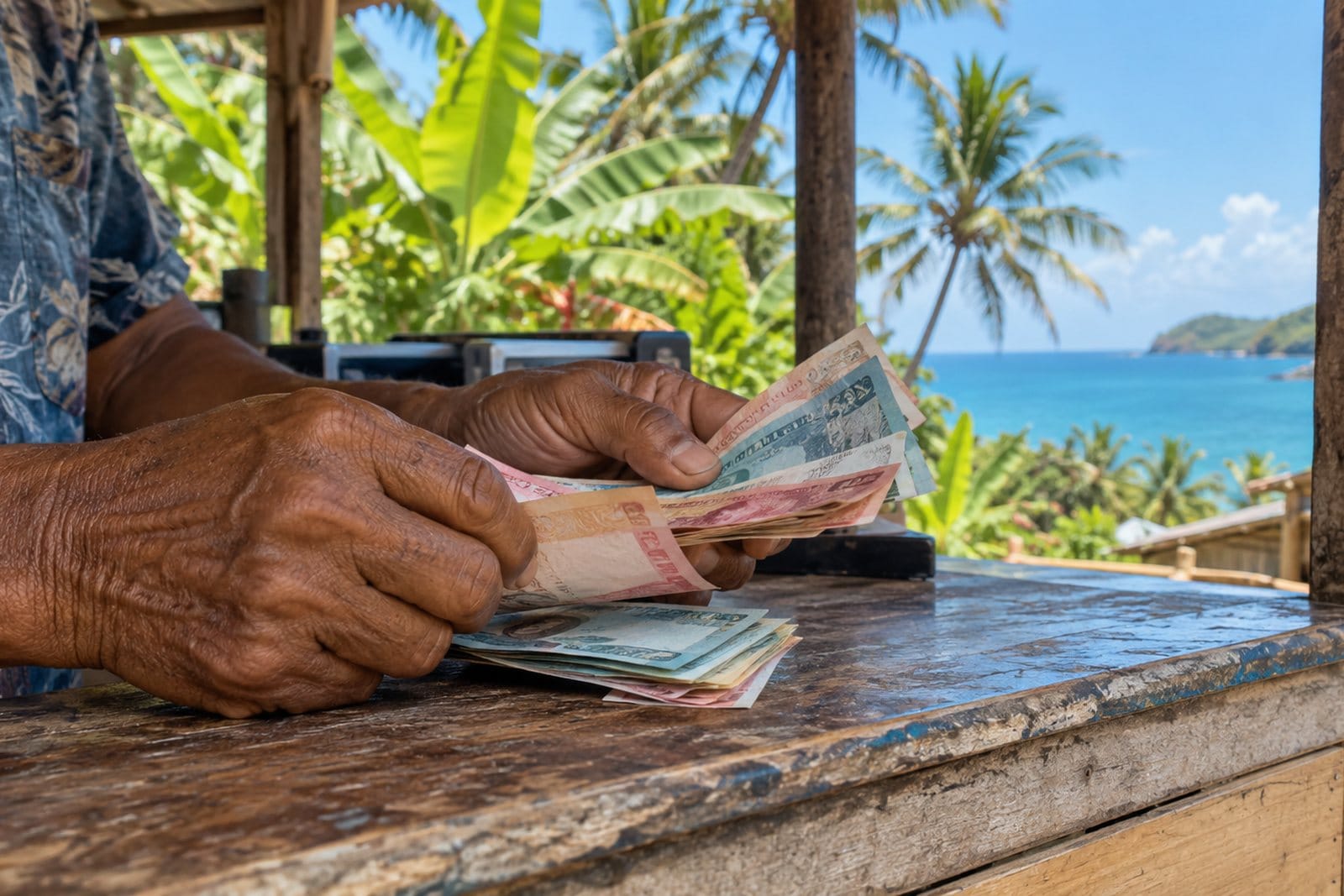 Rupiah holds after MSCI shock · Illustration: HubLombok (AI-generated)
Why a Currency Move Matters Beyond Equities
The source reports moves in the stock market, in government securities and in the rupiah. It does not report any effect on property transactions, and this article does not claim one. What it does allow is a reasoned look at the currency channel, which is the channel that reaches a foreign buyer most directly.
Reference conversions on this site assume roughly Rp16,500 per US dollar. At the Rp18,052 print on 16 October, the rupiah was weaker than that reference, so a buyer converting from dollars or euros would receive more rupiah per unit of currency. South Lombok land is quoted per are (1 are = 100 m²) in rupiah, and a weaker rupiah makes that price look lower in stronger currencies at the moment of exchange. That is a currency effect, not a change in the asset's value in rupiah, and it can reverse.
The same logic works in the other direction. A buyer who holds a budget in euros and converts later can lose the gain if the rupiah strengthens before settlement. The same is true for investors in listed Indonesian equities and government bonds: a stock or bond can be stable in rupiah and still lose value for an investor measuring in a stronger currency. The practical lesson is to decide early which currency the budget lives in, and to check the conversion rate on the day of payment rather than on the day the listing was read.
Bank Indonesia's measures are built to attract foreign capital and to dampen volatility. That is a sign of how seriously the authority treats the episode, but the source offers no promise about where the rate will settle, and neither does this article.
What This Means for Investors
For Lombok buyers, the episode is best read as a test of sentiment and liquidity, not as a verdict on the property market. Four points follow from the source:
- Separate the layers. The index proposal, the currency move and the local property market are different things, and they do not move in lockstep.
- Track the currency you are paying in. Budgets set in euros, dollars or sterling need a rate assumption and a plan for a range of outcomes, not a single number.
- Watch the hedging tools. Changes to DNDF incentives show how the central bank is weighing foreign capital flows, and they are worth following alongside the rate decisions.
- Compare in local units. Land is priced per are, so comparisons should use the same unit and the same exchange rate date.
The week's evidence is that the authorities had tools, described them openly and used them. The reaction to a reclassification proposal is also a reminder that currency and equity sentiment can move faster than the underlying asset. For a buyer with a multi-year horizon, the useful question is not what the rupiah did this week, but whether the plan still holds across a realistic range of exchange rates.
Stay informed: subscribe to the free Lombok Briefing, published twice a month (the 1st and 15th), for market intelligence like this.
Does the MSCI proposal change property ownership rules for foreigners?
No. The MSCI proposal concerns how an index provider classifies Indonesia's stock market, not land law. This article reports the proposal and the market reaction only. Before any purchase, check the title and ownership route with a licensed notary, because property rules are separate from index decisions.
What did Bank Indonesia change at its October 2026 board meeting?
At its 20-21 October board meeting, Bank Indonesia kept its BI Rate at 5.75 percent and its lending facility at 6.5 percent. It raised the deposit facility rate by 25 basis points to 5.0 percent and increased premium reductions on DNDF hedging instruments to support rupiah stability.
Why does a weaker rupiah matter to a foreign buyer?
A buyer paying in euros, dollars or sterling receives more rupiah per unit of currency when the rupiah weakens, so rupiah prices look lower in that currency at the moment of exchange. This is a currency effect, not a change in the asset's value, and it can reverse.

The Lombok Buyer's Field Guide
Legal structures ranked by risk, the honest ROI math line by line, all six zones ranked, and the 24-point due-diligence checklist. The whole book, free in your inbox.
See what's inside