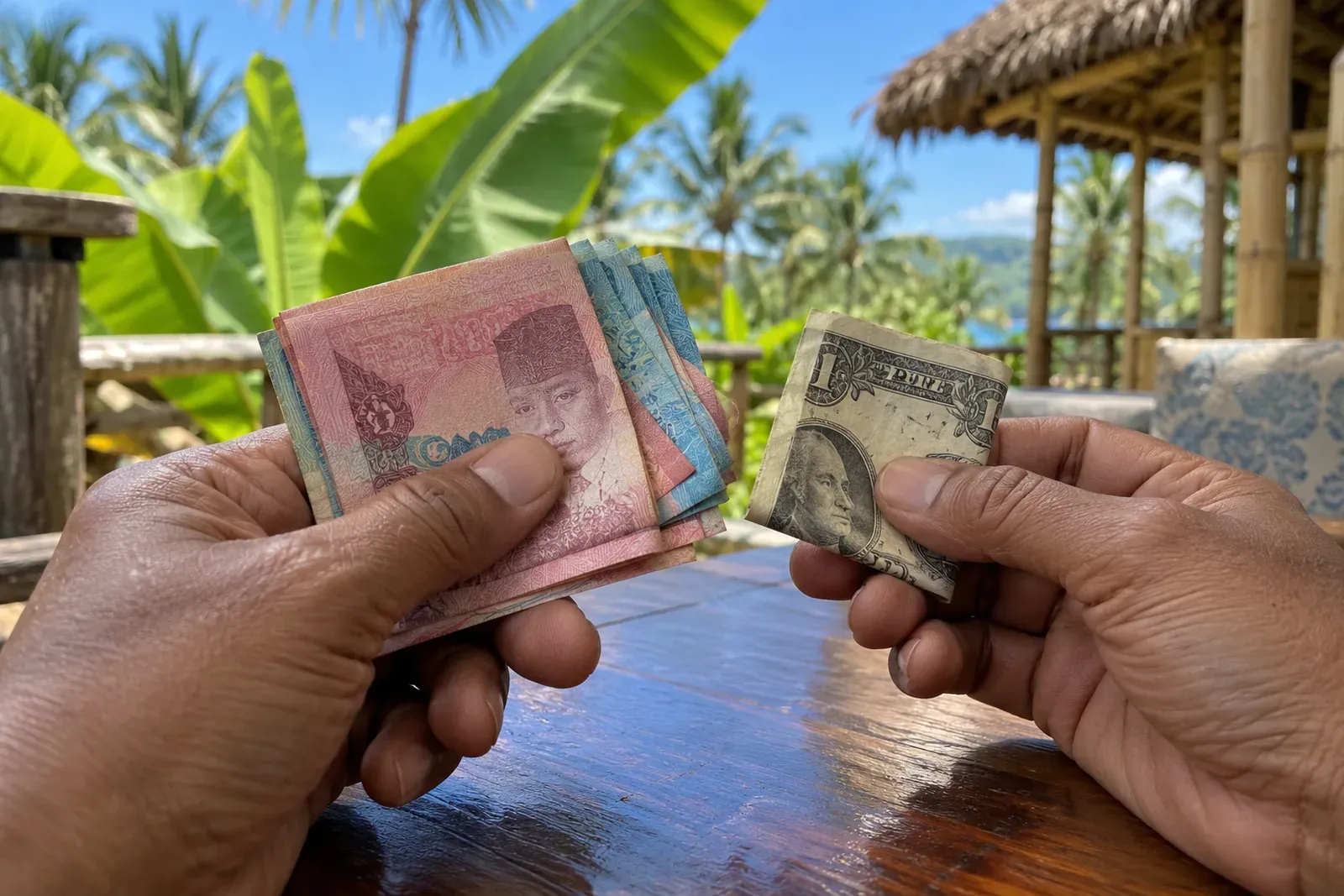
Rupiah Defends Rp19,000 Level: What Currency Shifts Mean for Lombok Real Estate
With the Indonesian rupiah testing Rp18,184 per US dollar, Coordinating Minister Hartarto projects resilience. We analyse what currency headwinds mean for South Lombok land and villa assets.
Quick answer: The Indonesian rupiah's move towards Rp18,184 per US dollar creates a temporary valuation advantage for foreign buyers acquiring rupiah-denominated land in South Lombok. With Bank Indonesia deploying US$146.3 billion in reserves to cap depreciation well below Rp19,000, foreign investors holding hard currency gain purchasing power while operating fundamentals and construction costs remain structurally stable.
Global macroeconomics rarely announces itself gently to island property markets. When oil crosses US$115 per barrel and US interest rates exert renewed gravitational pull on emerging market currencies, capital allocation models in London, Sydney, and Singapore immediately recalibrate. For investors assessing Indonesia, the headline exchange rate has become a focal point of strategic calculation.
The Context
Indonesia's macroeconomic managers are currently engaged in a calculated defence of the national currency. Coordinating Minister for Economic Affairs Airlangga Hartarto recently expressed firm confidence that the Indonesian rupiah will not breach the threshold of Rp19,000 per US dollar, pointing directly to the country's underlying macroeconomic fundamentals. Hartarto's reassurances followed a trading session where the rupiah slipped 28 points, or 0.15 percent, to close at Rp18,184 per US dollar in the spot market, weakening from Rp18,156 in the preceding session. Concurrently, Bank Indonesia's Jakarta Interbank Spot Dollar Rate (JISDOR) stood at Rp18,183 per US dollar.
The central bank has made no secret of the external forces shaping this movement. According to Erwin Gunawan Hutapea, Head of Bank Indonesia's Monetary and Securities Asset Management Department, currency depreciation across regional peers has been primarily propelled by escalating geopolitical conflict in the Middle East. Elevated crude oil prices above US$115 per barrel have compounded prospective fiscal risks and revived expectations of protracted US monetary tightening. The resulting global risk aversion has spurred capital outflows from emerging economies into high-yielding dollar assets.
Domestically, the currency has absorbed additional short-term friction. Market speculation surrounding a potential downgrade of Indonesia's equity market classification by index provider MSCI coincided with a customary month-end surge in corporate foreign exchange demand. On a monthly basis, the rupiah has depreciated by 1.15 percent. Yet Bank Indonesia remains well-armoured: national foreign exchange reserves stood at a robust US$146.3 billion at the end of September 2026. Hutapea confirmed that the monetary authority intervenes routinely across spot foreign exchange, Domestic Non-Deliverable Forward (DNDF), and offshore Non-Deliverable Forward (NDF) markets, alongside secondary purchases of government bonds (SBN) to preserve systemic stability.
Currency Mechanics: Hard Currency Inflows Versus Rupiah Assets
For foreign property investors, understanding the transmission mechanism between central bank interventions and land registry filings is essential. In Indonesia, real estate transactions follow a dual economic reality. Land in South Lombok is transacted and registered through local conventions in Indonesian rupiah per are (1 are = 100 square metres), whereas international turnkey villa offerings and development feasibility studies are often modelled in US dollars or euros.
When the rupiah trades at Rp18,184 per US dollar, foreign capital buys significantly more domestic physical asset base than it did under historical averages such as Rp16,500 per US dollar. Consider prime tourist-zone land in South Lombok, which currently trades across an authoritative spectrum of Rp 30 million to Rp 400 million per are:
- Kuta (Township Core): Rp 300-400 million per are (the liquidity and commercial benchmark, representing roughly $18,200-24,200 per are at baseline rates of ~Rp 16,500/USD).
- Selong Belanak: Rp 150-250 million per are (~$9,100-15,200 per are), anchored by prime family tourism and gradual capital expansion.
- Are Guling: Rp 120-180 million per are (~$7,300-10,900 per are), representing an active early-cycle frontier.
- Mandalika (Circuit Peripheral): Rp 100-150 million per are (~$6,100-9,100 per are), adjoining the state-backed Special Economic Zone.
- Mawun: Rp 50-80 million per are (~$3,000-4,800 per are), offering sheltered coastal plots.
- Bumbang: Rp 30-50 million per are (~$1,800-3,000 per are), capturing entry-level growth capital.
When raw land is acquired at current spot rates, an offshore investor funding from euro, sterling, or US dollar accounts secures an immediate discount against historical pricing levels, effectively widening the land arbitrage window that defines the South Lombok investment thesis.
 Rupiah Defends Rp19,000 Level · Illustration: HubLombok (AI-generated)
Construction Costs, Import Pressures, and Operating Yields
Currency depreciation is never entirely one-sided. While it enhances acquisition purchasing power, sophisticated investors must evaluate the counterweights: construction inputs and operational yield durability.
In hospitality developments, high-specification MEP (mechanical, electrical, and plumbing) equipment, specialised glazing, and imported finishes are sensitive to global supply chains and foreign exchange weakness. High global oil prices above US$115 per barrel also elevate domestic transport and freight tariffs across the Indonesian archipelago. However, unlike land-constrained Bali, South Lombok benefits from an abundant domestic supply of raw building materials, structural timber, stone, and regional concrete producers. This keeps the structural shell insulated from sharp currency shocks.
On the operational side, villa cash flows provide an intrinsic natural hedge. South Lombok tourism is experiencing significant expansion, with foreign arrivals recording +40-50% year-on-year growth driven by both general island discovery and international sporting events at Mandalika. Nightly rental rates for hospitality assets in Kuta and Mandalika are up by about +38% year-on-year, while Are Guling demonstrates momentum of about +47% year-on-year.
Because holidaymakers and long-term nomadic tenants pay rates benchmarked against international regional travel costs, revenue tracks foreign currency values closely. Conversely, on-the-ground operational costs, including housekeeping, landscaping, security, and local land taxes (PBB), remain denominated in local currency. This operational asymmetry cushions net profitability.
| Location / Metric | Land Price (Rp / are) | Turnkey Villa Entry | Stabilised Occupancy (Y1-3) | | :--- | :--- | :--- | :--- | | Kuta | Rp 300-400M | $194,000-344,000 | 55-70% | | Selong Belanak | Rp 150-250M | $151,000-301,000 | 55-70% | | Are Guling | Rp 120-180M | $150,000-255,000 | 55-70% | | Mandalika | Rp 100-150M | Investment Grade | 55-70% | | Bali Comparison | Rp 330-825M equiv. | $400,000-800,000 | 70-85% |
When projecting returns, prudent underwriting demands realism. Developer brochures frequently cite gross rental yields of 12-22%. However, these gross figures exclude property management fees (typically 18-22% of gross rental revenue) and online travel agency (OTA) booking commissions (15-20%). Once factored alongside stabilised occupancy rates of 55-70%, honest net yields settle between 7-12%, with only top-performing assets touching approximately 15% net as exceptional outliers. Currency shifts do not alter these structural expense ratios, but they do lower the entry basis upon which these yields are generated.
What This Means for Investors
For foreign capital navigating Indonesian real estate, structural discipline must always supersede speculative currency timing. The Indonesian legal framework provides clear, compliant mechanisms for international buyers, provided they reject dubious shortcuts.
Under Indonesian law, foreign nationals cannot hold freehold land titles (Hak Milik / SHM), which are reserved exclusively for Indonesian citizens. Legitimate foreign participation relies on three established vehicles: long-term leasehold agreements (Hak Sewa, typically 25-30 years with formal extension clauses); right-to-use titles (Hak Pakai, tied to personal KITAS or KITAP residency status); or the incorporation of a foreign investment company (PT PMA). A PT PMA is legally entitled to hold Right-to-Build titles (Hak Guna Bangunan / HGB) for 30 years with statutory extensions. Unofficial nominee arrangements, where a local citizen holds freehold title on behalf of a foreigner, are entirely illegal and unenforceable in Indonesian courts.
Transaction costs remain predictable regardless of currency swings. Buyers must budget for the Land and Building Acquisition Duty (BPHTB), which stands at roughly 5% of the assessed property value, alongside standard administrative disbursements executed before an authorised PPAT notary and recorded at the National Land Agency (BPN). For comprehensive legal due diligence, title searches, and corporate structuring, independent specialists such as TerraNusa Advisory coordinate the entire transaction chain to ensure foreign buyers maintain rigorous compliance.
Minister Hartarto's explicit line at Rp19,000 per US dollar, backed by Bank Indonesia's US$146.3 billion reserve war chest, suggests that the authorities possess both the liquidity and the mandate to prevent runaway volatility. For overseas investors, entry into turnkey investment-grade villas in South Lombok (ranging from EUR 95,000 to EUR 350,000, compared to USD 400,000 to USD 800,000 for equivalent specifications in Bali) remains compelling.
The strategic posture is therefore clear: capitalise on current currency-induced land discounts, secure legal structures via compliant PT PMA or leasehold vehicles, and underwrite development returns strictly against verified net yield metrics rather than optimistic gross projections.
HubLombok is the editorial arm of Samudra Villas, an active developer in South Lombok. That relationship is disclosed here because it shapes what we cover, not what we conclude.
Stay informed: subscribe to the free Lombok Briefing, published twice a month (the 1st and 15th), for market intelligence like this.
How does rupiah depreciation affect South Lombok land acquisitions?
Because raw land in Lombok is priced in Indonesian rupiah per are, a softer rupiah provides foreign buyers holding US dollars or euros with greater purchasing power, effectively lowering the foreign-currency entry cost for prime plots.
Can foreign investors buy freehold property to hedge currency risk?
No. Foreigners cannot hold Hak Milik freehold titles under Indonesian law. Investors must utilise compliant routes such as leasehold agreements, Hak Pakai, or a foreign-owned PT PMA holding Hak Guna Bangunan titles.
What net rental yields can international villa owners realistically expect?
After accounting for 18-22% management fees, 15-20% booking commissions, and stabilised 55-70% occupancy, honest net rental yields in South Lombok range between 7% and 12%, despite higher developer-quoted gross marketing figures.

The Lombok Buyer's Field Guide
Legal structures ranked by risk, the honest ROI math line by line, all six zones ranked, and the 24-point due-diligence checklist. The whole book, free in your inbox.
See what's inside