Prabowo Targets Rp400 Trillion in Loans to Fortify Indonesia's Grassroots Economy
President Prabowo Subianto announces a Rp400 trillion credit target for 2027, deploying nationwide TPAKD networks to strengthen household liquidity and grassroots enterprise.
Quick answer: President Prabowo Subianto has unveiled a Rp400 trillion target for productive loans in 2027, aiming to reach 28 million families and roughly 100 million citizens. For international investors, this unprecedented expansion of state-backed microcredit underpins domestic consumer purchasing power, hardens regional supply chains, and reinforces macroeconomic stability across regional Indonesia.
Speaking at the National Coordination Meeting of Regional Financial Access Acceleration Teams (TPAKD) in Jakarta, President Prabowo framed domestic welfare as the absolute anchor of national economic resilience. The ambitious programme signals an aggressive move to formalise and capitalise the lower tiers of the economy, deploying credit directly to coastal, agrarian, and outlying districts.
The Context
The scale of the newly announced commitment represents an immense fiscal and institutional undertaking. By designating up to Rp400 trillion (more than US$22 billion) for disbursement in 2027, the central government is seeking to transform grassroots balance sheets across the archipelago. The administration calculates that reaching 28 million beneficiary households will positively affect approximately 100 million individuals, based on an average household size of four people.
This policy initiative is not starting from zero. During the assembly, the president symbolically marked the disbursement of Rp53.15 trillion (approximately US$3 billion) in productive loans, which has already reached around 2.1 million debtors spanning micro, small, and medium enterprises (MSMEs), agricultural workers, and coastal fishing operations. The architecture supporting this distribution relies heavily on the Financial Services Authority (OJK), partner ministries, and municipal authorities, who completed the rollout of TPAKD units across all provinces, regencies, and cities by the close of 2024.
"The nation's true economic strength must be genuinely felt by the people: by farmers in villages; by fishers in coastal regions; by merchants at markets; by micro, small, and medium enterprises; and by mothers striving to support their families' finances," Prabowo affirmed.
To institutional observers, this rhetoric marks a decisive consolidation of state-directed credit expansion. Rather than relying entirely on central bank liquidity easing or metropolitan corporate lending, the administration is deliberately channeling liquidity toward the economic perimeter. The goal is straightforward: build resilient local consumption floors that protect the broader economy against external macroeconomic shocks.
Financial Formalisation at the Provincial Frontier
Historically, emerging provincial economies in Indonesia have faced persistent credit bottlenecks. While tier-one corporate conglomerates in Jakarta secure institutional financing with relative ease, primary producers in outer islands have remained dependent on unorganised, informal lenders or constrained personal savings. The deployment of TPAKD across every district provides the institutional pipeline required to reverse this structural deficit.
| Lending Metric | Current Interim Delivery | 2027 National Target | | :--- | :--- | :--- | | Total Loan Capital | Rp53.15 trillion (~US$3 billion) | Up to Rp400 trillion (>US$22 billion) | | Beneficiary Base | ~2.1 million debtors | 28 million families (~100 million individuals) | | Institutional Coverage | All provinces and regencies (end of 2024) | Universal nationwide distribution | | Primary Beneficiaries | MSMEs, agrarian producers, fisheries | Rural, coastal, urban low-income, frontier zones |
The strategic focus on low-income urban workers, agrarian communities, and maritime operators reflects a sophisticated appreciation of multiplier effects. When working capital reaches a regional logistics provider or an agricultural co-operative, the velocity of money accelerates far more rapidly than when equivalent capital is parked in metropolitan sovereign bonds. Increased household cash flow translates immediately into demand for staples, manufactured equipment, domestic transport, and retail commerce.
Furthermore, the explicit involvement of Bank Indonesia and the OJK ensures that governance standards are integrated into the disbursement pipeline. The central bank's ongoing push for improved financial reporting and managerial discipline among small borrowers will help convert formerly unbanked sole traders into commercially viable commercial counterparties.
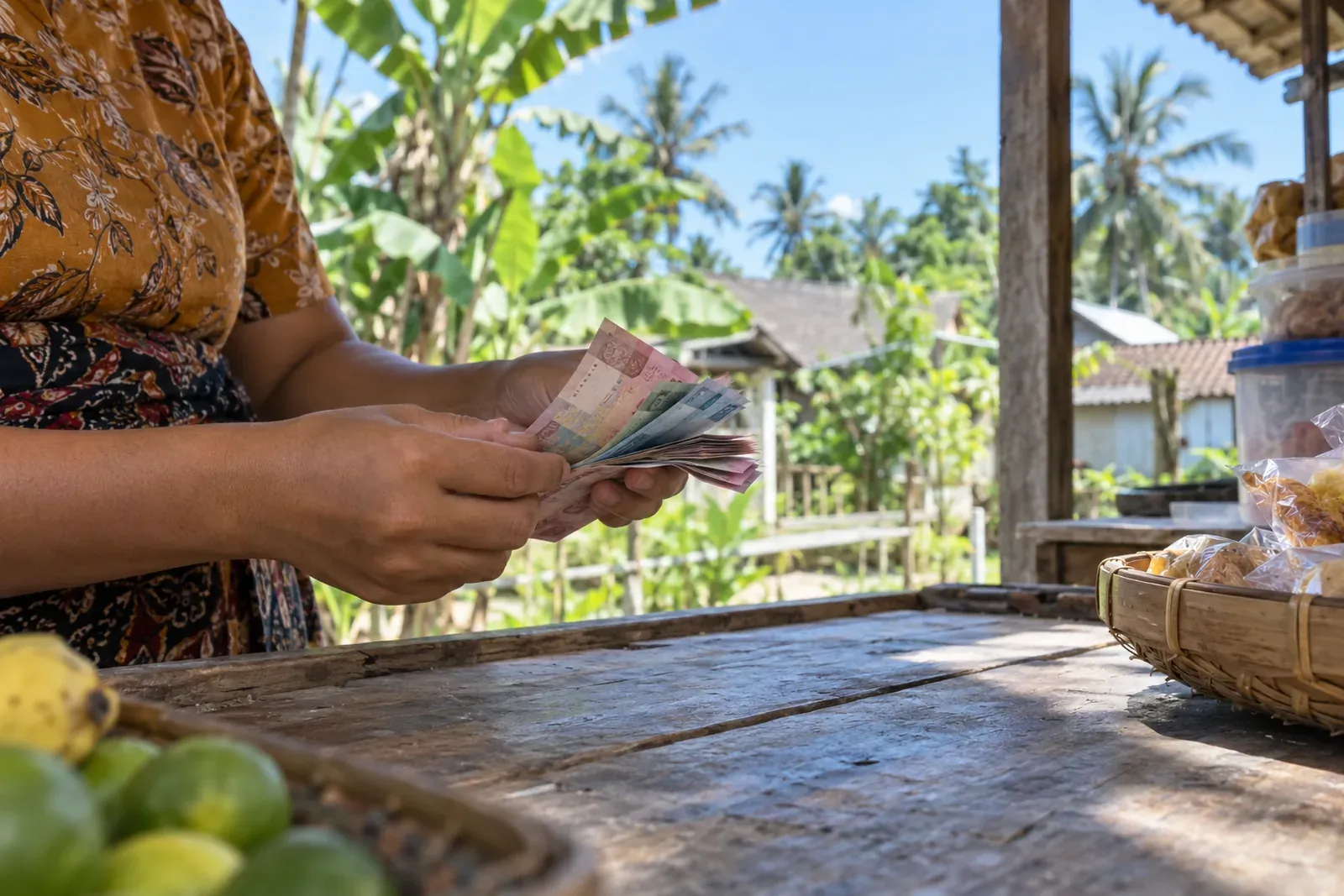
 Prabowo Targets Rp400 Trillion in Loans to Fortify Indonesia's Grassroots Economy · Illustration: HubLombok (AI-generated)
Household Purchasing Power as Sovereign Shield
President Prabowo's declaration that real public welfare is demonstrated through tangible increases in disposable income highlights a core philosophical tenet of his economic doctrine. In an uncertain global climate characterised by shifting trade policies and volatile commodity markets, sovereign resilience demands a self-sustaining internal consumer base. Strengthening the purchasing power of 28 million households creates a powerful domestic buffer.
The distribution targets underdeveloped, frontier, and outermost regions. In practical terms, this decentralised capital injection directly benefits regional supply chains that feed into Indonesia's burgeoning export and tourism hubs. When coastal fisheries gain access to affordable credit, cold-chain logistics improve; when rural farmers access equipment financing, regional food inflation moderates; and when village enterprises stabilise, municipal infrastructure functions with greater predictability.
This dynamic is particularly relevant across developing economic corridors outside Java. Areas experiencing heightened foreign arrivals and rapid regional expansion rely on local supply networks for construction labour, hospitality sourcing, agricultural produce, and municipal services. A well-capitalised regional microeconomy lowers operational friction, dampens local inflation, and guarantees steady supplies of goods and services to high-growth investment nodes.
What This Means for Investors
For institutional allocators and private direct investors observing Indonesia from abroad, the Rp400 trillion credit mandate offers several critical insights into the structural direction of Southeast Asia's largest economy:
- De-risking Regional Operating Environments: By targeting outermost and frontier regions, the state is actively mitigating the social and economic disparities that historically created regional operational volatility. Enhanced local liquidity translates into improved civic infrastructure and stronger commercial relationships.
- Reinforcing Macroeconomic Stability: Deepening financial access for 100 million citizens broadens the formal economic tax base over the long run, supports banking sector liquidity circulation, and diminishes systemic dependency on volatile foreign portfolio flows.
- Lowering Local Counterparty Risk: As small-scale logistics operators, builders, and service vendors gain access to formal TPAKD-supervised loans, their balance sheets become more robust, reducing default and execution risks for larger project developers.
- Sustaining Domestic Demand Trajectories: A sovereign commitment to protecting household real income ensures that domestic aggregate demand remains buoyant even when external global export markets experience cyclical slowdowns.
While the task of expanding annual disbursements from Rp53.15 trillion to Rp400 trillion over the coming years demands rigorous underwriting discipline and robust credit oversight, the policy trajectory is unmistakable. The administration has placed grassroots solvency and provincial liquidity at the very core of its national agenda. Foreign capital entering Indonesia will find a host economy deliberately structured to anchor top-line growth in broad-based, domestic household stability.
Stay informed: subscribe to the free Lombok Briefing, published twice a month (the 1st and 15th), for market intelligence like this.
What is the primary target of the Indonesian government's 2027 loan initiative?
The government aims to disburse up to Rp400 trillion (more than US$22 billion) in productive credit in 2027, targeting 28 million families and roughly 100 million citizens across agrarian, coastal, and frontier regions.
How does expanding grassroots microcredit benefit foreign direct investors?
Channeling liquidity to regional MSMEs strengthens local supply chains, reduces counterparty defaults among regional contractors and suppliers, and supports stable domestic purchasing power across emerging economic corridors.
What institutional network oversees the disbursement of these regional loans?
Disbursements are coordinated through the Regional Financial Access Acceleration Teams (TPAKD), established across all Indonesian provinces, regencies, and cities with oversight from the Financial Services Authority (OJK) and Bank Indonesia.

The Lombok Buyer's Field Guide
Legal structures ranked by risk, the honest ROI math line by line, all six zones ranked, and the 24-point due-diligence checklist. The whole book, free in your inbox.
See what's inside