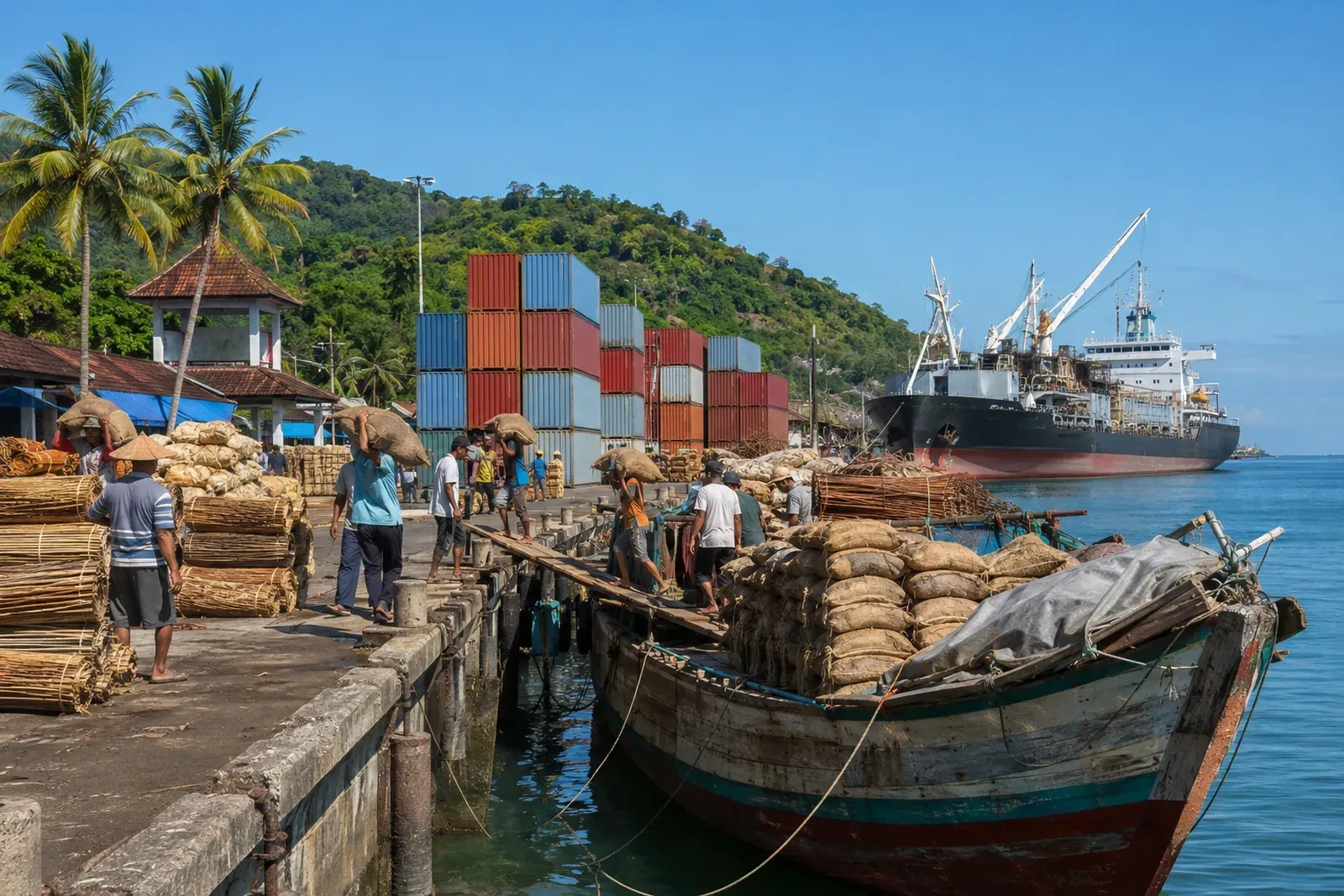
Prabowo Targets Doubling Indonesia-Russia Trade Under Proposed FTA
President Prabowo Subianto has proposed doubling Indonesia-Russia trade as implementation of the I-EAEU FTA is scheduled for 2027.
Indonesia’s President Prabowo Subianto has proposed a clear ambition for trade with Russia: to double its value during the initial review period of the Indonesia-Eurasian Economic Union Free Trade Agreement.
The proposal, made at the 11th Eastern Economic Forum in Vladivostok, places a prospective trade pact at the centre of Indonesia’s effort to deepen commercial ties with Russia and the wider Eurasian Economic Union.
A target built on recent trade growth
Prabowo said trade between Indonesia and Russia reached approximately US$5 billion in 2025, representing a 21.7% increase from 2024. He proposed that the two countries establish a challenge to double trade volume during the agreement’s initial review period.
Indonesia-Russia trade reached approximately US$5 billion in 2025, according to President Prabowo, who said this was a 21.7% increase compared with 2024.
The source does not set out a timetable for reaching that target, nor does it specify the review period’s duration. The stated implementation date for the I-EAEU FTA is 2027.
For investors following Indonesia’s economic policy, the significance lies less in a forecast than in the direction of travel. The administration is presenting trade integration as a practical framework through which Indonesia can widen commercial links beyond its immediate region.
Complementary sectors underpin the argument
Prabowo framed the relationship as one between complementary economies. Indonesia’s cited strengths include palm oil, coffee, fishery products, rubber, textiles and consumer goods, alongside its young workforce. Russia’s cited strengths include wheat, fertilisers, energy, science and engineering technology.
He argued that the strengths of one side can meet the needs of the other, providing a basis for trade that is fair and sustainable. That is a political and commercial proposition rather than a guarantee of outcomes: actual trade expansion will depend on the agreement’s implementation and on how businesses respond to the new framework.
The sectoral picture described by Prabowo is broad:
- Indonesia: palm oil, coffee, fishery products, rubber, textiles and consumer goods.
- Russia: wheat, fertilisers, energy, science and engineering technology.
- Shared objective: a stronger trade relationship supported by the planned free trade agreement.
For international investors, such agreements matter because they can shape the conditions under which goods and businesses move between markets. Yet the source provides no detail on tariff schedules, product exemptions, rules of origin or investment provisions. Those details will be important in determining which industries, if any, receive the most direct commercial benefit.
Indonesia’s ASEAN gateway proposition
Prabowo also positioned Indonesia as a gateway to ASEAN for the Eurasian business community. He described Indonesia as the region’s largest market, a central player in the Regional Comprehensive Economic Partnership, and a free-trade partner through the planned arrangement.
The ASEAN market, he said, comprises approximately 680 million people. That scale is central to Indonesia’s diplomatic pitch: a deeper Indonesia-Russia trading relationship could also offer Russian and Eurasian businesses a route towards the broader ASEAN region.
Prabowo described Indonesia as a natural gateway to ASEAN, whose market comprises approximately 680 million people.
This does not mean that access to Indonesia automatically creates access across ASEAN. Rather, it explains the strategic language surrounding the proposed FTA. Indonesia is presenting its position in regional trade arrangements as part of its appeal to Eurasian partners.
A high-level forum, and a developing framework
The announcement was delivered at the 11th Eastern Economic Forum in Vladivostok, where Prabowo appeared as the main guest of honour. He thanked Russian President Vladimir Putin and the Russian government for the opportunity to speak.
Prabowo said the visit was his second to Russia in 2026 and that he had met Putin five times since becoming President of Indonesia. These diplomatic contacts provide the setting for the commercial objective, although the source does not announce new private-sector commitments or transactions connected with the FTA.
That distinction is worth retaining. A presidential target can signal intent and help focus negotiations, but it is not itself evidence that trade will double. The scheduled 2027 implementation remains the key formal milestone identified in the report.
What this means for investors
The immediate investment takeaway is one of policy direction rather than a quantified opportunity. Indonesia is seeking to strengthen trade links with Russia and the Eurasian Economic Union, using the planned I-EAEU FTA as the central instrument.
Investors with exposure to Indonesian export sectors may watch for the agreement’s eventual operating terms, particularly where they relate to products highlighted by Prabowo. Businesses linked to agricultural commodities, fisheries, rubber, textiles and consumer goods may be attentive to whether the agreement improves commercial access. Equally, Indonesian businesses may follow provisions relevant to wheat, fertilisers, energy, science and engineering technology from Russia.
Three points merit particular attention:
- Implementation: the agreement is scheduled to begin in 2027.
- Scale: bilateral trade was approximately US$5 billion in 2025.
- Ambition: Prabowo has proposed doubling trade during the agreement’s initial review period, without a stated deadline in the source.
The wider message is that Indonesia intends to pair its ASEAN position with a broader Eurasian trade relationship. For investors, the prudent approach is to distinguish the announced objective from the eventual legal and commercial terms that will determine its practical effect.
The next signal will come as the planned agreement moves towards implementation and businesses gain greater clarity on the opportunities it may create.
Stay informed, subscribe to the free Lombok Briefing for analysis like this, published twice a month.
What trade target did Prabowo propose for Indonesia and Russia?
President Prabowo Subianto proposed that Indonesia and Russia aim to double their trade volume during the initial review period of the Indonesia-Eurasian Economic Union Free Trade Agreement. The source does not state a deadline or the length of that review period.
How large was Indonesia-Russia trade in 2025?
According to President Prabowo, trade between Indonesia and Russia reached approximately US$5 billion in 2025. He said this represented a 21.7% increase compared with 2024, while the report provides no separate breakdown by sector or product.
When is the Indonesia-Eurasian Economic Union FTA scheduled to begin?
Implementation of the Indonesia-Eurasian Economic Union Free Trade Agreement is scheduled to begin in 2027. The source does not provide details on tariffs, product coverage, rules of origin or other operating provisions, so investors will need to await those terms.
The Lombok Buyer's Field Guide
Legal structures ranked by risk, the honest ROI math line by line, all six zones ranked, and the 24-point due-diligence checklist. The whole book, free in your inbox.
See what's inside