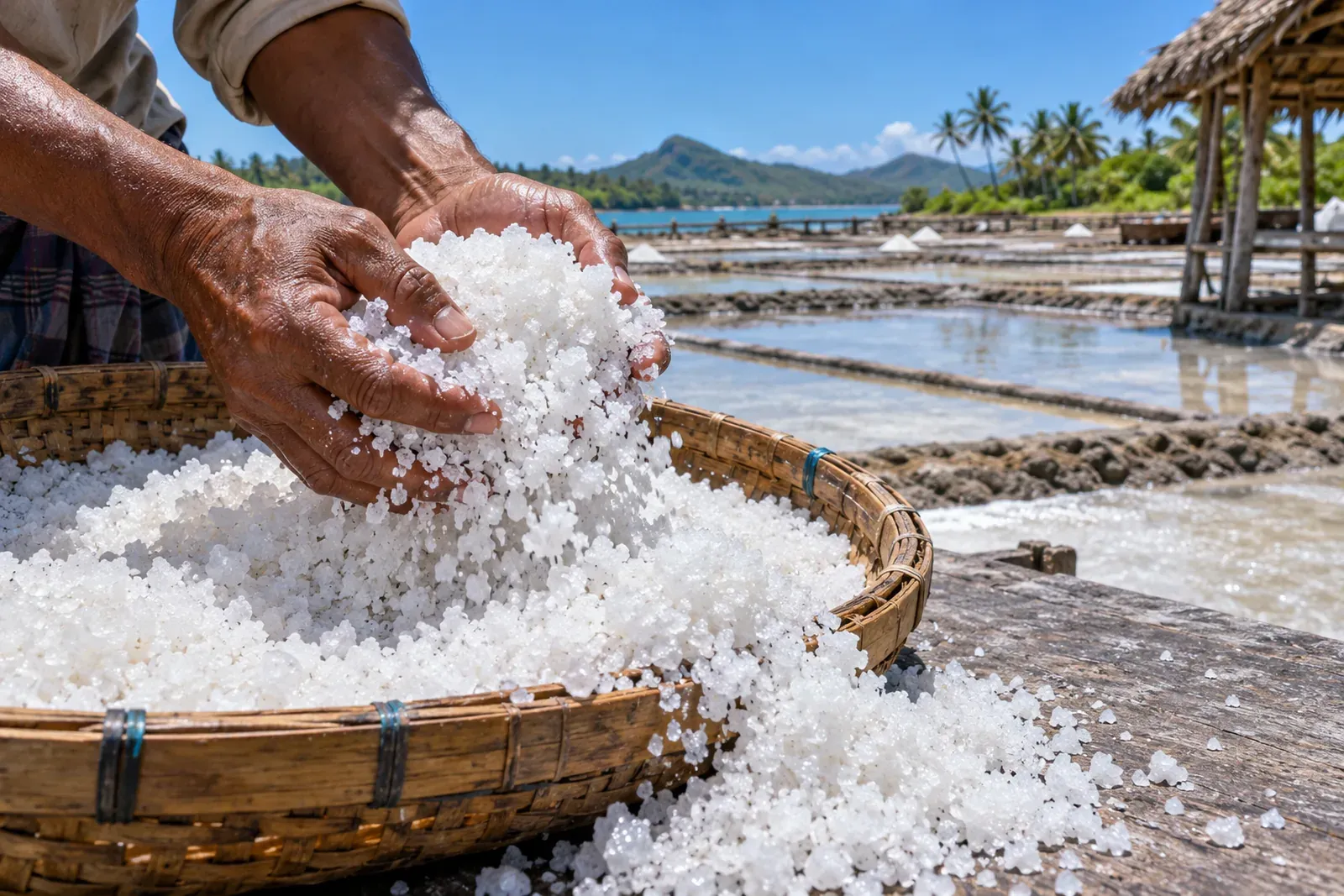
NTT Salt Hub Targets 26,000 Jobs and 2027 Self-Sufficiency
Indonesia accelerates its downstream industrial push in East Nusa Tenggara, projecting 26,000 jobs and 400,000 tonnes of industrial salt from Rote Ndao.
Quick answer: Indonesia has launched a 13,000-hectare national salt industrial estate in Rote Ndao, East Nusa Tenggara, targeting 26,000 local jobs and 400,000 tonnes of initial output. The project underpins Jakarta's mandate for national salt self-sufficiency by 2027, signalling accelerating sovereign infrastructure spending across the wider Nusa Tenggara regional corridor.
The Indonesian government has accelerated its eastern industrial strategy with the formal projection of 26,000 jobs at the National Salt Industry Center in Rote Ndao. Spanning a master-planned footprint of 13,000 hectares, the initiative represents a decisive structural shift from artisanal extraction toward high-spec downstream manufacturing. For international investors monitoring Eastern Indonesia, the development provides concrete evidence of state capital decentralisation beyond Java and Bali.
The Context
On Saturday, the East Nusa Tenggara provincial administration outlined the operational scale and commercial parameters of the National Salt Industry Center, known locally as K-SIGN. Speaking in Kupang, Stefania Tanggu Boro, Head of the NTT Marine Affairs and Fisheries Office, confirmed that the project is designed to elevate local household earnings to as much as 2.5 times the regional minimum wage. The initiative targets three host villages within the development zone, establishing community participation frameworks alongside state-backed industrial facilities.
Historically, Indonesia has relied heavily on imported industrial-grade sodium chloride to feed its chemical, pharmaceutical, glass, and food-processing sectors. While domestic coastal farmers produce substantial volumes of consumable salt, traditional sun-drying methods rarely attain the chemical purity demanded by advanced industrial off-takers. K-SIGN is structured specifically to eliminate this structural deficit by standardising output through controlled evaporative techniques, specialised laboratories, and dedicated bulk storage depots.
The project forms a central pillar of Indonesia's target to achieve comprehensive salt self-sufficiency by 2027. Under directives issued by the coordinating minister for food, raw salt from Rote Ndao will no longer be exported as an unrefined commodity. Instead, modern processing units will refine raw brine into high-purity industrial inputs directly on site, capturing value within the provincial economy rather than bleeding margin to offshore refiners.
Downstream Processing and the 2027 Mandate
The technical specifications governing K-SIGN reflect rigorous commercial benchmarking. Provincial authorities have set an aggressive productivity target of up to 200 tonnes per hectare, requiring sodium chloride concentrations to exceed 97 percent. This purity benchmark is mandatory for chemical manufacturing, water treatment, and heavy industrial applications, which have historically absorbed the bulk of foreign imports.
Under phase one of the master plan, development will focus on an initial operational zone of 2,000 hectares. At the projected yield of 200 tonnes per hectare, this initial tract is expected to contribute approximately 400,000 tonnes of refined industrial salt to national annual output. Scaling across the remaining 11,000 hectares will follow as processing infrastructure and distribution channels mature.
Beyond primary sodium chloride production, state planners have prioritised high-value chemical by-products. The refining process will actively capture and refine secondary mineral streams, specifically magnesium sulfate and potassium. These compounds serve as vital inputs for specialist agricultural fertilisers, pharmaceutical formulations, and industrial detergents. By integrating by-product extraction into the initial facility layout, the government aims to create an integrated chemical cluster in Rote Ndao rather than an isolated coastal extractive site.
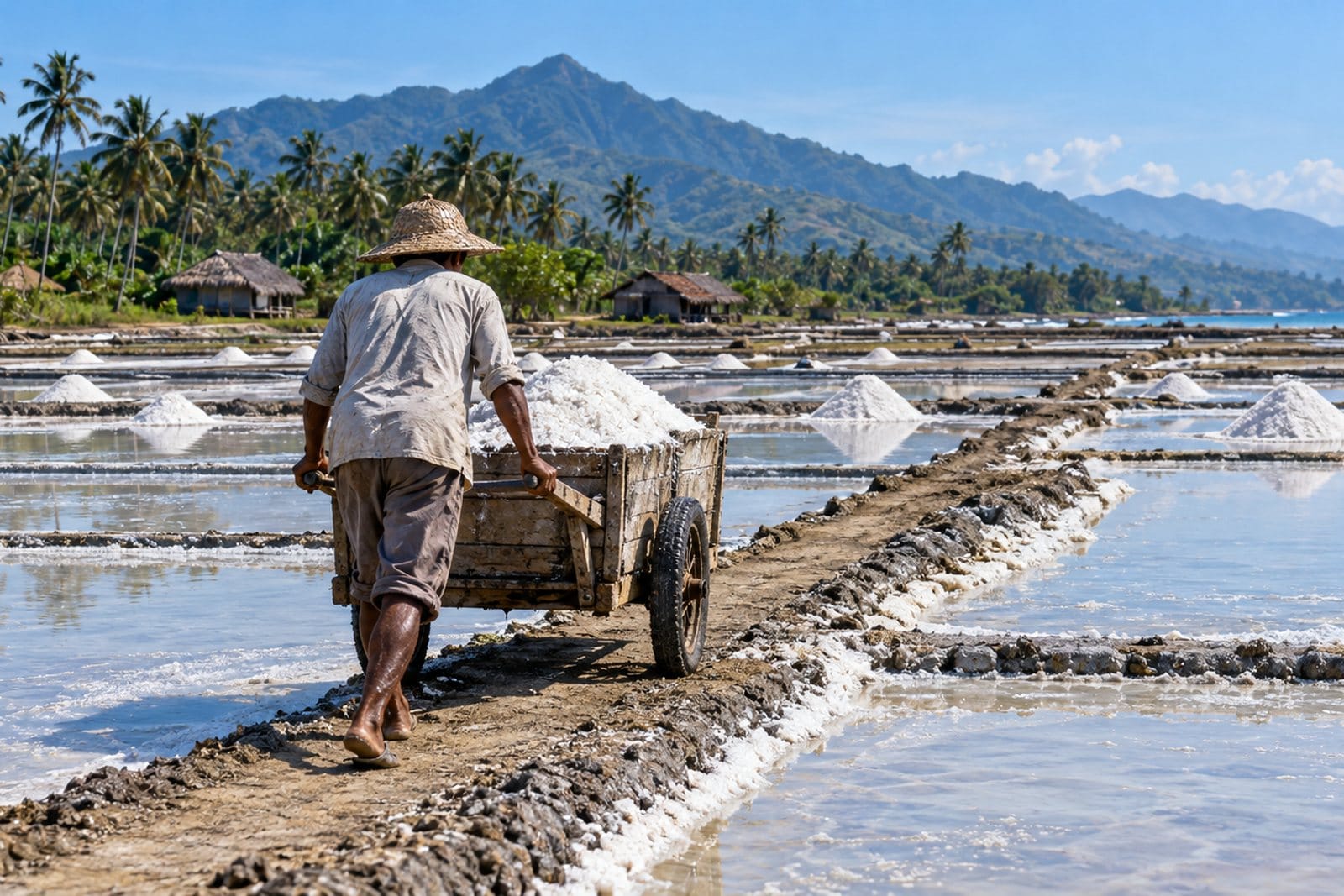 NTT Salt Hub Targets 26,000 Jobs and 2027 Self-Sufficiency · Illustration: HubLombok (AI-generated)
Infrastructure, By-Products, and Regional Supply Chains
The roll-out of K-SIGN carries profound implications for maritime transport and supply-chain logistics across the Lesser Sunda Islands. Establishing an industrial estate capable of generating hundreds of thousands of tonnes of dry bulk freight necessitates upgrades to regional port facilities, inter-island feeder shipping, and energy distribution networks. Rote Ndao, situated at the southern extremity of the archipelago, has historically operated on the periphery of national trade routes.
By anchoring large-scale industrial volumes in the province, state-owned enterprises and private logistics operators are compelled to enhance freight frequency between East Nusa Tenggara, West Nusa Tenggara, and central distribution hubs in Surabaya and Makassar. The resulting increase in maritime cargo capacity inevitably lowers back-haul container rates for surrounding islands, supporting broader regional commercial integration.
Furthermore, the social engineering component of the initiative represents a notable departure from historical extractive projects. Authorities have initiated formal engagement programmes across the three villages overlapping the 13,000-hectare footprint. Stefania Tanggu Boro acknowledged that while initial frameworks are active, provincial planners are deliberately expanding inclusion mechanisms to ensure local residents secure managerial roles, sub-contracting rights, and direct equity participation in auxiliary businesses. The declared objective is to build a sustainable local middle class capable of sustaining regional commerce long after initial construction expenditure subsides.
What This Means for Investors
For foreign and institutional capital, the significance of the Rote Ndao project extends well beyond the boundaries of agricultural commodities. It reflects an enduring, cross-administration commitment to sovereign industrialisation in Eastern Indonesia. Investors allocating capital in the region should draw several analytical conclusions:
- Decentralised State Capital: Sovereign capital expenditure is no longer concentrated solely in western manufacturing hubs. Secondary and tertiary provinces in the east are receiving dedicated budgetary allocations for energy, water, and transport infrastructure.
- Supply-Chain Efficiency: The expansion of industrial activity in NTT accelerates maritime connectivity across the entire Nusa Tenggara corridor, directly reducing logistics frictions for neighbouring regional economies.
- Downstream Value Capture: The regulatory prohibition on exporting unprocessed raw materials is expanding from mineral ores into marine and agricultural sectors, creating distinct opportunities for joint-venture processing, laboratory testing, and cold-chain infrastructure.
- Sovereign Import Substitution: With a hard deadline of 2027 for domestic salt self-sufficiency, state procurement will decisively favour domestic producers meeting the 97 percent sodium chloride standard, guaranteeing baseline demand for compliant industrial operators.
As Indonesia approaches its 2027 self-sufficiency milestones, the economic map of Eastern Indonesia is undergoing steady institutional modernisation. The transition of NTT from an agrarian periphery into an industrial contributor highlights the structural momentum reshaping the archipelago. While execution risks remain, particularly regarding local workforce integration and capital deployment across the full 13,000 hectares, the strategic direction is unambiguous.
Stay informed: subscribe to the free Lombok Briefing, published twice a month (the 1st and 15th), for market intelligence like this.
What is the scale of the K-SIGN project in NTT?
The National Salt Industry Center spans 13,000 hectares in Rote Ndao, with an initial 2,000-hectare phase projected to yield 400,000 tonnes of industrial salt.
When does Indonesia plan to achieve salt self-sufficiency?
The government has set 2027 as the target year to achieve domestic salt self-sufficiency, driven by high-purity industrial output from downstream centres like K-SIGN.
What chemical standards must K-SIGN production meet?
Production targets require salt pond yields of up to 200 tonnes per hectare, with sodium chloride purity exceeding 97 percent to supply domestic industrial sectors.

The Lombok Buyer's Field Guide
Legal structures ranked by risk, the honest ROI math line by line, all six zones ranked, and the 24-point due-diligence checklist. The whole book, free in your inbox.
See what's inside