NTB’s Solar Ambition Is a Signal, Not Yet an Investment Case
NTB has set out its renewable-energy ambition at Indonesia Solar Summit 2026. For investors, the important question is what policy intent can, and cannot, yet prove.
Quick answer: NTB’s appearance at Indonesia Solar Summit 2026 signals official support for renewable energy, solar provision and regional co-operation with Bali and NTT. For Lombok investors, it is a useful indication of policy direction and green-investment openness, but the official post does not establish project pipelines, commercial terms, capacity or investable returns.
A provincial delegation discussing solar energy in Sanur may sound remote from a Lombok investment decision. Yet energy is one of the quieter foundations beneath tourism, property, industry and public confidence: when the long-term direction is credible, it shapes how investors think about resilience, operating costs and the quality of a destination’s development.
The important discipline is to read the announcement for what it is. The official account of DPMPTSP Provinsi NTB describes a commitment and an ambition. It should be treated as a policy signal, not as evidence that a particular solar project, regulatory instrument or private-sector opportunity has already been delivered.
The Context
On Tuesday, 14 July, the Head of DPMPTSP Provinsi NTB, H. Irnadi Kusuma, accompanied the Governor of NTB, Dr H. Lalu Muhamad Iqbal, to Indonesia Solar Summit 2026 at The Meru Sanur in Bali. According to DPMPTSP Provinsi NTB’s official post, the Governor appeared as a principal panellist in a discussion on national energy sovereignty through accelerated regional energy independence, alongside the governors of Bali and NTT.
That setting matters because the message was not framed narrowly as a local power discussion. The provincial government used the forum to place NTB within a wider regional conversation about renewable energy and co-operation across Bali, NTB and NTT. It described the relevant umbrella as Kerjasama Regional Bali, NTB and NTT, or KR BNN.
The post sets out three linked strands of intent:
- full support for the renewable-energy transition;
- an ambition for NTB to become not only a solar-energy user but also a resilient provider; and
- continued regional synergy through KR BNN in response to future energy needs.
DPMPTSP Provinsi NTB said the provincial government is committed to supporting the renewable-energy transition and wants to widen space for green investment in West Nusa Tenggara.
For an investor, the language is significant chiefly because it comes from the provincial administration and its investment-service agency. Such institutions help set the tone in which investment proposals, land use, permitting conversations and public priorities are discussed. Their presence at a national forum can indicate that green investment has political attention.
But attention is not the same thing as execution. The source does not identify a solar site, a developer, a procurement process, a funding structure, a grid arrangement, a tariff, an investment timetable or a target capacity. It also does not set out the role available to foreign capital. None of those omissions make the ambition unimportant; they simply define its present evidential limits.
This distinction is especially useful in places where the investment narrative can quickly become larger than the paperwork beneath it. Infrastructure and energy stories often acquire momentum because they connect intuitively to a broader vision of growth. A careful reader should instead separate three layers: a government’s stated direction, the mechanisms needed to implement it, and the economics of any eventual asset or business.
At this stage, the official post speaks clearly to the first layer. It says much less about the latter two.
From Solar User to Solar Provider
The phrase “provider” is the most consequential part of NTB’s stated ambition. It suggests that the province is considering solar energy as more than a means of serving its own demand. That is a strategic framing, because it places energy within a regional economic proposition rather than treating it solely as a utility issue.
For Lombok and the wider province, such a proposition has several possible meanings in principle. It may concern local generation, regional co-operation, a stronger identity for green investment, or a combination of these. The DPMPTSP post does not specify which pathway will be adopted, and investors should resist filling in the blanks with a preferred scenario.
Still, the regional framing is worth noting. Bali, NTB and NTT are being discussed together in the official account, rather than as isolated jurisdictions. This makes intuitive policy sense: energy requirements, investment conversations and environmental positioning can all extend beyond one administrative boundary. Yet co-operation is a process, not a guaranteed outcome. The existence of KR BNN as a stated umbrella should not be mistaken for proof of a completed cross-regional commercial arrangement.
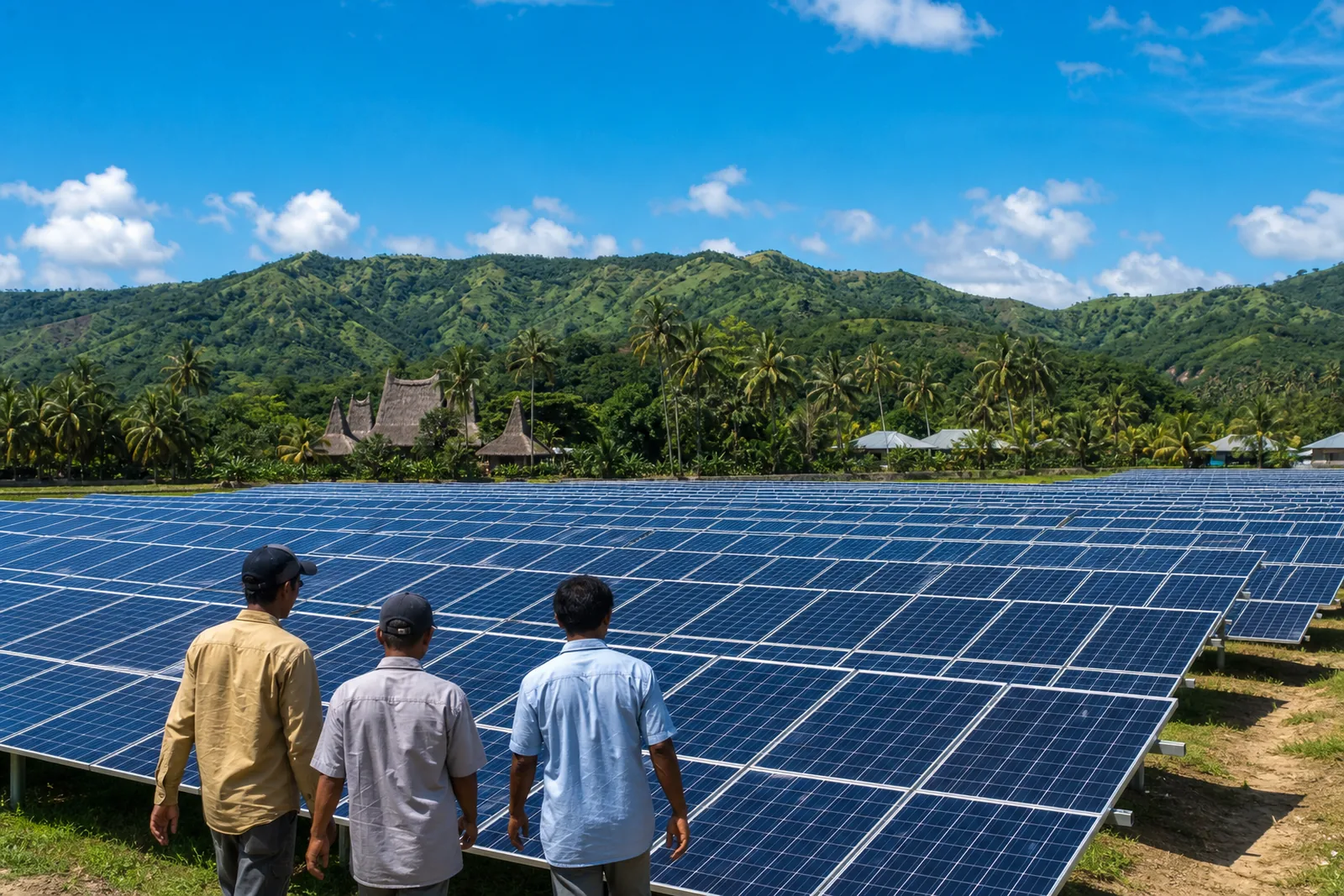
 NTB’s Solar Ambition Is a Signal, Not Yet an Investment Case · Illustration: HubLombok (AI-generated)
For private investors, the most relevant insight is that energy policy can influence a place before it produces a directly investable energy asset. Hospitality operators may watch it as part of their assessment of long-term destination quality. Property investors may see it as one element of the operating environment. Businesses with substantial energy needs may view it as a prompt to ask better questions of counterparties and advisers.
That is not a claim that solar policy will automatically improve returns, reduce costs or remove operational risk. The source provides no basis for such conclusions. It is instead a reminder that the quality of a market is not measured only by visitor demand or property pricing. The governance of essential systems matters too.
The announcement also illustrates why official language deserves close reading. “Support”, “targeted” and “will continue to strengthen” are all forward-looking formulations. They communicate priorities, but they are not equivalent to contracts, licences, approved budgets or operating assets. Investors who distinguish between these categories are less likely to mistake a constructive political signal for a completed investment thesis.
Reading Green-Investment Signals Carefully
DPMPTSP Provinsi NTB describes the attendance of its head as evidence of readiness to safeguard and open broad space for green investment in West Nusa Tenggara. This is the element of the post most directly relevant to capital allocators. An investment agency publicly associating itself with renewable energy tells prospective participants where it wants attention to gather.
The practical follow-up, however, is necessarily more granular than the post. Any investor considering an energy-related opportunity would need to establish the precise legal route, the relevant approvals, the land position where applicable, the counterparty, the allocation of construction and operating risk, and the commercial source of revenue. Those are ordinary investment questions, not signs of scepticism about the province’s stated goals.
The same caution applies to businesses adjacent to energy rather than directly involved in generation. A hotel, villa operator, logistics company or service business may regard the announcement as encouraging context. But it should not represent the policy ambition to customers, lenders or partners as a guaranteed supply outcome. A distinction between aspiration and obligation protects both credibility and decision-making.
There is also a broader reputational dimension. Tourism-oriented markets increasingly compete on the coherence of their development story. A province that publicly connects renewable energy, regional co-operation and investment openness is articulating a different kind of proposition from one based only on construction or visitor growth. That proposition may appeal to investors who want environmental considerations to form part of a long-duration regional view.
Yet this remains an interpretation of the policy message, not an official promise of investor performance. The source does not claim that NTB has secured a particular position in the renewable-energy market, nor does it quantify any effect on Lombok businesses or assets. HubLombok readers should hold both thoughts at once: the direction is meaningful, and the commercial evidence remains to be developed.
A useful diligence mindset is therefore to ask what has changed in the record, rather than what one hopes will change in the landscape. The official post adds a clear public statement of provincial intent. It does not, by itself, answer the questions that would determine whether a specific opportunity is viable.
What This Means for Investors
For investors with exposure to Lombok, the immediate takeaway is measured rather than dramatic. NTB is publicly positioning renewable energy and solar provision within its economic and regional agenda. That may strengthen the long-term context for green-minded capital, particularly where an investor’s thesis depends on the quality and durability of the wider operating environment.
It should not alter underwriting on its own. No project-level figures, timelines or returns are supplied in the announcement, and none should be inferred. The rational response is to add the statement to a watchlist of policy developments, then wait for evidence that turns ambition into an identifiable investment framework.
In practice, that means distinguishing between two questions:
| Question | What the official post supports | |---|---| | Is renewable energy a visible provincial priority? | Yes. DPMPTSP Provinsi NTB says NTB supports the renewable-energy transition. | | Is there a defined solar investment opportunity with known economics? | The post does not provide enough detail to establish one. |
For prospective investors, this is not an argument for passivity. It is an argument for proportion. Engage with a policy signal as context; assess a transaction on documents, permissions, counterparties and economics. The more ambitious the strategic language, the more valuable that distinction becomes.
The Indonesia Solar Summit appearance suggests that NTB wants to be part of the conversation about regional energy independence and solar development. If later announcements provide concrete mechanisms, those details will deserve close attention. Until then, the sensible conclusion is neither dismissal nor exuberance: it is to recognise a stated direction, preserve analytical discipline and allow evidence to earn its weight.
Stay informed, subscribe to the free Lombok Briefing for market intelligence like this, published twice a month.
What did NTB announce at Indonesia Solar Summit 2026?
DPMPTSP Provinsi NTB said the province supports the renewable-energy transition, aims to become a resilient solar-energy provider as well as a user, and will strengthen regional co-operation with Bali and NTT through KR BNN.
Does the NTB announcement create a defined solar investment opportunity?
No. The official post communicates policy ambition but does not identify a project, capacity, commercial structure, investment timetable, tariff, funding arrangement or expected return. Investors would need those details before assessing any specific opportunity.
Why should Lombok investors follow NTB’s renewable-energy policy?
Energy policy forms part of the wider operating environment for tourism, property and businesses. NTB’s statement is a useful indication that green investment has official attention, but it should be treated as context rather than proof of improved returns or energy outcomes.

The Lombok Buyer's Field Guide
Legal structures ranked by risk, the honest ROI math line by line, all six zones ranked, and the 24-point due-diligence checklist. The whole book, free in your inbox.
See what's inside