
Lombok Notebook: NTB’s Solar Ambition Is an Investment Signal, Not Yet a Project Pipeline
NTB’s appearance at Indonesia Solar Summit 2026 sets out a regional clean-energy ambition. For investors, the significance lies in what follows: investable projects, credible delivery and clear govern
Quick answer: NTB’s stated ambition to support renewable energy, become a stronger solar-energy provider and deepen regional co-operation is strategically relevant to Lombok investors. The official post, however, announces direction rather than a defined investment programme: it contains no project list, capacity target, timetable or commercial terms on which to underwrite an investment case.
For a destination seeking to attract investment, energy policy is rarely a decorative concern. It shapes the long-term setting in which hospitality, property, services and other commercial activity must operate. Yet the distinction between an encouraging political signal and an investable proposition is especially important in markets where confidence can outrun documentation.
The Context
According to an official Instagram post from DPMPTSP Provinsi NTB, the head of the agency, H. Irnadi Kusuma, accompanied the Governor of NTB, Dr. H. Lalu Muhamad Iqbal, to Indonesia Solar Summit 2026 in Bali. The Governor participated as a principal panellist in a discussion on accelerating regional energy self-reliance as part of national energy sovereignty.
The post presents three connected commitments by the Provincial Government of NTB:
- full support for the renewable-energy transition;
- an ambition for NTB to become not only a user of solar energy but also a resilient provider; and
- stronger regional action through the Bali–NTB–NTT Regional Co-operation framework, described as KR BNN.
That combination is worth reading carefully. It is not simply a statement of environmental preference. The language of provision, regional co-operation and green investment places energy within a wider economic-development narrative. DPMPTSP describes its role as supporting provincial leadership and opening the widest possible space for green investment in West Nusa Tenggara.
The official message is one of intent: renewable energy is being positioned as an area in which NTB wishes to welcome investment.
For investors assessing Lombok and the wider NTB economy, this matters because infrastructure ambition can influence the quality of future opportunity. A province that publicly frames solar energy as both a local need and a potential source of supply is signalling that it sees energy as part of its investment agenda. That does not establish outcomes. It does establish a policy conversation to watch.
The regional framing also deserves attention. The summit discussion brought together the Governors of NTB, Bali and NTT around a shared national theme. DPMPTSP says that NTB intends to strengthen its response to future energy needs through the KR BNN umbrella. In investment terms, that suggests officials are considering energy questions beyond a single locality or a single asset class.
There is a useful discipline here. A first-party post is evidence of what the organisation says it intends to prioritise. It is not, by itself, evidence that a specific solar project has been approved, financed, built or made available to private investors. Treating those categories as interchangeable is how a promising policy narrative becomes an overextended investment thesis.
What the Post Establishes, and What It Does Not
The DPMPTSP post is clear on political commitment, but narrow in operational detail. It identifies the forum, the provincial representatives, the broad energy theme and the intention to create room for green investment. It does not set out the mechanisms through which that room would be created.
| The post establishes | The post does not establish | |---|---| | NTB support for renewable energy | A named project or investment vehicle | | An ambition to become a solar-energy provider | Capacity, generation or financial targets | | Regional co-operation with Bali and NTT | A delivery timetable or allocation of responsibilities | | A stated openness to green investment | Terms, approvals, returns or investor eligibility |
This is not a criticism of the announcement. Public policy is often communicated first as direction, then translated through institutions, permits, procurement, partnerships and operating arrangements. The analytical point is that each stage carries a different evidential weight.
For capital providers, the relevant question is not whether the language is attractive. It is what follows from it. A credible investment proposition would require particulars that are absent from the post: the nature of a proposed asset or programme, the legal and commercial route into it, the responsibilities of public and private parties, and the basis on which revenues and risks would be assessed.
The same applies to the phrase “green investment”. It is broad enough to encompass many possible activities, but the source does not specify which activities NTB seeks to prioritise. Investors should therefore resist assigning a preferred meaning to the term. A hotel owner may read it as an invitation to consider onsite solar. A developer may see a future infrastructure opportunity. A fund may look for a regional platform. None of those interpretations can be presented as an announced NTB scheme on the basis of this post alone.
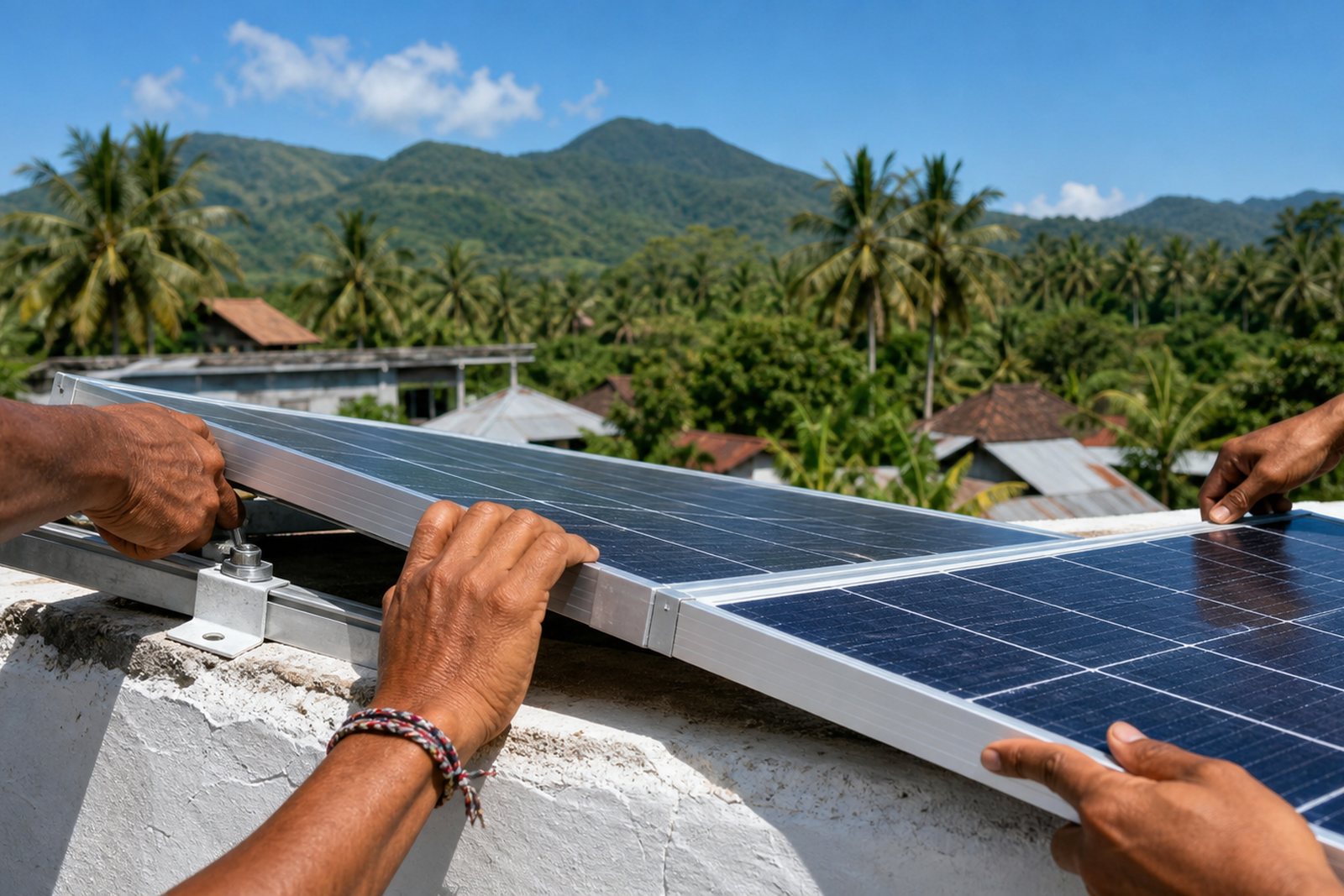 Lombok Notebook · Illustration: HubLombok (AI-generated)
There is also a governance point. DPMPTSP’s participation is presented as evidence of institutional readiness to accompany provincial leadership and open investment space. That is a useful indication of administrative attention. It is not equivalent to a completed approval process, a project guarantee or a commitment to a particular investor. The distinction may sound formal, but it is central to prudent allocation.
In property markets, promotional narratives can easily be absorbed into valuation stories before the underlying policy has become concrete. Lombok investors should be particularly careful not to capitalise a prospective energy improvement into land or asset pricing prematurely. The source offers no basis for calculating such an effect.
From Summit Language to an Investable Question
The most useful way to read this announcement is as an early-stage signal with several possible implications, rather than as a conclusion. It places renewable energy, solar provision and regional collaboration on the provincial agenda. That can be relevant to long-horizon investors whose exposure depends on the durability and quality of the local operating environment.
It may also sharpen questions that deserve answers before an investor acts. Those questions are practical rather than ideological:
- Which green-investment opportunities, if any, are being prepared for private participation?
- How would a prospective project relate to provincial priorities and the KR BNN framework?
- What approvals, land rights, contractual arrangements or operating permissions would apply?
- Which organisation would be responsible for implementation, oversight and investor engagement?
- What evidence would demonstrate that an ambition has become a deliverable programme?
These are not requests for excessive certainty. They are the normal boundary between policy enthusiasm and investment discipline. A solar-energy ambition can be strategically sound while still being commercially indeterminate. Equally, a carefully designed programme can emerge later from a broad declaration. The source does not permit a judgement on either outcome.
The regional element gives the announcement a further layer of interest. Co-operation across Bali, NTB and NTT could, in principle, make energy planning a broader regional conversation. But the DPMPTSP post does not describe the structure, commitments or practical work of KR BNN. Investors should therefore regard it as a framework named by the provincial government, not as proof of a completed regional energy arrangement.
This is where patient analysis is more useful than urgency. The announcement does not create a reason to rush towards an energy-themed transaction. It creates a reason to monitor subsequent official material for the transition from aspiration to specifics. Investment quality will depend on the details that follow, not on the fluency of the initial statement.
For operators in Lombok, the same restraint applies. Renewable energy may become increasingly important to the province’s investment positioning, but the post does not set requirements for businesses, announce incentives or define an implementation pathway. It would be premature to represent any of those as policy.
What This Means for Investors
The immediate investment takeaway is measured but meaningful: NTB has publicly linked renewable energy, solar ambition and green investment. That is a relevant contextual signal for investors considering the wider Lombok economy, especially where investment decisions have a long operating horizon.
The appropriate response is due diligence, not extrapolation. Keep the announcement in a policy-monitoring file; distinguish official commitments from executable projects; and seek primary documentation before assigning value to any claimed energy opportunity. Where a proposal later involves land, corporate participation, permits or investment structures, independent professional advice should test the legal and commercial facts rather than rely on a general policy message.
HubLombok is the editorial arm of Samudra Villas, an active developer in Are Guling, South Lombok. This note does not treat the DPMPTSP announcement as a forecast for property values or a recommendation to invest in any development. Its relevance is broader: the quality of a market is shaped not only by current transactions, but by the seriousness with which public institutions articulate and execute long-term priorities.
For now, the official record supports a simple conclusion. NTB wants to be seen as supportive of renewable energy, more ambitious on solar provision and open to green investment within a regional frame. Whether that ambition becomes investable will depend on the projects, rules and evidence that follow.
Stay informed, subscribe to the free Lombok Briefing for market intelligence like this, published twice a month.
What did NTB announce at Indonesia Solar Summit 2026?
According to DPMPTSP Provinsi NTB, the provincial government reaffirmed support for renewable energy, an ambition for NTB to become a resilient solar-energy provider, and stronger co-operation with Bali and NTT through the KR BNN framework.
Does the NTB post announce a specific solar investment project?
No. The official post describes commitments and an openness to green investment, but it does not name a project, capacity target, timetable, financing structure, commercial terms or investor-return profile.
How should Lombok investors use this solar-energy announcement?
Treat it as a policy signal rather than an investment recommendation. It indicates that NTB is placing renewable energy and green investment on its agenda, while any future opportunity should be assessed through primary documentation and appropriate independent due diligence.

The Lombok Buyer's Field Guide
Legal structures ranked by risk, the honest ROI math line by line, all six zones ranked, and the 24-point due-diligence checklist. The whole book, free in your inbox.
See what's inside