Why NTB’s Fisheries Governance Agenda Matters to Lombok Investors
NTB’s annual fisheries committee meeting puts data, sustainable management and integrated business links at the centre of the province’s marine economy.
Quick answer: NTB’s annual fisheries-management meeting signals a policy focus on sustainable, data-led marine governance and a more integrated fisheries business ecosystem. For Lombok investors, the immediate relevance is contextual: it highlights how provincial institutions are framing fisheries, aquaculture, ports, processing and finance as connected parts of the regional economy.
A coastal investment story is rarely only about beaches, hotels or land. It is also about the institutions that govern the working economy beyond the shoreline: the systems through which natural resources are managed, businesses are connected and policy priorities are expressed.
That was the underlying significance of the 2026 Annual Meeting of the Joint Fisheries Management Committee in Mataram. According to the official Instagram account of DPMPTSP Provinsi NTB, the meeting brought together fisheries-sector businesses, vertical agencies, provincial government bodies and other stakeholders to discuss stronger sustainable fisheries governance in West Nusa Tenggara.
The Context
The official post is not an investment prospectus, and investors should not read it as one. It contains no project pipeline, capital target, production forecast or commercial timetable. What it does offer is a clear statement of institutional direction from a forum convened around the management of marine and fisheries resources in NTB.
Muslim, S.T., M.Si., Head of the NTB Marine Affairs and Fisheries Service, said that Government Regulation Number 27 of 2021 on the administration of maritime affairs and fisheries, together with Government Regulation Number 11 of 2023 on measured fishing, provides an important foundation for sustainable management of the province’s marine and fisheries resources. The source does not set out the detailed provisions of either regulation; its relevance here lies in the fact that provincial officials presented them as part of the governance framework for NTB.
The meeting also placed particular emphasis on Fisheries Management Areas WPP 713 and WPP 573. Governor Dr H. Lalu Muhammad Iqbal, M.Hub.Int., described the management of these areas as a major responsibility and stressed that accurate data should form the basis of policy-making. In a resource-dependent sector, that language matters. Data-led management is not a guarantee of outcomes, but it is a different proposition from policy framed solely around short-term extraction.
“Data yang akurat”, accurate data, was identified by the Governor as the basis for fisheries policy, according to DPMPTSP Provinsi NTB.
For investors looking at Lombok within the wider NTB economy, this is best understood as a governance signal. The province’s public conversation is linking the condition of fish stocks with the quality of policy, rather than treating fisheries as an isolated activity. It also acknowledges that sustainable management requires decisions to be appropriately targeted, not simply ambitious in wording.
That distinction is useful because coastal economies have several overlapping constituencies. Fishing communities, processors, port operators, financiers, tourism businesses and residents can all be affected by how marine resources are managed. Their interests do not always align automatically. A committee forum cannot remove those tensions, but it can provide a place to formulate recommendations for central and regional government and to align policy with local wisdom, as the official post describes.
The post further notes an international certification for tuna fisheries management in WPP 713. It attributes this achievement to the management of that fishery, without naming the certification or setting out its terms. Investors should therefore avoid attaching broader claims to it. The appropriate reading is narrower: the provincial fisheries leadership cited it as an encouraging example within its sustainability discussion.
From Catch to Connected Economy
The most economically interesting part of the official account is its description of an integrated fisheries business ecosystem. The Governor encouraged stronger connections between fishers, seafood processors, ports and financial institutions through partnership or cooperative models.
This is a systems view of the sector. It shifts attention from the moment a fish is landed to the links that determine whether a fishery can support a wider chain of activity. The source does not claim that such links have already been built, nor does it identify particular investments or companies. It records an official policy encouragement: to strengthen those relationships.
For an investor, the distinction between an aspiration and an established commercial reality is essential. A policy direction can indicate where dialogue, administrative attention or future collaboration may concentrate. It cannot substitute for diligence on licences, counterparties, infrastructure, supply arrangements, operating costs or the legal rights attached to any investment.
Still, the framework is worth watching because it identifies the parts of the economy that provincial leadership sees as interdependent:
- Fishers, whose livelihoods are directly connected to marine resources.
- Processors, who sit between landings and downstream markets.
- Ports, which are part of the logistical chain.
- Financial institutions, which the Governor included in the proposed partnership or cooperative ecosystem.
- Aquaculture, which officials presented as an important avenue for reducing dependence on catching fish at sea while supporting the sustainability of fish stocks.
The aquaculture point deserves careful attention. The official post says its development is considered important for reducing reliance on marine capture and safeguarding the sustainability of fish stocks. It does not say where projects will be located, what species may be involved, how they will be financed or when activity may occur. Those questions remain outside the supplied information.
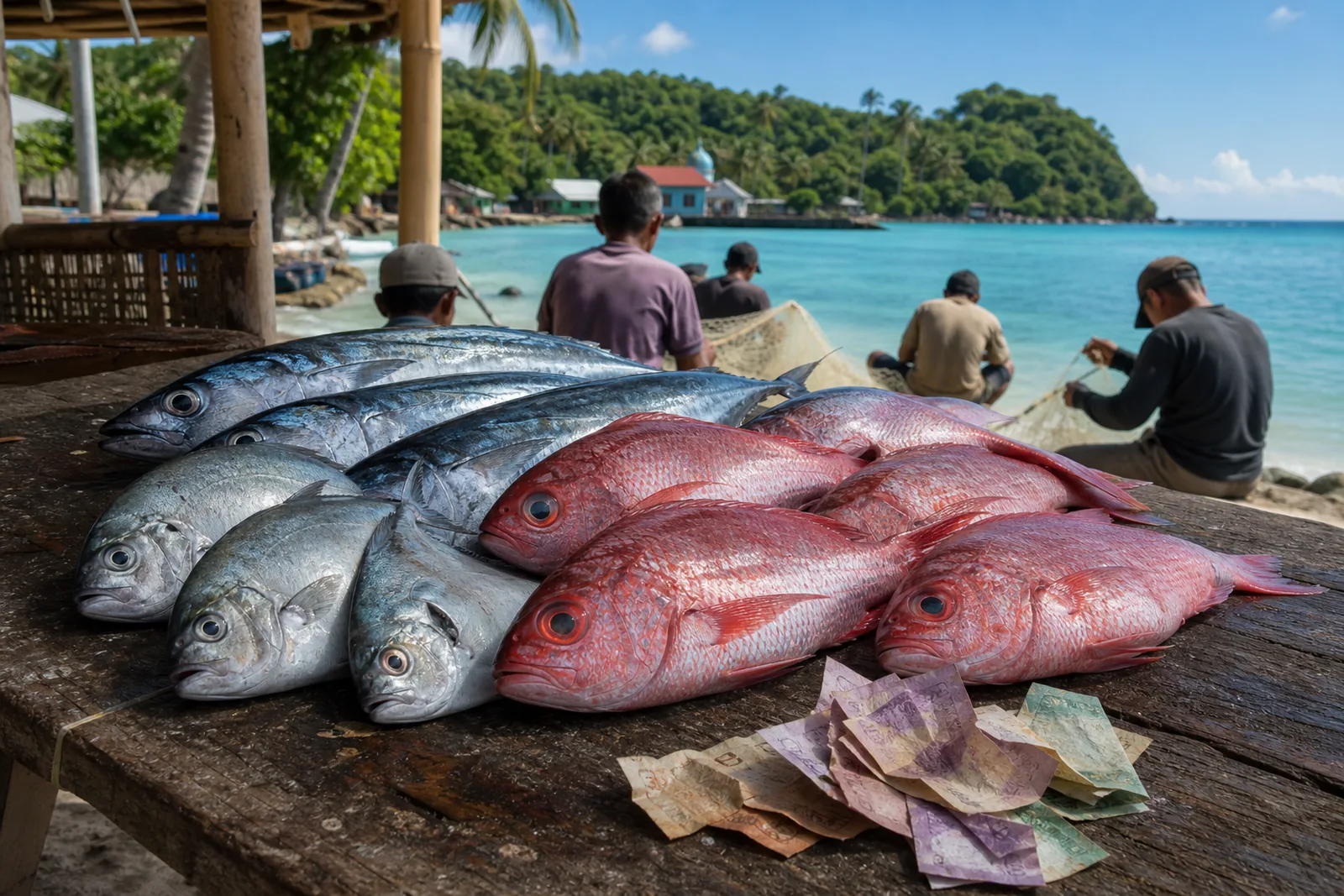
 Why NTB’s Fisheries Governance Agenda Matters to Lombok Investors · Illustration: HubLombok (AI-generated)
Nor should “integrated” be mistaken for simple. Integration can describe a desirable relationship between participants, but its practical meaning depends on arrangements that the post does not specify. The discipline for investors is to separate a stated policy preference from the operational evidence needed to assess any particular opportunity.
That is particularly relevant in a destination such as Lombok, where the coastal economy can be discussed through several lenses at once. Tourism may be more visible to international property buyers, while fisheries and aquaculture speak to the productive economy that continues beyond visitor demand. The annual committee meeting points towards that broader picture without claiming to resolve it.
Data, Sustainability and the Limits of a Policy Signal
The language used at the meeting suggests three themes that deserve to be held together: information, stewardship and business organisation.
First, the emphasis on accurate data makes a modest but important claim about how decisions should be made. The Governor’s position, as reported by DPMPTSP Provinsi NTB, is that sound data should underpin fisheries policy. This is a governance principle, not a disclosed data set. The source does not provide stock assessments, catch figures, compliance measures or economic output; none should be presumed from the meeting’s statements.
Second, sustainability is presented as the purpose of management. Muslim described the cited regulations as an important foundation for sustainable marine and fisheries resources in NTB, while the Governor linked appropriate policy with the continuity of fish resources. This framing places the resource itself at the centre of the economic discussion. It is not merely an environmental add-on to commercial activity.
Third, the business ecosystem is treated as a chain rather than a collection of disconnected actors. Partnerships or cooperatives are presented as possible models for bringing fishers, processors, ports and finance closer together. Such models can take many forms, and the source does not endorse a specific legal or commercial structure. Its significance lies in the official recognition that sector development involves more than the catching of fish.
A sensible Lombok Notebook reading is therefore neither exuberant nor dismissive. It would be premature to turn one committee meeting into a prediction about investment returns, fisheries output or specific development plans. Equally, it would be too narrow to overlook the meeting simply because it did not announce a transaction.
Policy forums reveal the vocabulary through which authorities are approaching a sector. Here, that vocabulary includes measured fishing, data accuracy, international certification, local wisdom, integrated business relationships and aquaculture. These are not interchangeable slogans. Together, they describe a provincial effort to connect resource management with economic organisation.
The source also underscores the multi-level nature of fisheries governance. The committee is described as a vehicle for preparing recommendations for both central and regional government. The meeting included business participants, vertical agencies, provincial bodies and other stakeholders. That does not tell us what recommendations will be adopted, but it does show that the discussion is not confined to a single department or commercial constituency.
For overseas investors, that complexity should encourage patience. An attractive coastal narrative can tempt observers to focus only on the asset closest to a transaction. Yet the durability of a regional economy is also shaped by the quality of its institutions, the clarity of its rules and the ability of participants to work across a supply chain. The DPMPTSP post speaks directly to the first and third of these themes, while leaving the transaction-level detail for further evidence.
What This Means for Investors
The practical conclusion is measured. Investors with an interest in Lombok and the wider NTB economy should treat the annual fisheries committee meeting as context for research, not as a standalone investment thesis.
It supports several questions worth carrying into further work:
- How are provincial and central policy discussions being translated into sector-specific implementation?
- What evidence is available for the data-led approach cited by the Governor?
- How are fishers, processors, ports and finance actually participating in partnerships or cooperative arrangements?
- Where, if anywhere, is aquaculture being developed under the sustainability rationale described by officials?
- What role do the management approaches for WPP 713 and WPP 573 play in the local businesses an investor is considering?
These are questions, not conclusions. The official account provides no answers at project level, and responsible analysis should preserve that boundary.
For property-oriented investors, the relevance is similarly indirect. The source makes no claim about villa demand, land values or hospitality performance. Its value is in broadening the lens. Lombok’s investment context includes a provincial marine economy in which officials are explicitly discussing sustainability, data quality and the connections between resource users, logistics, processing and finance.
For investors considering fisheries-adjacent activity, the caution is sharper still. A policy statement cannot establish rights to operate, prove supply availability or validate a commercial model. It can, however, indicate the themes against which a prospective investment may eventually need to be assessed.
The most useful takeaway is therefore one of analytical discipline. Follow the evidence trail: distinguish an official aspiration from implementation, a sector-level framework from a company-level opportunity, and a sustainability objective from demonstrated performance. In NTB’s fisheries discussion, those distinctions are not a reason to look away. They are the reason to look more carefully.
The annual meeting in Mataram offered a concise view of how provincial officials want to frame the marine economy: sustainable fisheries management supported by accurate data, local understanding and a more connected business ecosystem. For Lombok investors, that is not a headline to trade on. It is a piece of institutional context worth keeping in the notebook.
Stay informed, subscribe to the free Lombok Briefing for market intelligence like this, published twice a month.
What did NTB’s annual fisheries committee meeting focus on?
According to DPMPTSP Provinsi NTB, the meeting focused on strengthening sustainable fisheries governance. Officials highlighted accurate data for policy, the management of WPP 713 and WPP 573, integrated links between sector participants, and aquaculture as a way to reduce reliance on marine capture.
Does the meeting announce a specific investment opportunity in Lombok?
No. The official post does not announce a project, transaction, investment target, production forecast or commercial timetable. It provides policy and governance context for NTB’s marine economy, so investors should conduct separate diligence on any specific business or asset.
Why does fisheries governance matter to Lombok investors?
It matters as regional context. DPMPTSP Provinsi NTB describes a policy focus on sustainable resource management, accurate data and connections among fishers, processors, ports and finance. These themes help investors understand how officials are framing the wider coastal economy, without proving investment outcomes.

The Lombok Buyer's Field Guide
Legal structures ranked by risk, the honest ROI math line by line, all six zones ranked, and the 24-point due-diligence checklist. The whole book, free in your inbox.
See what's inside