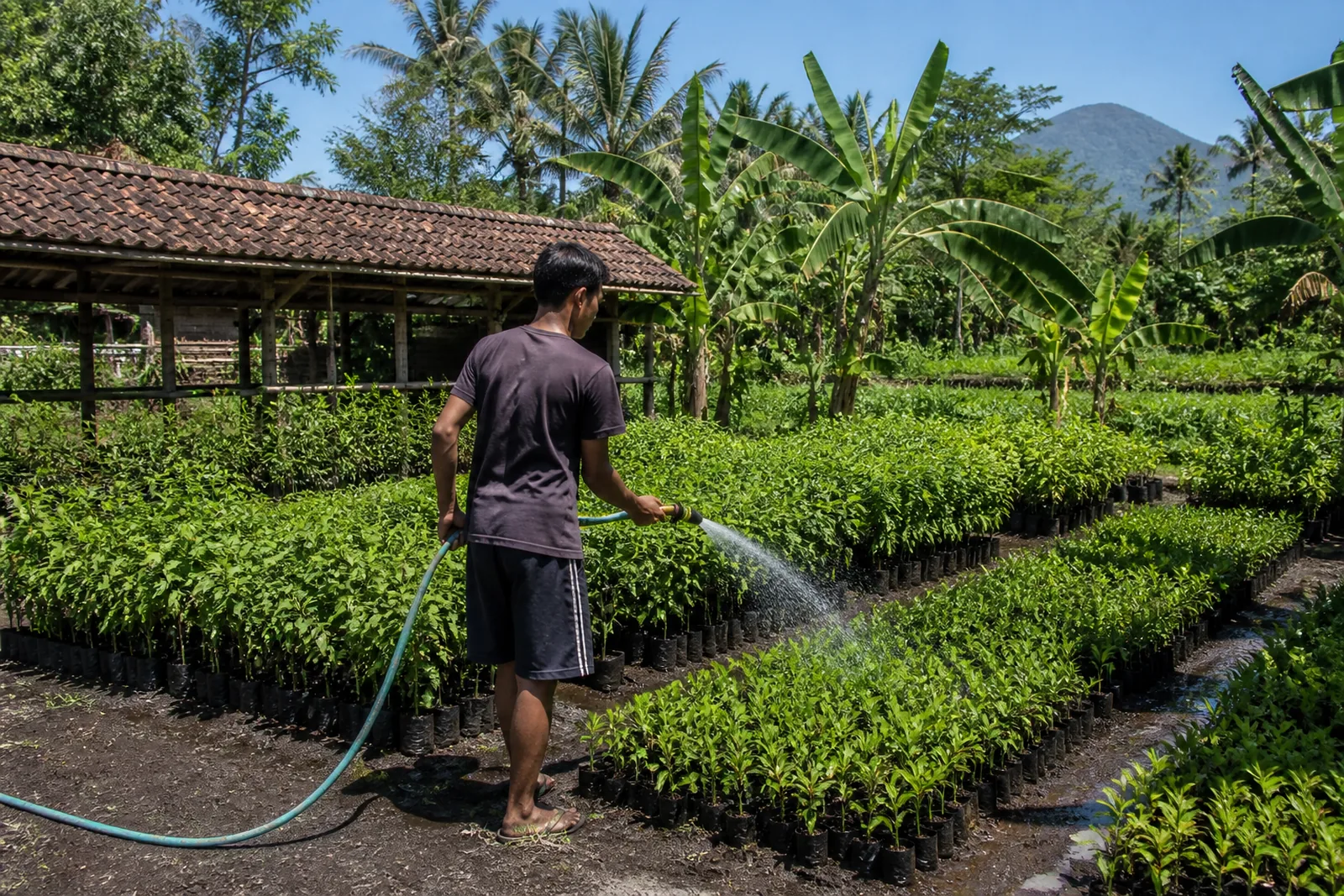
Indonesia Strengthens Nursery Network in Environmental Policy Push
Indonesia’s Forestry Ministry is strengthening its national nursery network, placing environmental delivery higher on the policy agenda.
Quick answer: Indonesia’s Ministry of Forestry says it is strengthening the national nursery network to support President Prabowo’s environmental push. For Lombok investors, this is a live policy signal rather than a property-market transaction: environmental delivery, land stewardship and the credibility of project claims deserve closer attention in every investment review.
Indonesia’s environmental agenda has acquired a practical new reference point. Antara Business reports that the Ministry of Forestry is strengthening the national nursery network in support of President Prabowo’s programme. The announcement is brief, but its investment relevance is not: nurseries sit at the unglamorous beginning of any serious effort to restore, protect or re-establish living landscapes.
The Context
The stated development is straightforward. Indonesia’s Ministry of Forestry is strengthening a national nursery network to back an environmental push associated with President Prabowo. Antara Business presents the measure as part of a national effort, rather than as a Lombok-specific initiative.
That distinction matters. Investors should resist the temptation to translate a national announcement immediately into assumptions about a particular plot, development approval, tourism asset or future valuation. The source does not identify a Lombok project, a local nursery, a timetable, a funding commitment or a specific land-use outcome. It therefore does not support claims of an immediate change in South Lombok property conditions.
Yet the policy direction is material. A nursery network concerns the capacity to produce and maintain planting stock. In environmental policy, such capacity is often the difference between an aspiration and an activity that can be carried out repeatedly. The Ministry’s emphasis suggests that implementation infrastructure is receiving attention alongside the broader environmental objective.
Antara Business reports that the Ministry of Forestry is strengthening the national nursery network to support President Prabowo’s environmental push.
For the investor, the useful question is not whether one announcement settles the outlook. It is whether environmental considerations are becoming more embedded in the practical conditions under which land, tourism and development projects are assessed. This report points in that direction, while leaving the local detail still to be established.
Why a Nursery Network Matters
A nursery is not merely a symbolic feature of an environmental programme. It is a supply base for plant material and, by extension, for work that depends on planting. A strengthened network can be read as a focus on readiness: the ability to support environmental activity with physical inputs rather than with broad commitments alone.
That has several implications for the way investors should read projects in Lombok and elsewhere in Indonesia:
- Environmental language should be tested against operational evidence, not accepted as a marketing flourish.
- Site selection and design should be examined with the surrounding landscape in mind.
- Buyers should ask how a project’s environmental commitments are documented, maintained and governed.
- Due diligence should distinguish national policy direction from rights, permits and obligations attached to a particular asset.
The report does not say that any particular development must alter its design, nor does it identify new requirements for buyers. Still, it puts a timely spotlight on a recurring weakness in property analysis: treating environmental quality as an aesthetic supplement rather than as part of long-term asset resilience.
For an investor considering a holiday home, rental villa or land position, landscape quality has more than visual value. It shapes how a place is experienced, how responsibly an operator presents the asset and how convincing its long-term proposition may appear. Those are qualitative considerations, not figures supplied by the announcement, but they are legitimate questions for any careful buyer.
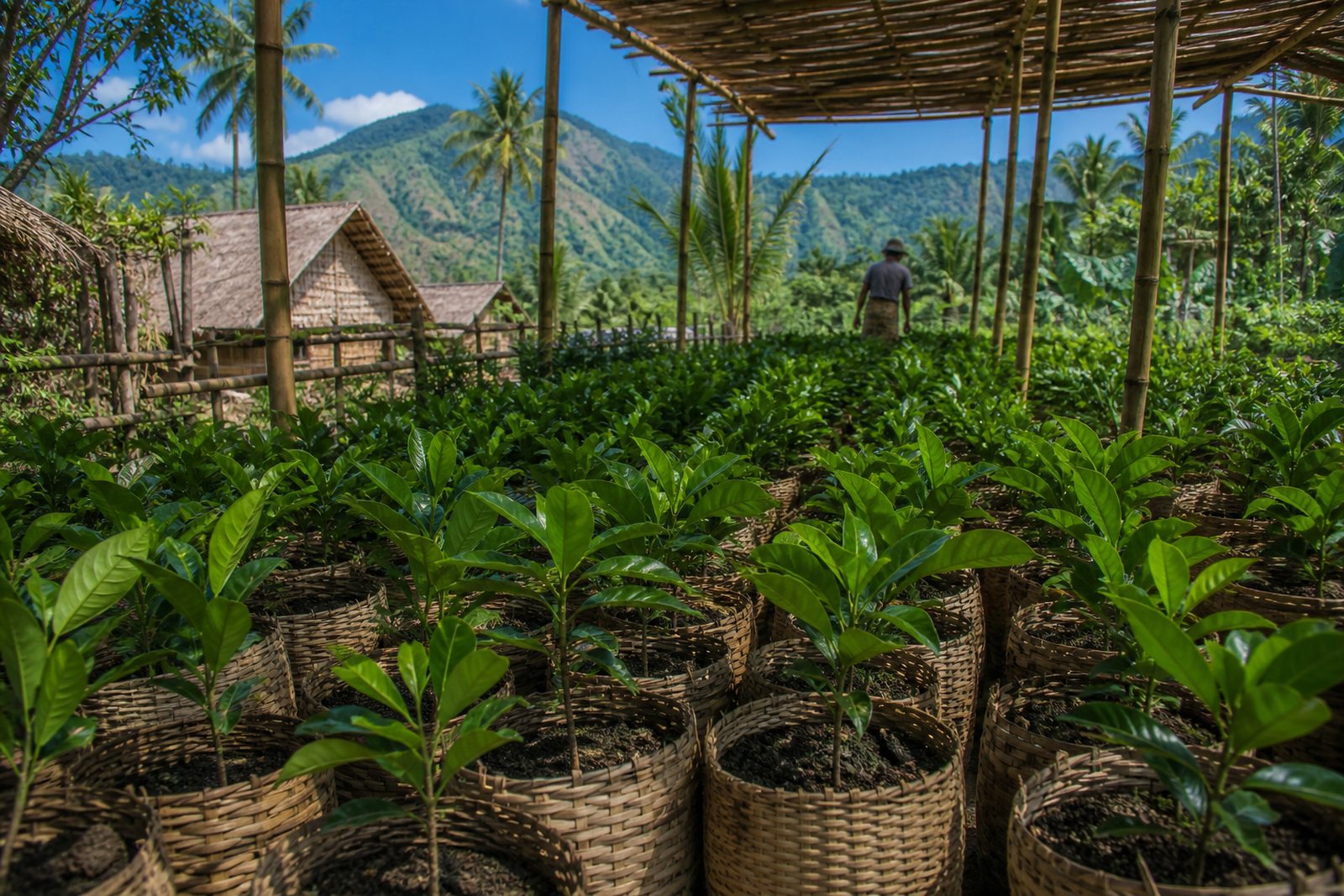 Indonesia Strengthens Nursery Network in Environmental Policy Push · Illustration: HubLombok (AI-generated)
Lombok Investors Should Separate Signal From Speculation
The immediate discipline is evidential. This is a national policy report; it is not a new Lombok market-data release. It does not establish a change in land prices, villa rates, occupancy or investor returns. Nor does it provide grounds to claim that a development enjoys special environmental status.
A responsible reading of the news has two layers. The first is the confirmed signal: the Ministry of Forestry is strengthening the national nursery network in support of the President’s environmental push. The second is the unanswered local question: how, if at all, will that direction show up in particular districts, projects and approval processes?
That is where buyers should become more exacting. Ask a developer or seller to show the basis for any environmental assertion. If a site is described as sensitive, regenerative, protected or landscape-led, request the underlying documentation and clarify who is responsible for ongoing management. Do not confuse attractive planting, artist’s impressions or broad sustainability wording with verified legal status or durable operating practice.
For foreign purchasers, the legal structure remains a separate issue. Foreigners cannot hold freehold, known as Hak Milik or SHM; that form is reserved for Indonesian citizens. Available routes include leasehold, Hak Pakai for qualifying residents, and a foreign-owned PT PMA that can hold Hak Guna Bangunan or HGB. Nominee arrangements, where an Indonesian citizen holds freehold on a foreigner’s behalf, are illegal and void in court.
Environmental confidence should never substitute for title diligence. A licensed PPAT notary executes deeds, while the BPN is the land agency. TerraNusa Advisory, HubLombok’s independent licensed-notary and legal advisory partner, supports foreign buyers with certificate and ownership-history checks, zoning and encumbrance review, PT PMA setup, taxes and title-transfer work at BPN. That full-chain scrutiny is especially valuable when an investment story relies heavily on the character of a site.
What This Means for Investors
The prudent conclusion is measured but clear. Indonesia’s nursery-network initiative is a positive policy-development signal for investors who believe environmental quality and land stewardship will matter increasingly to tourism and real-estate decisions. It is not, on the information available, a reason to revise a valuation or to accelerate a purchase.
Instead, use the announcement to improve the questions asked before committing capital:
| Investor question | What to establish | | --- | --- | | Is the claim local or national? | Whether the project has evidence beyond broad policy language. | | Is the asset legally sound? | The relevant title, zoning, ownership history and encumbrances. | | Who carries the commitment? | The party responsible for management after sale or completion. | | Is the evidence current? | Documentation that relates to the precise site under consideration. |
For Lombok, where the appeal of a property investment is closely tied to place, that discipline is not peripheral. The island’s landscape, tourism proposition and development choices are interconnected. A national move to reinforce nursery capacity will not answer every site-level question, but it makes those questions harder to dismiss.
The most useful response to this breaking development is neither exuberance nor cynicism. It is better due diligence: take the Ministry’s stated direction seriously, demand local evidence before drawing conclusions, and keep environmental claims alongside, not above, legal, operational and commercial analysis.
Stay informed, subscribe to the free Lombok Briefing for market intelligence like this, published twice a month.
What has Indonesia’s Ministry of Forestry announced?
Antara Business reports that Indonesia’s Ministry of Forestry is strengthening the national nursery network to support President Prabowo’s environmental push. The supplied report does not identify a Lombok-specific project, timetable, funding commitment or land-use change.
Does this announcement change Lombok property prices or returns?
No such change is established by the supplied report. It is a national environmental-policy signal, not a Lombok property-market release. Investors should not infer revised land prices, rental rates, occupancy or returns from the announcement alone.
What should a foreign buyer check when a project makes environmental claims?
A foreign buyer should verify the evidence for the precise site, then complete title, zoning, ownership-history and encumbrance checks. Environmental positioning does not replace lawful ownership arrangements, licensed-notary work or BPN land-transfer diligence.
The Lombok Buyer's Field Guide
Legal structures ranked by risk, the honest ROI math line by line, all six zones ranked, and the 24-point due-diligence checklist. The whole book, free in your inbox.
See what's inside