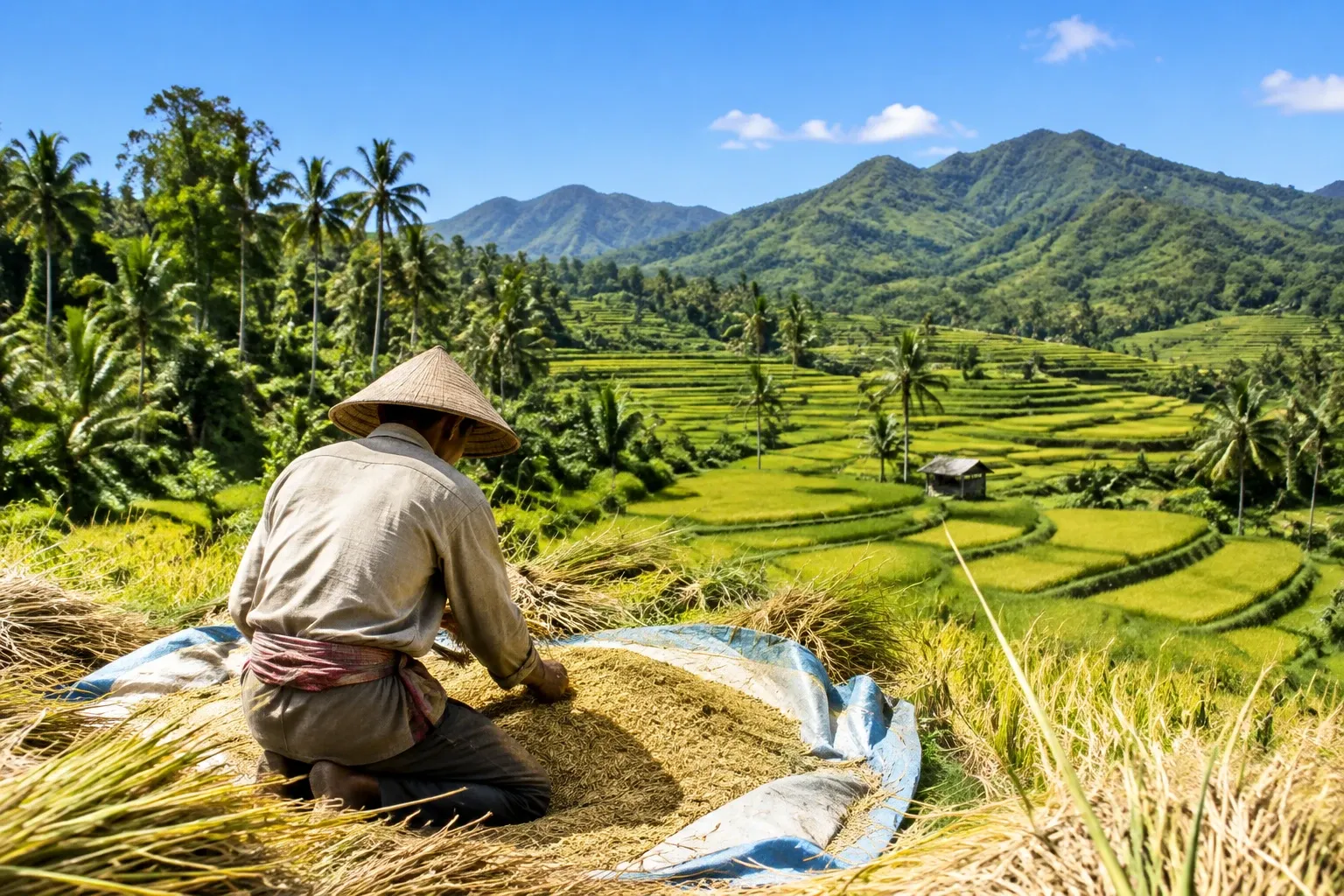
Indonesia Halts Domestic Rice Imports in 2025: Output Hits 34.69 Million Tons
Indonesia reports no rice imports for domestic use in 2025 and a 34.69 million ton harvest. What the government's claims mean, and do not mean, for Lombok investors.
Quick answer: Indonesia reported no rice imports for domestic use in 2025, a result the government ties to output of 34.69 million tons, up 13.29 percent. For South Lombok investors this is a national policy signal, not a property event: the source says nothing about land, leasehold or villa rates.
Indonesia's government says the country bought no rice for its own consumption during 2025, within the first two years of the Prabowo Subianto and Gibran Rakabuming Raka administration. The statement, issued by the Government Communications Agency (Bakom) on Sunday, presents food self-sufficiency as a central policy objective. It is a food policy story first, and a property story only in indirect ways.
The Context
The release frames the outcome as the product of measures introduced since 20 October 2024. It names three levers: changes to how subsidised fertiliser is distributed, a cut in the maximum retail price of that fertiliser, and wider programmes to support farming communities across the country. Food security is presented as a national security question, and rice is the centre of that argument.
The most concrete figures concern fertiliser. According to the government, it simplified distribution by eliminating 145 cumbersome regulations and reduced the maximum retail price (HET) of subsidised fertiliser by 20 percent, with the stated aim of lowering farmers' production costs. These are official claims about policy design. This dispatch has no independent data on how far those savings reached individual farms.
"National rice production reached 34.69 million tons in 2025, up 13.29 percent from 2024. Indonesia did not import rice for domestic consumption throughout 2025." (Government Communications Agency, Bakom)
Context matters for readers outside Indonesia. Rice is the core staple of the national diet, and import decisions can move both trade balances and domestic prices. A country that stops buying abroad changes the pressure on its farm economy, on its state logistics company and on import-dependent households. The release addresses the first two. It says nothing about consumer prices.
Supply, Reserves and the Self-Sufficiency Test
The release sets out four figures that frame the claim. All of them are government numbers, and the projections are estimates rather than outcomes.
- 2025 national output: 34.69 million tons, up 13.29 percent from 2024
- Government rice reserves managed by Bulog, end of 2025: 3.248 million tons
- Projected 2026 national output: 34.77 million tons
- Estimated domestic demand: 31.10 million tons
On those estimates, the projected gap between output and demand is about 3.67 million tons. That arithmetic is ours, built on the government's own figures, and it assumes the projection is met. A harvest shortfall, a weather shock or a drop in fertiliser use would shrink that margin. The release models none of those scenarios, and it does not say how the reserves would be drawn down in a bad year.
The release also widens the frame beyond grain. The Ministry of Marine Affairs and Fisheries ran its Red and White Fishing Villages programme at 100 locations in 2025, with 65 villages already in the operational trial phase. The government aims to expand it to 1,386 locations by the end of 2026, to strengthen fisheries infrastructure, raise fishers' productivity and stimulate growth in coastal communities. Coastal economies are the part of this story closest to Lombok's own, although the source gives no detail on sites, investment or timelines.
 Indonesia Halts Domestic Rice Imports in 2025 · Photo by Quang Nguyen Vinh on Pexels
What the Source Does Not Tell Us
Read as a property story, this dispatch is thin, and that is the honest reading. The source contains no data on land prices, rental rates, tourist arrivals, zoning changes or foreign investment. It says nothing about Lombok, Bali or any specific island. Anything we added on those topics would be our speculation, and this desk does not present forecasts as facts.
There are three indirect channels worth watching, and the source confirms none of them. The first is land use. A national push on agricultural output can shape how rural and coastal land is zoned and farmed, so the legal status of a specific plot matters more than its headline price. The second is cost. Fertiliser and farm input policy affects the rural economy around tourist areas, including the staff, suppliers and food costs of any villa operation. The third is attention. A government that treats food as a security objective may also scrutinise rural land use more closely. That last point is a judgement, not a finding.
What would change this assessment is evidence the release does not provide: published land-use rule changes for coastal or agricultural zones, fertiliser cost data at farm level, or a clear link between the rice policy and regional property activity. None of these appears in the statement.
What This Means for Investors
For a buyer considering a villa or land in South Lombok, the practical takeaways are procedural rather than macroeconomic.
- Legal route first. Hak Milik is reserved for Indonesian citizens only. The routes open to foreign buyers remain leasehold (Hak Sewa, typically 25-30 years with extensions), Hak Pakai, which is personal and requires KITAS or KITAP residency, and a PT PMA holding Hak Guna Bangunan (HGB), 30 years extendable.
- Zoning and designated use. Confirm the planning status of any plot before a deposit is paid. A policy push on agriculture makes the designated use of a site more important, not less.
- Price per are. Land in Lombok is quoted per are (1 are = 100 m²), which is the convention to compare against. This announcement does not change any verified price range, and no reliable price signal can be read from it.
Independent due diligence is the control point. TerraNusa Advisory, an independent licensed-notary and legal desk for foreign buyers in Lombok, covers certificate checks (SHM and HGB), ownership history, zoning, encumbrances, PT PMA setup, BPHTB and PPh taxes, and the deed and title transfer at the land office (BPN). Its own positioning is that most notaries handle the deed and nothing else, while TerraNusa runs the whole chain. It is an advisory partner, not part of Samudra Villas.
Three government milestones are worth tracking over the next year: whether 2026 output reaches the projected 34.77 million tons, whether the fisheries target of 1,386 locations is met, and whether the fertiliser reforms appear in farm costs. Each can be checked against later official reporting, which makes them better signals than the headline itself.
The announcement is a clear statement of policy success on the government's own terms. For Lombok investors the sensible response is to leave the investment thesis as it is until better evidence arrives, and to let the paperwork and the due diligence, not the headline, decide any purchase.
Stay informed: subscribe to the free Lombok Briefing, published twice a month (the 1st and 15th), for market intelligence like this.
Does this rice policy change property rules for foreign buyers in Lombok?
No. The statement covers rice supply and food policy, not land law. Hak Milik is reserved for Indonesian citizens only. The routes open to foreign buyers remain leasehold (Hak Sewa), Hak Pakai and a PT PMA holding Hak Guna Bangunan, so the legal check before any purchase is unchanged.
Are the Indonesian rice figures independently verified?
Not in this dispatch. The figures come from a government statement issued by the Government Communications Agency (Bakom) and reported by Antara Business. They are official claims. The 2026 output figure is a projection and the demand figure is an estimate, so both should be read as targets, not results.
Should this news change how I assess a Lombok land purchase?
Not on its own. The source contains no data on Lombok land prices, zoning or villa rates. Any purchase still needs independent checks on certificates, zoning and encumbrances, and land prices should be compared per are (1 are = 100 m²), the local convention.

The Lombok Buyer's Field Guide
Legal structures ranked by risk, the honest ROI math line by line, all six zones ranked, and the 24-point due-diligence checklist. The whole book, free in your inbox.
See what's inside