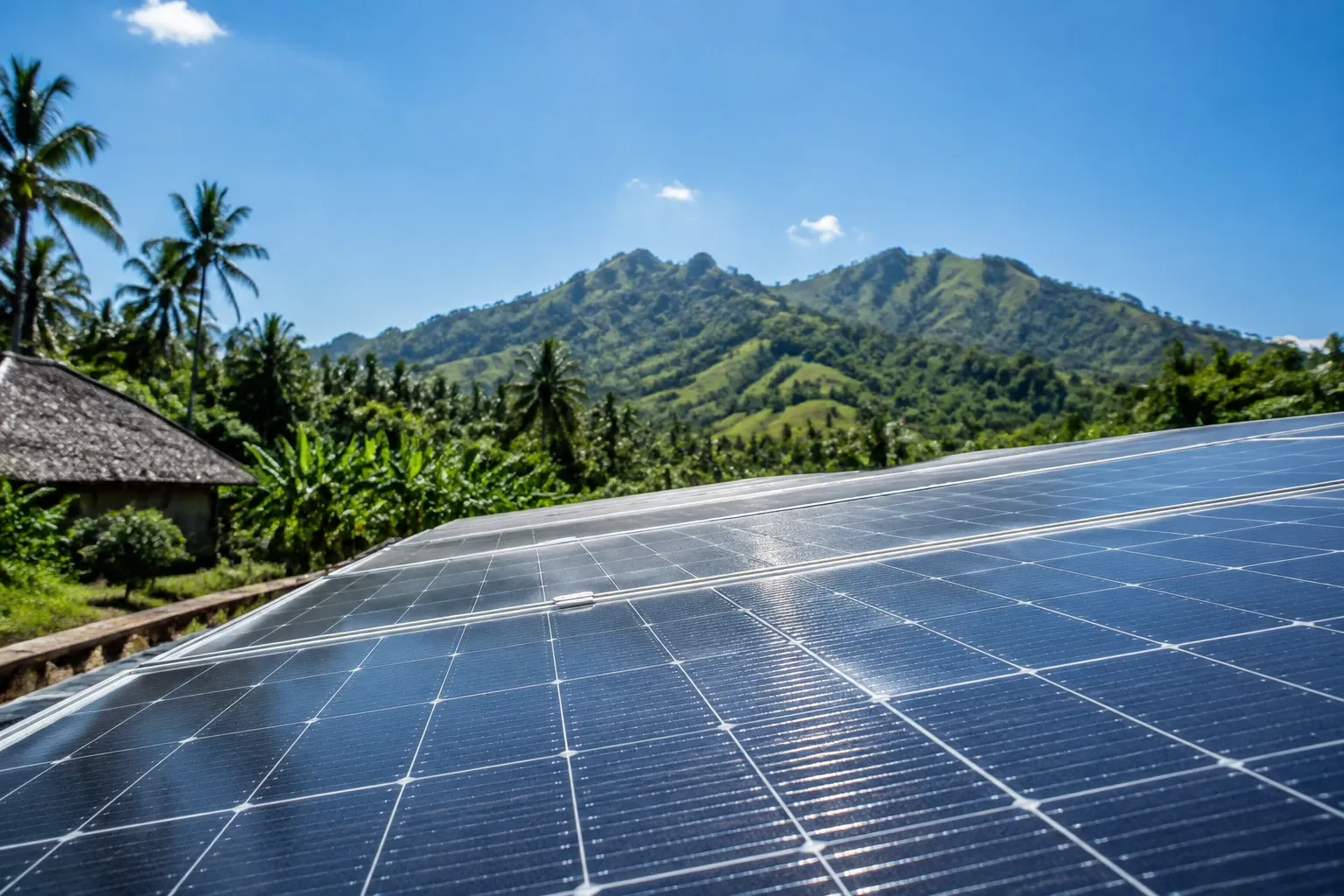
Jakarta's energy record: biodiesel savings and a 100 GWp solar target
Indonesia's government reports biodiesel savings, higher oil lifting and a 100 GWp solar target. Here is what the figures do and do not mean for South Lombok investors.
Quick answer: Indonesia's government reports that oil lifting met the budget target for the first time since 2016, and that biodiesel blending saved Rp130.21 trillion in foreign exchange in 2025. For South Lombok investors this is a policy signal, not a direct property catalyst, since the source never mentions Lombok or property.
Two years into its term, the administration has put energy at the centre of its national agenda. In a statement on Sunday, the government's communication agency listed what it counts as progress: higher domestic oil output, a biodiesel programme that is already reducing fuel imports, a large solar target and electricity reaching remote communities. Read at face value, the message is clear. Indonesia wants to produce more of its own energy and buy less of it from abroad.
The Context
The statement came from the Government Communication Agency and was reported by Antara Business. Its central theme is energy self-reliance. The agency's deputy for partnerships and media relations described it as a focus for laying the foundation of national transformation.
Energy self-reliance is one of the government's focuses in laying the foundation for national transformation.
Three claims anchor the report. First, oil lifting, including natural gas liquids, met the state budget target in 2025 for the first time since 2016. Lifting is the measure used here, so the claim is about oil and gas liquids sold against budget assumptions, not a full picture of production. Second, the mandatory B40 biodiesel blend saved Rp130.21 trillion in foreign exchange over 2025. Third, the mandatory B50 blend launched in July 2026 is estimated to save up to Rp170 trillion while aiming to end diesel imports.
It is worth reading these as what they are: official statements of achievement, published by the government about its own programmes. The source includes no audit, no independent analysis and no methodology for the savings estimates. The B50 figure is explicitly an estimate. The B40 figure is a retrospective claim that the source does not break down by year, price or import volume.
Solar, Rural Power and Waste-to-Energy
The most ambitious element is solar. The government's target is 100 gigawatts peak (GWp) of solar capacity within three years. The programme was launched on August 25, 2026, with an initial phase of 14 projects totalling 5,216 megawatts peak (MWp), or about 5.2 GWp. That first phase is roughly one-twentieth of the three-year goal, which is the most useful number for judging how far the programme has to go.
The rural electrification record is more concrete. In 2025 the Village Electricity Program was implemented at 1,516 locations and reached 77,616 customers. The government says it continues in 2026 for communities not yet connected to the grid.
Waste-to-energy is at an earlier stage. In April 2026 the government signed cooperation agreements for projects in three priority areas: Greater Denpasar, Bekasi City and Greater Bogor. It says it has prepared to accelerate cooperation in 12 other urban agglomerations, but the source does not name them or give timelines.
| Programme | Figure stated in the source | Status in the source | |---|---|---| | Biodiesel B40 | Rp130.21 trillion saved in foreign exchange | Completed over 2025 | | Biodiesel B50 | Up to Rp170 trillion saved (estimate) | Launched July 2026 | | Solar, initial phase | 14 projects, 5,216 MWp | Launched August 25, 2026 | | Solar, national goal | 100 GWp within three years | Target | | Village Electricity | 1,516 locations, 77,616 customers | Implemented 2025, continuing 2026 | | Waste-to-energy | 3 priority areas signed, 12 more prepared | Agreements April 2026 |
 Jakarta's energy record · Photo by Mayukh Karmakar on Pexels
What the Source Does Not Say
For investors the omissions matter as much as the claims. The report names no costs, no tariffs, no financing structure for the solar programme and no regional breakdown of where the 100 GWp will sit. Solar capacity is quoted in peak output, which is higher than the average output a plant delivers across a year, so any comparison with grid demand needs that adjustment before it means anything.
It does not mention Lombok, Nusa Tenggara or any property market. The three waste-to-energy priority areas are Greater Denpasar, Bekasi City and Greater Bogor, and none of them is in Lombok. Nor does it mention land, construction rules or foreign ownership. Anyone who reads this as a signal for land demand in Lombok is reading into the story, not from it.
The reading that holds up is narrower. A government that reduces fuel imports, builds renewable capacity and extends grid access is shaping the national cost base of electricity over the long term. How quickly any of that reaches the Lesser Sunda islands is not in the source, and nothing in it supports a timeline for South Lombok.
What This Means for Investors
Three implications are relevant to South Lombok buyers. Each one is an inference from the source, not a finding within it.
- Power reliability as an operating cost. Villa owners carry electricity as a running cost. If grid access and supply improve over time, the operating risk of remote properties may fall. The source does not say this and gives no date.
- Fuel import exposure. Lower diesel imports would ease one pressure on the national budget. The source does not quantify any effect on the rupiah or on local prices, so do not treat this as a currency forecast.
- Policy direction, not a property trigger. The energy agenda is slow-moving infrastructure policy. The first visible effects would appear in project announcements and tenders, not in zone prices.
For the zone picture, the pricing reference remains local. Kuta is priced at Rp 300-400 million per are, Are Guling at Rp 120-180 million per are and Mandalika at Rp 100-150 million per are. Those ranges are driven by tourism, access and supply, not by national energy statistics. A buyer should not change a price view because of this report.
On legal structure, the source is silent. Foreign buyers remain limited to leasehold (Hak Sewa), Hak Pakai tied to residency, or a PT PMA holding Hak Guna Bangunan. Any structure should be checked with a licensed notary before commitment.
What to watch: implementation of the B50 blend, tender or contract announcements under the 100 GWp programme, and whether the Village Electricity Program names island regions in future updates. Each would be a checkable signal, unlike the statement itself.
The statement is a useful record of where the government says it is heading. It is not yet evidence that the programme is delivering in places that matter for Lombok property. For a buyer, the sensible course is to watch the tenders and the figures that get audited, not the headline.
Stay informed: subscribe to the free Lombok Briefing, published twice a month (the 1st and 15th), for market intelligence like this.
Does this Indonesian energy news change land prices in South Lombok?
The source does not mention Lombok, land or property, so it gives no direct basis for a price effect. South Lombok land is priced per are by local demand: Kuta at Rp 300-400 million per are and Are Guling at Rp 120-180 million. National policy may matter over years, but nothing in this report quantifies that link.
Are the Indonesian energy achievements independently verified?
The achievements come from a statement by the government's own communication agency, reported by Antara Business. The figures are the government's claims. The report includes no audit or methodology, and the B50 savings are described as estimates, so treat them as official projections rather than verified results.
Does this news change foreign ownership rules for property in Lombok?
No. The source does not address foreign ownership. Foreign buyers remain limited to leasehold (Hak Sewa), Hak Pakai tied to residency, or a PT PMA holding Hak Guna Bangunan. Check any structure with a licensed notary before you commit.

The Lombok Buyer's Field Guide
Legal structures ranked by risk, the honest ROI math line by line, all six zones ranked, and the 24-point due-diligence checklist. The whole book, free in your inbox.
See what's inside