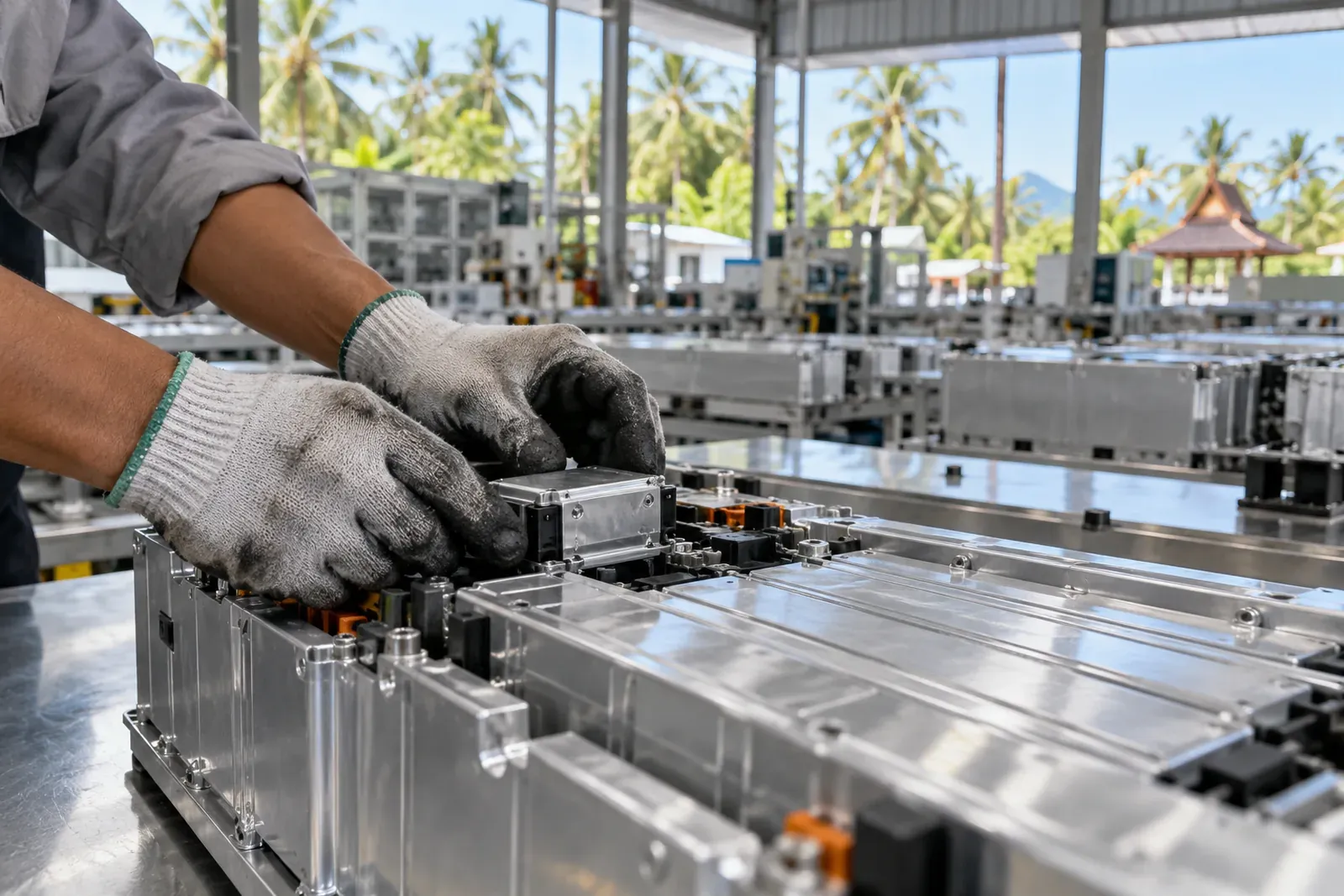
Indonesia Opens CATL-Antam Battery Plant as Industrial Integration Accelerates
Indonesia has commenced production at its third electric-vehicle battery facility, marking a critical milestone in President Prabowo Subianto's domestic resource downstreaming agenda.
Quick answer: Indonesia has commenced production at the joint CATL-Antam electric-vehicle battery plant, scheduled for formal inauguration by President Prabowo Subianto. The milestone establishes a third domestic battery facility and completes an end-to-end processing ecosystem, reinforcing sovereign economic stability and domestic energy transition before opening the door to international export markets.
Industrial policy in Southeast Asia rarely presents itself with such deliberate vertical coherence. The formal confirmation that the CATL-Antam battery plant has entered commercial production marks the culmination of a decade-long national pivot from raw commodity extraction toward high-value advanced manufacturing. For foreign capital evaluating Indonesian sovereign risk, this development offers a revealing benchmark of policy continuity under the current administration.
The Context
Speaking at the Presidential Palace in Jakarta, Coordinating Minister for Downstreaming and Energy Transition Bahlil Lahadalia confirmed that the CATL-Antam joint venture facility has moved past its commissioning phase. Production commenced more than twelve months after President Prabowo Subianto originally broke ground on the installation, with the head of state now scheduled to lead the formal inauguration proceedings.
"Our car-battery ecosystem is fully integrated, from mining and smelting to HPAL, precursors, cathodes and battery cells. Few countries have this." , Bahlil Lahadalia, Coordinating Minister for Downstreaming and Energy Transition
With this commissioning, Indonesia now operates three distinct electric-vehicle battery manufacturing centres:
- The Hyundai facility, anchoring early automotive manufacturing partnerships in West Java.
- The Chinese-backed processing hub in Halmahera, focused heavily on upstream refinement and mineral transformation.
- The CATL-Antam project, bridging state-owned resource extraction with tier-one global cell manufacturing expertise.
This tri-part industrial base represents the practical manifestation of Indonesia's downstreaming strategy, known domestically as hilirisasi. Rather than shipping unrefined nickel ore to offshore processing hubs, the domestic supply chain now encompasses raw extraction, smelting, high-pressure acid leach (HPAL) processing, chemical precursors, active cathode materials, and finished battery-cell fabrication.
Minister Bahlil noted that while international demand for battery packs remains intense, state policy prioritises national requirements first. Commercial exports will commence only after domestic industrial electrification and transport mandates are thoroughly satisfied.
Downstreaming and Sovereign Economic Stability
The completion of the CATL-Antam complex delivers proof that the transition from the administration of Joko Widodo to President Prabowo Subianto preserves fundamental economic orthodoxy. The policy of mandatory resource processing, once viewed sceptically by foreign trading partners, has achieved operational reality. The domestic retention of mineral value strengthens state revenue generation, cushions the national trade balance, and establishes a resilient foundation for long-term currency management.
| Industrial Stage | Operational Scope | Strategic Function | | :--- | :--- | :--- | | Upstream Mining | Domestic concessions (Antam) | Raw mineral security | | Chemical Refining | High-Pressure Acid Leach (HPAL) | Mixed hydroxide precipitate output | | Component Synthesis | Precursor and cathode lines | High-purity active materials | | Final Assembly | Finished battery cells | Domestic automotive integration |
For international observers who evaluate sovereign risk through fiscal governance, this integrated industrial capacity matters deeply. Natural resource windfalls historically produced volatile fiscal trajectories across emerging markets. By capturing every tier of the value chain internally, the Indonesian state builds a predictable tax base and reduces structural reliance on imported manufactured goods.
Furthermore, the explicit policy of meeting domestic consumption targets before permitting cross-border export underscores a clear strategic calculation. Jakarta intends to utilise its mineral wealth to lower the domestic cost of energy transition, stimulating regional supply chains before competing directly in global automotive markets.
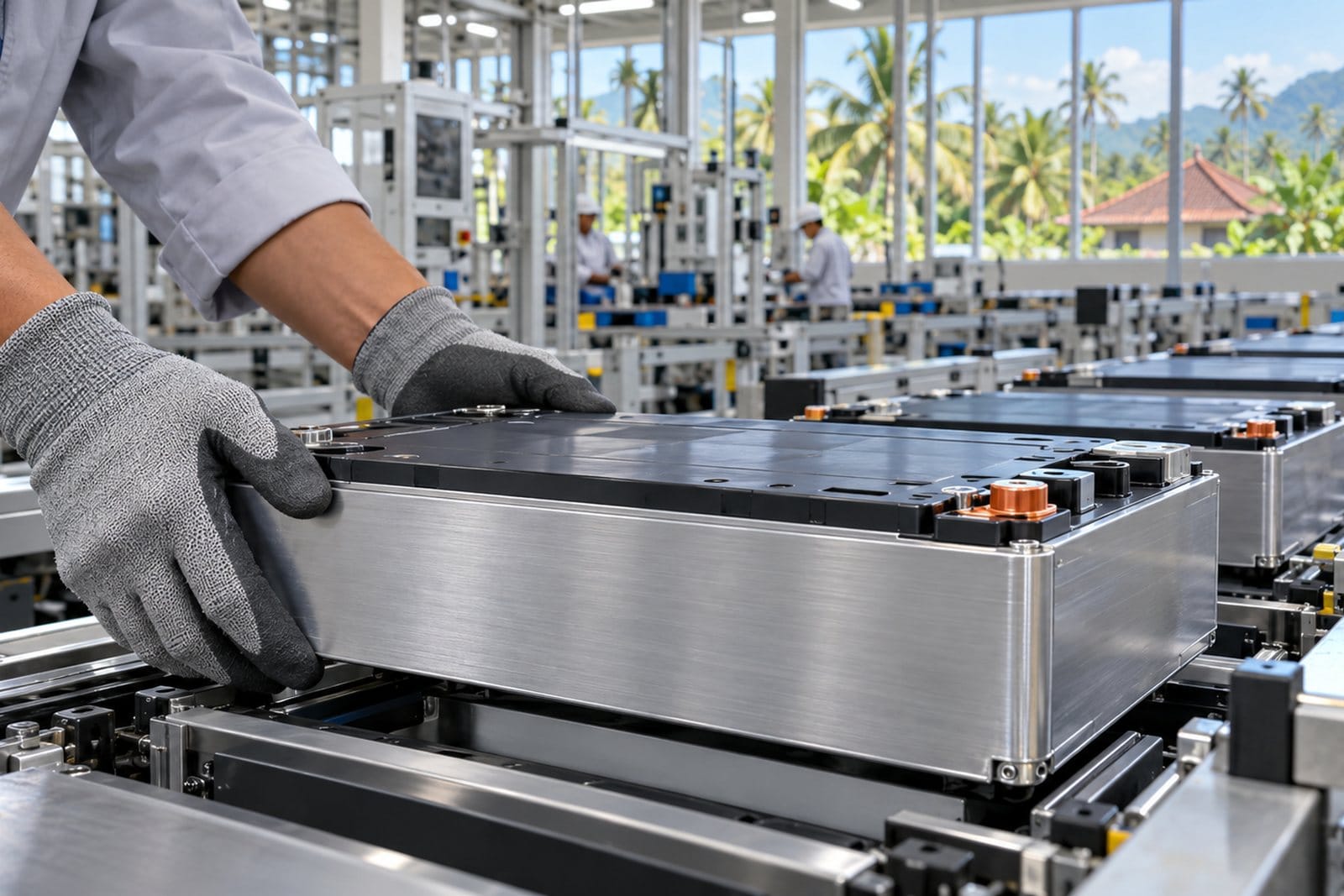 Indonesia Opens CATL-Antam Battery Plant as Industrial Integration Accelerates · Illustration: HubLombok (AI-generated)
Global Supply Chains and the Geopolitical Balance
Navigating foreign industrial partnerships during an era of fragmented global trade requires delicate diplomatic balance. Indonesia has managed to secure primary balance-sheet commitments from both East Asian automotive leaders and Chinese battery innovators without surrendering regulatory autonomy. The presence of contemporary manufacturing units backed by South Korean industrial conglomerates alongside major Chinese battery manufacturers demonstrates an open, multi-aligned commercial posture.
By partnering state-owned miner PT Aneka Tambang (Antam) with Contemporary Amperex Technology Co. Limited (CATL), the world's largest manufacturer of electric vehicle batteries, Indonesia secures direct access to proprietary chemical engineering and industrial scaling expertise. Concurrently, state ownership within the domestic joint venture ensures that strategic control remains firmly anchored in Jakarta.
The broader geopolitical dividend is substantial. Very few sovereign jurisdictions outside of East Asia possess the technical capacity, geological reserves, and processing infrastructure required to convert raw soil into functional lithium-ion cells within a continuous internal border. As Western economies construct protective regulatory frameworks around raw material sourcing, Indonesia's demonstrated capacity to execute complex engineering facilities positions the nation as an unavoidable node in worldwide logistics.
This industrial momentum also creates strong ancillary pressures across peripheral domestic sectors. As state revenues expand from corporate income taxes, mineral royalties, and high-skilled employment clusters, public capital expenditure continues to feed nationwide maritime logistics, commercial airports, and municipal arterial roadways. The economic benefits of industrialisation, though concentrated in processing corridors, circulate outward across the broader national monetary base.
What This Means for Investors
For foreign allocators deploying private capital within Indonesia, macroeconomic maturity represents the most vital underwriting consideration. The successful rollout of complex, capital-intensive manufacturing plants provides concrete evidence of institutional capacity and administrative reliability. Sovereign stability is not measured purely by inflation targets or parliamentary majorities; it is evidenced by the timely delivery of large-scale industrial projects.
- Institutional Continuity: The seamless transition from groundbreaking to active production confirms that regulatory support for long-term investments survives executive political transitions.
- Currency Resilience: Expanding high-value industrial manufacturing supports balance-of-payments discipline, providing stability for cross-border capital repatriation.
- Infrastructure Positive Externality: National downstreaming surpluses sustain continuing government capital outlays toward regional transit, electrification, and logistics networks.
- Broader Investment Climate: A maturing domestic corporate ecosystem fosters greater international confidence, encouraging institutional participation across real estate, hospitality, and sustainable development.
While heavy industrial operations remain physically distant from the pristine coastal enclaves of the Lesser Sunda Islands, the macroeconomic health of the archipelago is indivisible. A nation that successfully manufactures advanced automotive battery packs is a nation capable of sustaining robust regional tourism growth, modern aviation networks, and transparent legal frameworks for foreign property holdings.
As President Prabowo prepares to lead the official inauguration ceremony, the message to international capital is unmistakable. Indonesia is not content to remain an exporter of raw materials to wealthier neighbours. The republic has built the technical, regulatory, and industrial infrastructure to process its own future, establishing an enviable platform for sustained domestic economic expansion.
Stay informed: subscribe to the free Lombok Briefing, published twice a month (the 1st and 15th), for market intelligence like this.
What is the strategic significance of the CATL-Antam plant?
The CATL-Antam facility represents Indonesia's third operational electric-vehicle battery facility. It completes an integrated domestic supply chain spanning nickel mining, HPAL smelting, chemical precursors, cathodes, and finished cell production, significantly accelerating the national industrial downstreaming strategy.
Will Indonesia immediately export finished electric-vehicle batteries?
According to the Coordinating Minister for Downstreaming and Energy Transition, the Indonesian government will prioritise meeting domestic vehicle and energy storage requirements before permitting battery exports to international markets.
How does heavy industrial downstreaming impact private investors?
National industrialisation strengthens state revenue, reinforces trade balances, and underpins currency stability. This institutional execution track record reduces sovereign risk and fosters an attractive, predictable environment for foreign capital deployed across real estate, infrastructure, and regional tourism.

The Lombok Buyer's Field Guide
Legal structures ranked by risk, the honest ROI math line by line, all six zones ranked, and the 24-point due-diligence checklist. The whole book, free in your inbox.
See what's inside