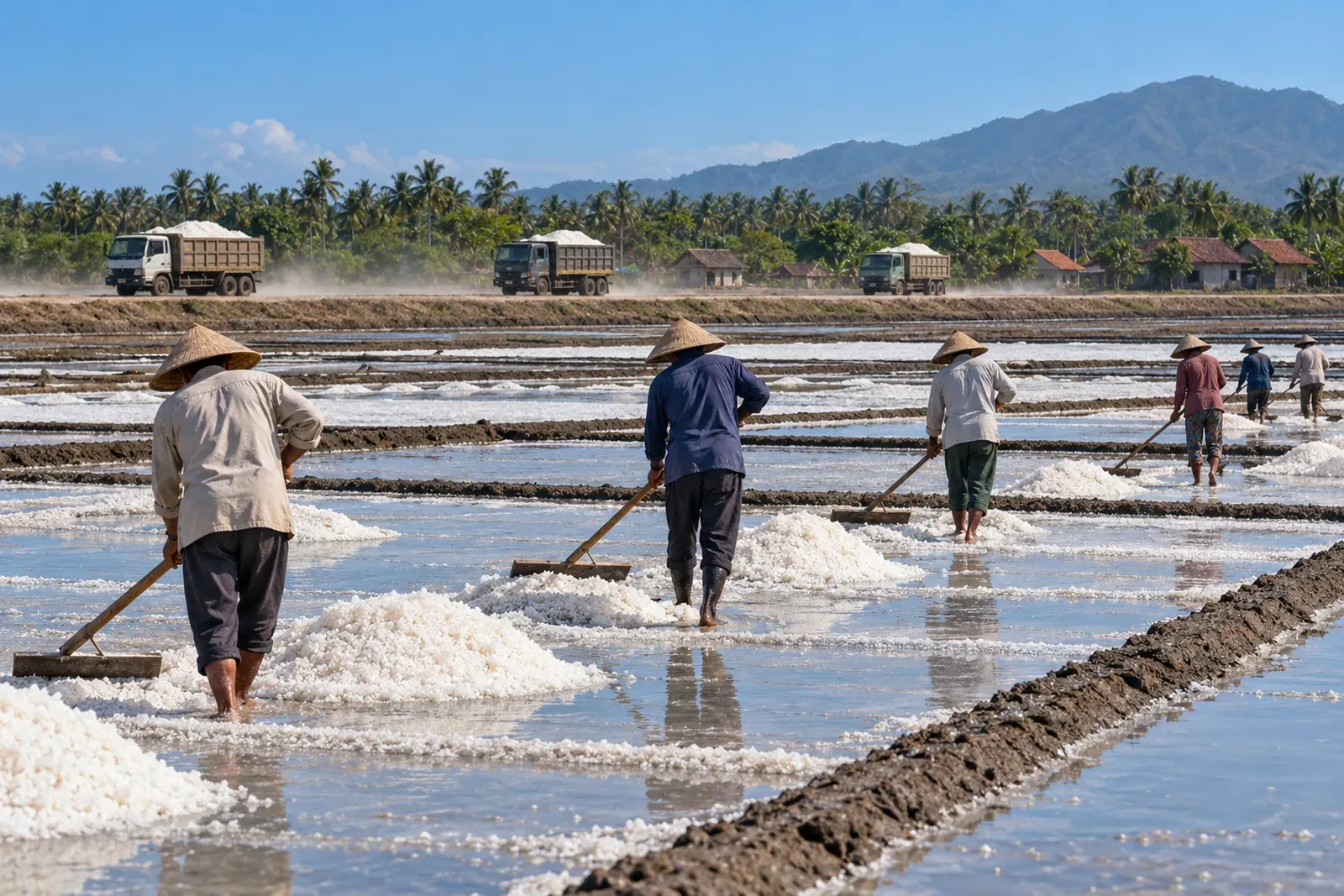
Eastern Indonesia's Salt Corridor: Industrial Capital Across the Nusa Tenggara Arc
Indonesia's 13,000-hectare K-SIGN industrial salt hub in NTT signals a broader economic shift across Nusa Tenggara, accelerating state infrastructure spending and regional supply chains.
Quick answer: Indonesia's planned 13,000-hectare National Salt Industry Center in neighbouring East Nusa Tenggara marks a major industrial capital deployment across the Nusa Tenggara island chain. For investors in Lombok, this regional downstream push signals rising state-backed infrastructure allocation, evolving inter-island logistics, and long-term economic maturation across the archipelago's eastern frontier.
Industrial policy in the Indonesian archipelago has long concentrated capital across Java and resource-rich swathes of Kalimantan and Sulawesi. Yet the broader Nusa Tenggara corridor, historically viewed through the dual lenses of subsistence agriculture and leisure tourism, is quietly entering a more complex economic phase. The announcement of the National Salt Industry Center, known locally as K-SIGN, in Rote Ndao District underscores how national strategic initiatives are now reaching the southern and eastern perimeter of the republic.
The Context
According to official projections from the East Nusa Tenggara provincial administration, the K-SIGN undertaking in Rote Ndao is designed to cover an eventual 13,000 hectares. The project is projected to create employment for around 26,000 local residents, with provincial officials estimating that participating household earnings could reach up to 2.5 times the regional minimum wage. The initiative forms an explicit pillar of Jakarta's broader ambition to secure domestic salt self-sufficiency by 2027.
Indonesia has historically relied upon substantial import volumes of high-grade industrial salt, particularly for chemical manufacturing, pharmaceuticals, and food processing. The strategic objective behind K-SIGN is to dismantle this structural dependence. The initiative targets a field productivity rate of up to 200 tons per hectare, alongside a sodium chloride concentration exceeding 97 percent, the threshold required for advanced commercial applications. Under the initial phase, a development area of 2,000 hectares is projected to generate roughly 400,000 tons of output, with production scheduled to commence in September 2026.
To achieve these technical specifications, the state plans to integrate physical processing facilities, analytical testing laboratories, and dedicated storage sites directly on site. Secondary industrial processing is also slated to capture higher-value chemical by-products, specifically magnesium sulfate and potassium, intended to attract downstream private enterprise to an island chain previously bypassed by industrial capital.
Downstream Value Capture and Eastern Logistics
The central thesis underpinning K-SIGN mirrors the resource nationalism and downstream processing mandates that transformed Indonesia's mineral sector over the past decade. As articulated by regional fisheries authorities and the coordinating ministry for food, raw commodity extraction without domestic value addition is no longer state policy. By refining raw brine into industrial-grade salt and specialty chemical inputs, the state aims to retain fiscal value within eastern domestic boundaries.
| Project Metric | Official Government Specification | | :--- | :--- | | Total Planned Footprint | 13,000 hectares | | Initial Phase Area | 2,000 hectares | | Projected Local Employment | Circa 26,000 jobs | | Target Land Productivity | Up to 200 tons per hectare | | Initial Phase Output Capacity | Circa 400,000 tons | | Minimum Chemical Standard | Over 97 percent sodium chloride | | Secondary Mineral By-Products | Magnesium sulfate, potassium | | Targeted National Self-Sufficiency | 2027 |
For the broader Nusa Tenggara arc, which links West Nusa Tenggara (encompassing Lombok and Sumbawa) with East Nusa Tenggara, the expansion of an industrial anchor on this scale demands logistics modernization. Moving hundreds of thousands of tons of bulk commodity cargo out of Rote Ndao requires reliable inter-island freight corridors, expanded maritime berths, and consistent power generation. The operational demands of modern processing plants will inevitably pull forward maritime logistics investments that benefit surrounding island economies.
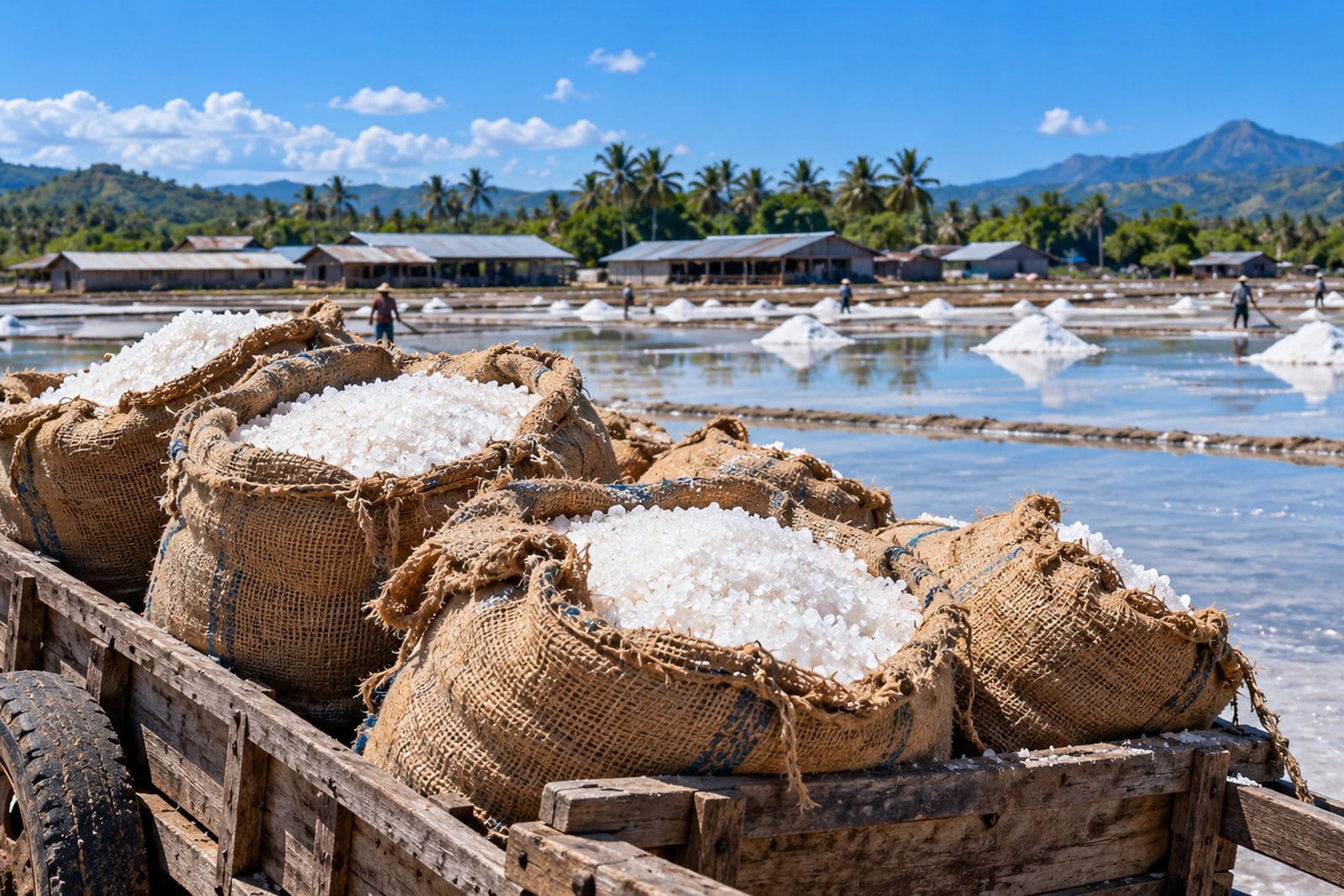 Eastern Indonesia's Salt Corridor · Illustration: HubLombok (AI-generated)
Regional Labour Markets and Economic Maturation
The socio-economic implications of the Rote Ndao facility extend beyond trade balance sheets. Transforming a traditional coastal economy into a structured industrial zone alters the local labour matrix. Provincial leadership has confirmed that community engagement measures are already underway across three host villages situated inside the project development boundary. Moving rural labour from informal, seasonal salt harvesting into formal industrial operations, complete with technical training and laboratory compliance, establishes a benchmark for regional wage standards.
"As the coordinating minister for food has said, Rote Ndao's salt must not always be sold as a raw material. It must be processed into higher-value products that deliver greater economic benefits for local communities."
This deliberate creation of formal employment, with wages projected up to 2.5 times the local baseline, has significant regional implications. In emerging island markets, secondary and tertiary economic activities follow formal industrial wages. The growth of banking services, commercial retail distribution, transport services, and residential building typically accelerates once a stable corporate payroll enters the provincial economy. While early execution hurdles remain regarding land management and inclusive local commercial integration, the trajectory toward structural formalization is unmistakable.
What This Means for Investors
Foreign direct investors focused on South Lombok typically assess the island through a specialized real estate lens: tourism expansion, premium hospitality yields, and international airport connectivity. However, sustainable real estate appreciation requires macroeconomic depth. A region dependent entirely on visitor arrivals remains exposed to exogenous travel shocks. The systematic industrialization of the wider Nusa Tenggara province provides an underlying layer of macroeconomic stability.
Several structural takeaways emerge for institutional and private capital allocating to the region:
- Infrastructure Co-Investment: State expenditure rarely remains isolated. The capital allocated to marine facilities, power grids, and freight corridors to support heavy primary processing across eastern islands creates network efficiencies for regional transport, including cargo transit through West Nusa Tenggara ports.
- Diversified Regional GDP: The emergence of heavy primary industries alongside lifestyle tourism diversifies the eastern archipelago's revenue base, strengthening provincial fiscal capacity and banking liquidity across Nusa Tenggara.
- Institutional De-risking: As central government ministries deploy significant balance-sheet capital into multi-thousand-hectare projects in eastern provinces, regulatory attention, administrative streamlining, and legal protections naturally mature across the entire maritime corridor.
Lombok remains the prime hospitality and lifestyle gateway of the eastern islands, benefiting from structural tourism migration out of overbuilt sections of Bali. Yet watching state capital formalize adjacent provinces offers reassuring evidence that the Indonesian government views the eastern archipelago not merely as a scenic backdrop for resorts, but as a productive, integrated engine of national economic output.
As September 2026 approaches, the physical commissioning of the initial 2,000-hectare tract in Rote Ndao will provide a tangible milestone. Investors evaluating long-term holdings in eastern Indonesia should welcome the shift: sovereign capital is laying foundations that will anchor the regional economy for decades to come.
Stay informed: subscribe to the free Lombok Briefing, published twice a month (the 1st and 15th), for market intelligence like this.
What is the K-SIGN project in East Nusa Tenggara?
K-SIGN is Indonesia's National Salt Industry Center in Rote Ndao, planned across 13,000 hectares. It aims to create 26,000 jobs, produce 400,000 tons in its initial 2,000-hectare phase, and achieve industrial salt self-sufficiency by 2027.
How does an industrial salt project in NTT impact Lombok investors?
While Lombok focuses on tourism and real estate, large-scale industrial projects across the Nusa Tenggara corridor accelerate state infrastructure spending, improve inter-island logistics, and diversify the wider regional economy against single-sector shocks.
When is commercial production scheduled to begin at K-SIGN?
The Rote Ndao industrial salt hub is scheduled to commence production in September 2026, targeting salt with over 97 percent sodium chloride content alongside mineral by-products such as potassium and magnesium sulfate.

The Lombok Buyer's Field Guide
Legal structures ranked by risk, the honest ROI math line by line, all six zones ranked, and the 24-point due-diligence checklist. The whole book, free in your inbox.
See what's inside