Bank Indonesia to Base MSME Credit Scoring on QRIS Merchant Data
Bank Indonesia plans to turn QRIS merchant payment flows into credit scores for small enterprises, expanding formal lending across emerging tourism economies like Lombok.
Quick answer: Bank Indonesia is moving to convert transaction histories from its QRIS digital payment system into formal credit scores for micro, small, and medium enterprises. For investors in Lombok, this initiative promises to formalise local merchant supply chains, lower financing barriers for grassroots hospitality operators, and deepen commercial liquidity across regional tourism hubs.
Financial inclusion in archipelago economies rarely arrives through traditional branch banking. Instead, it advances quietly at the checkout counter, where a printed matrix code bridges the gap between informal commerce and institutional capital. Bank Indonesia has now formally articulated the next step in this evolution: transforming merchant payment flows into quantifiable creditworthiness.
The Context
Speaking at the Danantara Technology Innovation Investment Forum 2026, Bank Indonesia Governor Destry Damayanti confirmed that the central bank intends to use transaction records from the Quick Response Code Indonesian Standard, universally known as QRIS, as an underwriting reference for micro, small, and medium enterprises (MSMEs). The objective is straightforward yet consequential: providing financial access to merchants at the bottom of the economic pyramid by letting empirical digital cash flow substitute for conventional collateral.
Central bank data through the third quarter of 2026 illustrates the remarkable scale of this payment rail:
- 70.6 million registered QRIS users nationwide.
- 49.4 million participating merchants, with 97 percent classified as MSME operators.
- 75.8 percent year-on-year increase in third-quarter transaction volume.
Alongside QRIS, the central bank highlighted the operational maturity of BI-FAST, the national retail payment infrastructure enabling round-the-clock clearing. In the third quarter of 2026, BI-FAST handled 1.631 billion transactions, marking a 31.78 percent year-on-year expansion, whilst aggregate transaction value reached Rp4,049 trillion, a rise of 33.91 percent compared to the same period a year earlier. Crucially for regional tourism markets, cross-border payment integration is also testing real-world application: the central bank logged 200 cross-border QRIS transactions during the 2026 Mandalika MotoGP.
Transforming Merchant Transaction Trails into Bankable Equity
For decades, commercial growth across regional Indonesia has encountered an unyielding structural hurdle: small-scale entrepreneurs generate steady cash flows but lack audited financial statements, registered land titles, or conventional pledges to satisfy institutional bank mandates. Without formal credit records, an independent warung, surf charter, laundry service, or boutique cafe must finance expansion out of retained cash or high-interest informal borrowing.
| Digital Payment Rail | Q3 2026 Scale | Year-on-Year Momentum | | :--- | :--- | :--- | | QRIS Merchant Base | 49.4 million (97% MSMEs) | Broad structural coverage | | QRIS Transaction Volume | Rapid national adoption | +75.8% YoY | | BI-FAST Transaction Volume | 1.631 billion transactions | +31.78% YoY | | BI-FAST Settlement Value | Rp4,049 trillion | +33.91% YoY |
By leveraging QRIS settlement data directly into an algorithmic credit score, the central bank aims to turn high-velocity point-of-sale activity into verifiable balance sheets. Every settled payment, from a foreign visitor scanning a domestic code to a wholesale seafood purchase cleared via BI-FAST, establishes an immutable record of revenue velocity, seasonality, and counterparty reliability. Underwriting algorithms evaluating rolling ninety-day turnover can offer working capital facilities far more accurately than a balance sheet auditor reviewing an unbanked business.
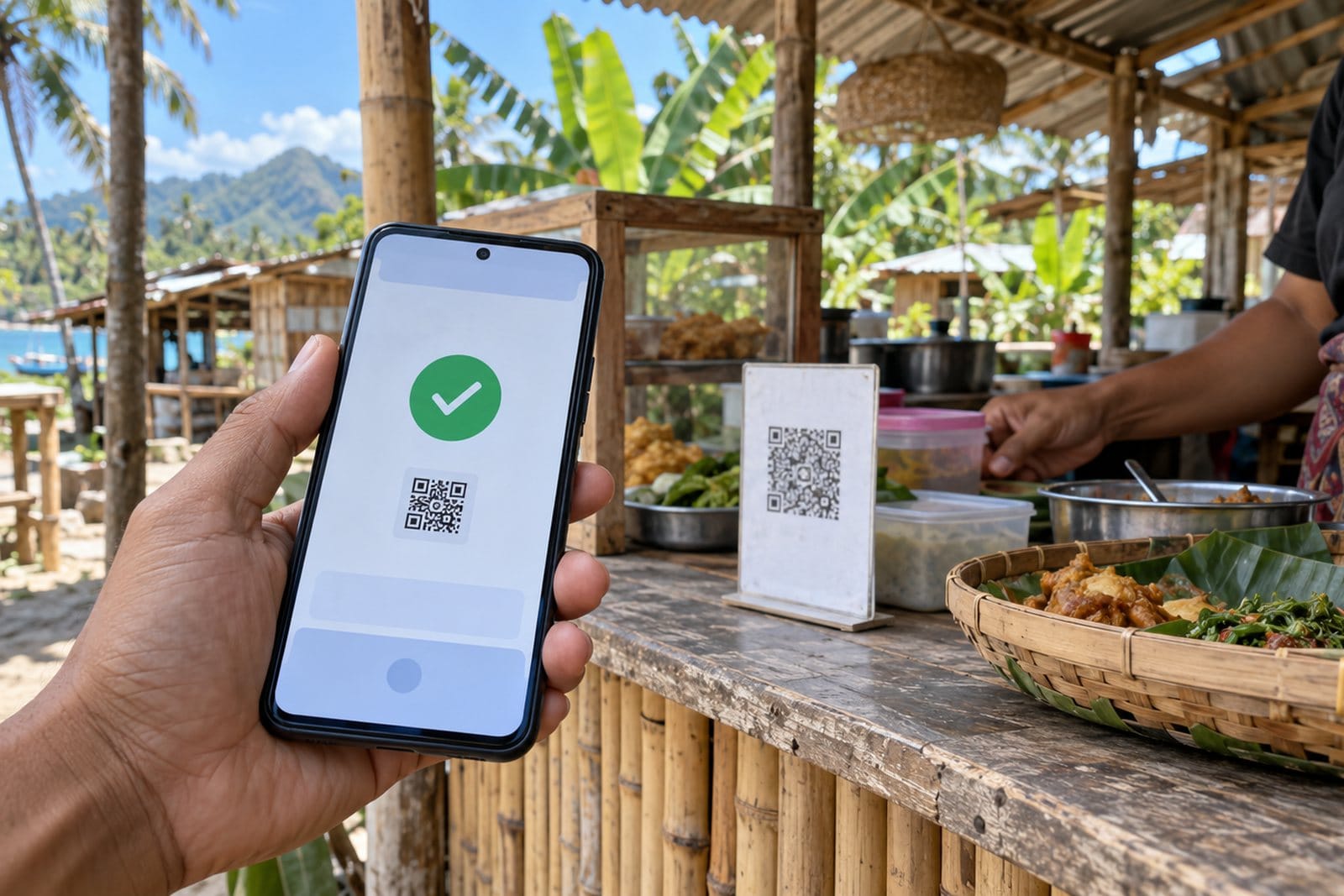 Bank Indonesia to Base MSME Credit Scoring on QRIS Merchant Data · Illustration: HubLombok (AI-generated)
The Regional Impact on South Lombok Commercial Infrastructure
The implications for outer island tourism destinations are immediate. Lombok is currently undergoing an accelerated economic transformation, sustained by a foreign-arrivals trend running at +40-50% YoY, driven by broader tourism recovery and the profile of international events at the Mandalika circuit. Yet beneath the high-profile infrastructure projects, the day-to-day tourist economy relies entirely on an ecosystem of micro and small merchants.
When local supply chains lack institutional financing, the costs of goods and auxiliary hospitality services rise, creating friction for commercial investors and villa developers alike. Consider the foundational operations underpinning the hospitality sector:
- Local food and beverage supply chains: Organic produce growers, fishermen, and artisanal bakeries can leverage digital turnover to purchase cold-storage equipment or transport assets.
- Turnkey service providers: Facility maintenance firms, laundry operations, and independent tour guides can secure equipment loans without pledging family land.
- Construction and hardware sub-contractors: Local material suppliers can obtain invoice financing based on digital clearing history rather than waiting for extended trade credit terms.
As small merchants secure cheaper, formal debt, the overall quality and reliability of the destination supply chain matures. The informal economy progressively integrates with regulated domestic banking, stabilising operational costs for prime tourism districts such as Kuta, Selong Belanak, and Mawun.
Cross-Border Interoperability and the Mandalika Corridor
The central bank confirmed that international integration is progressing in parallel with domestic scoring. The recording of 200 cross-border QRIS transactions at the 2026 Mandalika MotoGP serves as an operational proof-of-concept. As regional central banks across Southeast Asia interconnect their national QR networks, international visitors can settle retail transactions directly against their home-country bank balances, bypassing conventional card terminals and currency exchange booths.
"This is at least an achievement where we give financial access to merchants at the bottom, small merchants too, whose data can later become a kind of credit scoring. In the future it will be like that.", Destry Damayanti, Governor of Bank Indonesia
For regional economies like Lombok, foreign tourist spending captures immediate domestic value rather than leaking into overseas credit card interchange fees. Because funds settle near-instantaneously via BI-FAST rails, local merchants retain immediate liquidity, reducing counterparty settlement risk and reinforcing the empirical payment history that will feed their upcoming credit scores.
What This Means for Investors
International capital assessing frontier or early-cycle tourism markets frequently worries about systemic friction: opaque vendor pricing, cash-in-hand vulnerabilities, unreliable logistics partners, and an underbanked commercial fabric. Bank Indonesia's coordinated deployment of QRIS scoring and BI-FAST infrastructure fundamentally shifts this dynamic.
First, operational transparency improves significantly. As local suppliers adopt digital payments to build their institutional borrowing profiles, enterprise procurement becomes fully traceable. Villa managers, hospitality operators, and development syndicates benefit from clean digital invoices, verifiable vendor records, and more predictable operational overheads.
Second, the domestic banking sector gains the underwriting confidence needed to disburse capital into regional tourist economies. Historically, commercial bank credit in West Nusa Tenggara has concentrated heavily in conventional commodity agriculture or major state infrastructure. Granular MSME credit scoring allows banks to distribute productive lending directly into the private tourism services sector, fostering local business reinvestment and accelerating town-level urbanisation.
Third, destination resilience strengthens. A tourism market supported by financially robust, bank-funded local operators is far less fragile than one dependent on fragile informal arrangements. For private property owners and foreign investors acquiring assets in South Lombok, an institutionalised, digitally enabled local service economy provides the indispensable foundation for sustainable capital appreciation.
Indonesia is methodically constructing a modern digital financial stack. By anchoring future MSME lending to empirical point-of-sale performance rather than static collateral, the central bank is dismantling one of the most stubborn structural bottlenecks in emerging market commercial growth.
Stay informed: subscribe to the free Lombok Briefing, published twice a month (the 1st and 15th), for market intelligence like this.
How will Bank Indonesia use QRIS data for credit scoring?
Bank Indonesia plans to utilise empirical QRIS point-of-sale transaction histories to assess merchant cash flow, revenue velocity, and stability, allowing formal financial institutions to underwrite small businesses without requiring traditional property collateral.
How large is the QRIS merchant and user network in Indonesia?
According to central bank data through the third quarter of 2026, QRIS reached 70.6 million users and 49.4 million merchants nationwide, with 97 percent of participating businesses classified as MSMEs.
Why does MSME credit scoring matter for Lombok property investors?
Accessible credit enables local suppliers, transport operators, and hospitality maintenance contractors to upgrade equipment, stabilising the commercial supply chain and improving operating conditions for luxury villas and regional resorts.

The Lombok Buyer's Field Guide
Legal structures ranked by risk, the honest ROI math line by line, all six zones ranked, and the 24-point due-diligence checklist. The whole book, free in your inbox.
See what's inside