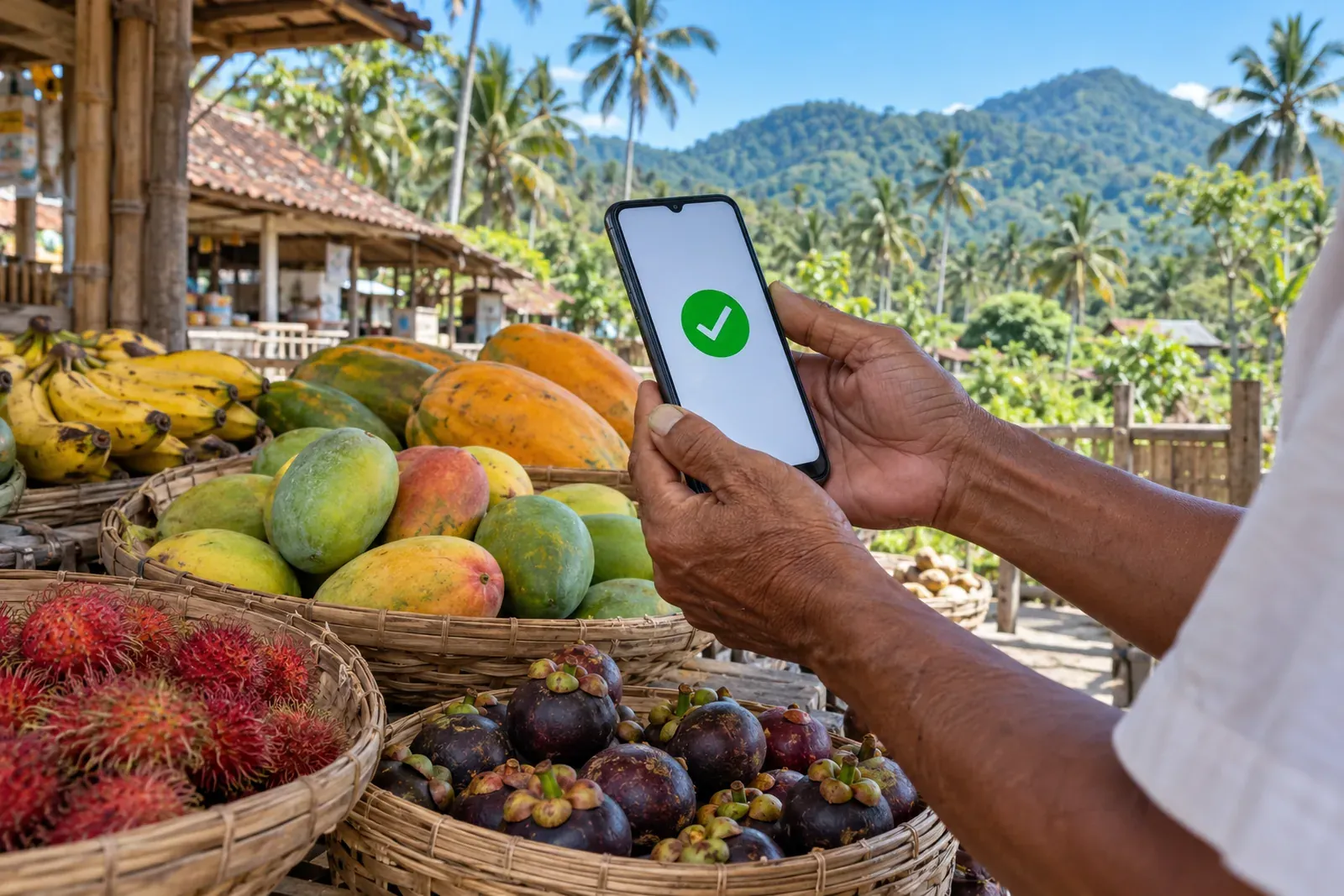
Bank Indonesia QRIS Credit Scoring: What Digital Underwriting Means for Lombok
Bank Indonesia plans to turn QRIS transaction data into formal credit scores for small businesses, unlocking capital across Lombok's expanding hospitality and tourism supply chains.
Quick answer: Bank Indonesia is preparing to convert merchant QRIS payment trails into formal credit scores for micro, small, and medium enterprises. For Lombok investors, this systemic shift promises to formalise local tourism supply chains, ease working-capital bottlenecks for hospitality vendors, and reduce counterparty operational risks across the island's expanding visitor economy.
Financial infrastructure rarely arrives with the fanfare reserved for airport expansions or international motor racing circuits. Yet the announcement by Bank Indonesia that merchant digital transaction records will soon anchor small business credit scoring represents a foundational modernisation of the Indonesian economy. In secondary island markets such as Lombok, where economic activity has long operated in the cash-heavy periphery of formal banking, digital underwriting could permanently reshape operational efficiency.
The Context
Speaking at the Danantara Technology Innovation Investment Forum 2026 in Jakarta, Bank Indonesia Governor Destry Damayanti outlined an ambitious initiative: turning the digital footprints left by merchants on the Quick Response Code Indonesian Standard (QRIS) network into verifiable credit metrics. For years, the structural impediment facing Indonesian micro, small, and medium enterprises (MSMEs) has not been a lack of daily commerce, but a lack of formal accounting records acceptable to commercial bank underwriting committees.
Bank Indonesia data through the third quarter of 2026 highlights the immense scale of this digital adoption. The QRIS network recorded 70.6 million users and 49.4 million registered merchants nationwide. Crucially, 97 percent of those merchants are MSME operators. Transaction volume across the network grew by 75.8 percent year-on-year in the third quarter of 2026, demonstrating that digital payments have penetrated far beyond Tier-1 metropolitan centres into regional economies.
Alongside QRIS, the central bank's national real-time gross settlement infrastructure, BI-FAST, continues to post rapid gains. BI-FAST recorded a transaction volume of 1.631 billion in the third quarter of 2026, marking a 31.78 percent year-on-year expansion. Total transaction value reached Rp 4,049 trillion, representing an increase of 33.91 percent compared to the same quarter of the previous year. Governor Damayanti noted that round-the-clock clearance generates extraordinary economic savings while laying the pipeline for sustainable, inclusive financial access.
Building Working Capital in Secondary Island Economies
To grasp why central bank payment plumbing matters to foreign real estate and hospitality investors, one must examine the microeconomics of tourist destinations undergoing rapid acceleration. Foreign tourist arrivals to Lombok have demonstrated robust momentum, expanding at 40-50 percent year-on-year, propelled by broader regional tourism recovery and the calendar visibility of events at the Mandalika International Circuit.
Yet the commercial ecosystem supporting this influx remains largely informal. A boutique hospitality asset, whether situated along the prime tourist stretch of Kuta or adjacent to the Special Economic Zone in Mandalika, relies on a web of local subcontractors, organic produce farmers, boat captains, maintenance services, and transport providers. Historically, these operators have lacked audited balance sheets, titled collateral, or formal bank credit lines. As a result, sudden seasonal spikes in occupancy or catering demands frequently stretch local suppliers beyond their working capital capacity.
"This is at least an achievement where we give financial access to merchants at the bottom, small merchants too, whose data can later become a kind of credit scoring," noted Bank Indonesia Governor Destry Damayanti.
When transaction histories can be aggregated, verified, and mapped into automated risk profiles, commercial banks and micro-lending institutions can extend unsecured working-capital lines based on proven cash flow rather than physical collateral. For regional suppliers in West Nusa Tenggara, this transition bridges the divide between cash-in-hand survival and sustainable commercial scaling.
 Bank Indonesia QRIS Credit Scoring · Illustration: HubLombok (AI-generated)
Underwriting the Tourism Value Chain: Mandalika and Beyond
Cross-border digital settlement is already establishing deep roots in southern Lombok. Central bank reporting confirmed 200 cross-border QRIS transactions logged directly at the 2026 Mandalika MotoGP, proving that international visitors from partner countries are actively bypassing foreign exchange booths in favour of direct mobile payment. As visitors use QRIS for everything from beachfront warung dining to surf coaching and scooter rentals, the digital trail records authentic velocity in real time.
| Digital Payment Metric (BI Data Q3 2026) | Volume / Scale | Year-on-Year Growth | | :--- | :--- | :--- | | Active QRIS Users | 70.6 million | Robust national base | | Registered QRIS Merchants | 49.4 million | 97% classified as MSMEs | | QRIS Transaction Volume | Multi-billion transactions | +75.8% YoY | | BI-FAST Transaction Volume | 1.631 billion transactions | +31.78% YoY | | BI-FAST Transaction Value | Rp 4,049 trillion | +33.91% YoY |
The integration of QRIS data into credit underwriting creates three distinct operational dividends across the island's hospitality landscape:
- Supply Chain Resilience: Local food and beverage suppliers, linen laundering services, and artisanal maintenance teams can secure inventory loans ahead of peak seasons, mitigating service disruptions for luxury operators.
- Reduced Transaction Friction: Cross-border settlement reduces merchant reliance on physical currency handling and international card processing terminals, which often carry high merchant discount rates and intermittent regional telecom connectivity issues.
- Fiscal Transparency: As informal vendors migrate into the verified merchant ecosystem, municipalities gain clearer transaction visibility, which historically correlates with better public infrastructure planning and utility deployment.
This balance sheet maturation arrives at a crucial juncture for the regional property sector. Prime tourist-zone land in Kuta trades at Rp 300-400 million per are (about USD 18,200-24,200 per are, where 1 are equals 100 square metres), leading the island in liquidity. Meanwhile, land around the Mandalika circuit stands at Rp 100-150 million per are (about USD 6,100-9,100 per are). As land values and villa room rates appreciate (villa rates in Kuta and Mandalika have risen approximately 38 percent year-on-year), the supporting business ecosystem must mature at an equal pace to maintain international hospitality standards.
What This Means for Investors
For foreign capital acquiring or operating hospitality assets in Lombok, the broader macroeconomic implications are constructive. Realistic net rental yields in South Lombok range between 7 and 12 percent, after deducting management fees (typically 18-22 percent of gross rental revenue), online travel agency commissions (15-20 percent), and factoring in stabilised occupancy rates of 55-70 percent across years one to three. Although top-performing assets can reach around 15 percent net, disciplined investors recognise that achieving upper-quartile performance depends directly on the reliability of local supply chains.
When local laundry contractors, seafood purveyors, and logistics operators access structured working capital through automated QRIS scoring, operational volatility falls. Key benefits for property owners include:
- Lower Counterparty Risk: Property managers can contract with local vendors who possess formal banking relationships, ensuring consistent delivery schedules during peak occupancy periods.
- Lower Operational Leakage: Transitioning on-site expenditures from petty cash to direct digital settlement streamlines accounting audits, simplifies compliance, and eliminates cash handling vulnerabilities.
- Support for Stabilised Yields: Operational efficiency cushions net operating margins, protecting the realistic 7-12 percent net yield window against unexpected supply bottlenecks or emergency contractor premiums.
Sophisticated investors monitor monetary infrastructure as closely as municipal roads or airport master plans. Bank Indonesia's plan to weaponise transaction data on behalf of underbanked merchants is not merely a social inclusion agenda. It is a structural catalyst that underpins commercial formality across emerging destinations like Lombok, turning fragmented informal cash flows into a modern, bankable regional economy.
Stay informed: subscribe to the free Lombok Briefing, published twice a month (the 1st and 15th), for market intelligence like this.
How does Bank Indonesia plan to use QRIS data for credit scoring?
Bank Indonesia plans to use digital transaction histories from 49.4 million registered QRIS merchants, 97 percent of whom are small businesses, as verifiable cash flow data. This allows commercial lenders to evaluate creditworthiness and extend working capital without requiring traditional physical collateral.
Why does small merchant credit scoring matter to Lombok property investors?
Hospitality assets rely heavily on local suppliers for maintenance, laundry, and dining provisions. When local vendors secure formal working capital through digital transaction records, supply disruptions decline, operational counterparty risks fall, and property managers can better protect target net rental yields of 7-12 percent.
What is the current scale of QRIS and digital payments in Indonesia?
Through the third quarter of 2026, QRIS reached 70.6 million users and 49.4 million merchants, with transaction volume expanding 75.8 percent year-on-year. In parallel, BI-FAST processed 1.631 billion transactions worth Rp 4,049 trillion, up 33.91 percent in value year-on-year.

The Lombok Buyer's Field Guide
Legal structures ranked by risk, the honest ROI math line by line, all six zones ranked, and the 24-point due-diligence checklist. The whole book, free in your inbox.
See what's inside