Bank Indonesia Targets $55bn in Local Currency Deals as De-Dollarisation Accelerates
Bank Indonesia targets $55bn in local currency settlements in 2026. Discover how reduced dollar reliance and regional payment rails stabilise foreign property investment in Lombok.
Quick answer: Bank Indonesia has set an ambitious target of US$55 billion in local currency transactions for 2026, more than doubling last year's US$25 billion. For international property investors in Lombok, this bilateral settlement push dampens foreign exchange volatility, reduces dollar conversion friction, and establishes more resilient financial rails for cross-border capital deployment across the archipelago.
In a decisive monetary policy dispatch from Jakarta, Bank Indonesia has laid down a clear roadmap to insulate Southeast Asia's largest economy from external currency shocks. Addressing markets on Monday, Governor Destry Damayanti confirmed that the central bank intends to more than double the volume of bilateral trade and investment conducted outside the US dollar sphere within the year. The move marks an aggressive acceleration of Indonesia's de-dollarisation framework, transitioning local currency settlements from an emergency shock absorber into a permanent, structural pillar of national economic architecture.
For foreign investors deploying capital into frontier hospitality and prime property markets such as South Lombok, the strategic implications are immediate. Real estate acquisition and operational asset management in emerging markets invariably carry foreign exchange risk, particularly when cross-border remittances are routed through third-party intermediaries and intermediate dollar conversions. As Bank Indonesia expands direct currency corridors with primary economic partners, the macro backdrop underpinning real asset values in the archipelago is acquiring substantial balance-sheet insulation.
The Context
Bank Indonesia's local currency transaction (LCT) framework is designed to bypass the greenback entirely for bilateral merchandise trade, cross-border services, and direct foreign investment. Governor Damayanti confirmed that transaction values reached approximately US$25 billion last year. The projected surge to US$55 billion in 2026 is anchored by bilateral agreements with six to seven key trading partners, with mainland China acting as a primary operational catalyst.
Under conventional clearing mechanisms, bilateral commerce between Indonesia and its primary Asian trade partners required dual conversions. An offshore investor or trading house exchanged their domestic currency into US dollars before converting those dollars into Indonesian rupiah (Rp). Each leg incurred commercial bank spreads, settlement delays, and exposure to intraday currency volatility. The LCT operational framework establishes direct bilateral conversion rates between Bank Indonesia and partner central banks, cutting out the intermediary dollar clearing leg.
This currency diversification strategy unfolds alongside an equally swift integration of retail cross-border payment architecture. Bank Indonesia's Quick Response Code Indonesian Standard (QRIS) network has already expanded into seven regional nations. International appetite for these integrated channels is broadening quickly. Singapore has registered formal interest in joining the bilateral LCT scheme, while India is actively exploring comprehensive cooperation spanning both local currency settlements and cross-border QRIS interoperability.
Domestically, the QRIS infrastructure has achieved near-ubiquitous penetration. Official central bank data for the third quarter of 2026 reveals that total registered QRIS users reached 70.6 million individuals, supported by a merchant network of 49.4 million vendors. Micro, small, and medium-sized enterprises (MSMEs) account for 97 percent of these registered merchants. Crucially, aggregate QRIS transaction volume expanded by 75.8 percent year on year over the same reporting window, underscoring the velocity of digital transaction adoption across both tier-one commercial capitals and regional tourist provinces.
| Macro Metric | 2025 Historic | 2026 Official Target / Level | Primary Driver | | :--- | :--- | :--- | :--- | | LCT Annual Settlement Volume | ~US$25 billion | US$55 billion | Bilateral accords with 6-7 nations (China leading) | | QRIS Merchant Base | Under 40 million | 49.4 million (97% MSMEs) | Digital integration in regional retail & hospitality | | QRIS Active Consumer Users | ~50 million | 70.6 million | Mobile-first consumer banking adoption | | QRIS Transaction Volume Growth | Baseline | +75.8% YoY (Q3 2026) | Cashless migration across tier-one and regional hubs |
Rupiah Resilience and Frontier Real Estate Fundamentals
The central bank's concerted push towards local currency clearing is primarily conceived as a defence mechanism for the domestic currency. By shifting substantial fractions of import and export settlements away from foreign exchange markets, Bank Indonesia diminishes the structural corporate demand for spot dollars. This structural easing reduces depreciation pressure on the rupiah during periods of global monetary tightening or heightened geopolitical tension.
For real estate capital allocators, currency volatility represents one of the most critical variables governing total return. An investor underwriting a luxury holiday villa in South Lombok must manage currency dynamics on multiple fronts. Property acquisition costs, title registration fees, and professional notary disbursements are executed exclusively in local currency. Similarly, operational holding costs, estate staffing, utility overheads, and annual land and building taxes (PBB) are settled strictly in rupiah.
When a national currency experiences unpredictable, sharp devaluations against the dollar, foreign investors face erratic imported inflation on specialised construction materials and unpredictable operational margins. Conversely, an excessively volatile currency introduces uncertainty into the repatriation of operational profits. Net rental yields, even when performing at an honest 7-12% post-management benchmark, can be distorted if underlying foreign exchange spreads fluctuate violently between guest booking receipts and overseas owner distributions.
By systematically removing billions of dollars in transaction demand from the commercial spot market, Bank Indonesia fosters a far more stable macroeconomic equilibrium. A resilient domestic currency anchors the purchasing power of the domestic workforce, stabilises domestic supply chains, and provides foreign asset managers with a predictable pricing environment across multi-year holding horizons.
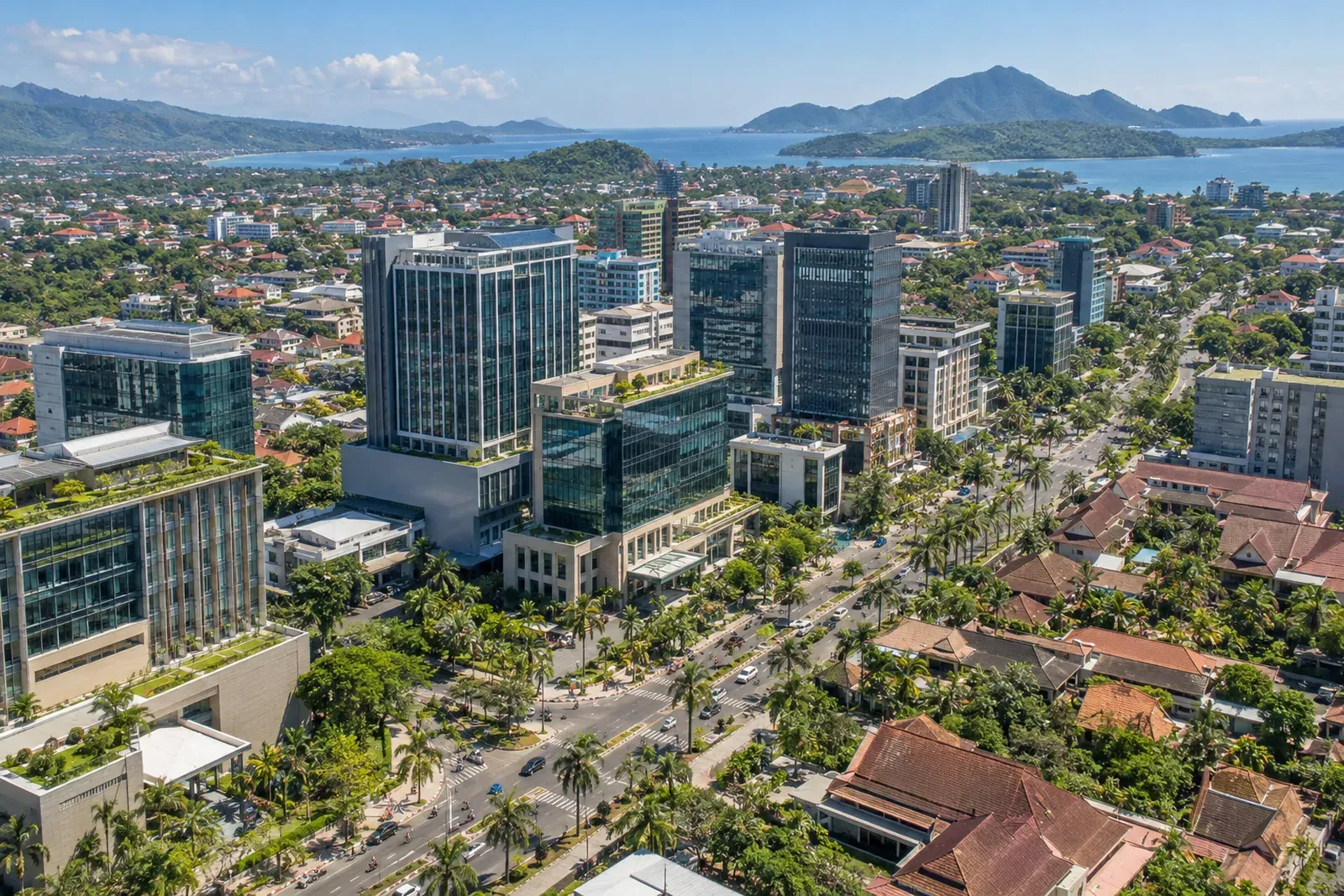
 Bank Indonesia Targets $55bn in Local Currency Deals as De-Dollarisation Accelerates · Illustration: HubLombok (AI-generated)
De-Dollarisation and the Asian Capital Corridor
The composition of Bank Indonesia's bilateral partnerships reveals a significant structural pivot toward intra-Asian liquidity corridors. With mainland China serving as a cornerstone contributor, and both Singapore and India positioning themselves for direct settlement integration, Indonesia is harmonising its banking conduits directly with Asia's most prolific capital exporters.
This shift matches the demographic transformation occurring across Indonesian tourism destinations. Regional visitor inflows to island economies have expanded briskly, with foreign tourist arrivals trending upward by 40-50% year on year across primary resort markets. Notably, an increasing proportion of these visitors and lifestyle investors originate from intra-regional economic powerhouses such as Singapore, Australia, India, and East Asia, rather than legacy long-haul Western European hubs alone.
Direct local currency clearing removes several structural hurdles for regional investors:
- Reduced Foreign Exchange Leakage: Direct conversion mechanisms between partner currencies and the rupiah bypass the double-spread charges levied by international commercial clearing banks.
- Lower Institutional Frictions: PT PMA entities (foreign-owned corporate investment vehicles holding Hak Guna Bangunan titles) can streamline corporate capital injections directly from regional treasury centres.
- Accelerated Settlement Speed: Same-day bilateral central bank clearing reduces settlement risk for major property transaction milestones and notary deposits executed by licensed PPAT desks.
- Sovereign Hedging Alignment: Access to direct currency swaps and local clearing lines allows institutional hospitality groups to hedge operational liabilities without relying on costly dollar-denominated financial instruments.
As Governor Damayanti emphasised during Monday's address, pursuing targeted bilateral agreements has proven to be the most pragmatic and resilient methodology under fluid global economic conditions. Rather than waiting for complex multilateral consensus, Indonesia's sovereign monetary authorities are constructing bespoke, high-volume currency bridges with the counterparties that matter most to real-economy capital flows.
What This Means for Investors
For private investors and family offices assessing Indonesian real estate, macroeconomic policy pronouncements from Jakarta offer invaluable guidance on structural risk. While retail buyers often concentrate solely on local micro-location metrics, institutional capital monitors the broader balance of payments, currency stability, and regulatory security.
The trajectory charted by Bank Indonesia delivers three tangible advantages to property allocators:
First, it lowers friction for capital ingress. Foreign investors acquiring real assets via standard legal mechanisms, such as establishing a foreign-owned investment company (PT PMA) to hold extendable Hak Guna Bangunan (HGB) rights, require transparent banking channels. Working in tandem with independent notary and legal partners such as TerraNusa Advisory, institutional buyers can execute transaction milestones with greater FX efficiency, knowing that sovereign clearing channels minimise remittance bottlenecks.
Second, the rapid scaling of domestic financial technology directly enhances asset yields. The explosive 75.8% annual expansion in QRIS transaction volume, coupled with cross-border linkages spanning seven countries, means hospitality assets can now capture international guest revenue instantaneously. Boutique villa operations and turnkey resorts are able to eliminate expensive merchant processing fees and legacy credit card interchange costs, preserving net operating income across their holiday rental portfolios.
Third, foreign currency diversification fortifies the sovereign credit profile. By insulating the banking system against sudden liquidity shocks in the offshore dollar market, Indonesia protects the legal and financial frameworks that safeguard foreign capital. Investors deploying equity into early-stage, capital-appreciating tourist corridors benefit from an environment where institutional property rights, corporate registry integrity at the land office (BPN), and fiscal assessment processes remain anchored to a mature monetary regime.
Bank Indonesia's ambitious target of US$55 billion in local currency settlements demonstrates that Southeast Asia's powerhouse economy is building permanent fiscal resilience. For long-term real estate investors, a structurally stable currency paired with hyper-efficient digital payment rails provides the exact macroeconomic foundation required to compound real wealth with absolute confidence.
Stay informed: subscribe to the free Lombok Briefing, published twice a month (the 1st and 15th), for market intelligence like this.
What is Bank Indonesia's local currency transaction target for 2026?
Bank Indonesia aims to achieve US$55 billion in bilateral local currency transactions in 2026, more than doubling the approximate US$25 billion recorded last year. The expansion relies on bilateral currency partnerships with six to seven key trading partners, with China serving as a leading contributor.
How does local currency settlement benefit foreign property investors in Indonesia?
By clearing bilateral transactions directly without intermediate conversion into US dollars, foreign investors eliminate dual currency exchange spreads. This mechanism reduces foreign exchange volatility, protects operational rental returns from currency shocks, and speeds up capital deployment for PT PMA entities purchasing real estate assets.
What role does QRIS expansion play in regional hospitality and real estate yields?
With 70.6 million users and cross-border acceptance across seven countries, QRIS enables direct, low-cost retail payments from international visitors. This eliminates heavy credit card interchange fees, directly defending operational net profit margins for boutique hospitality assets and managed villa investments across Indonesia.

The Lombok Buyer's Field Guide
Legal structures ranked by risk, the honest ROI math line by line, all six zones ranked, and the 24-point due-diligence checklist. The whole book, free in your inbox.
See what's inside