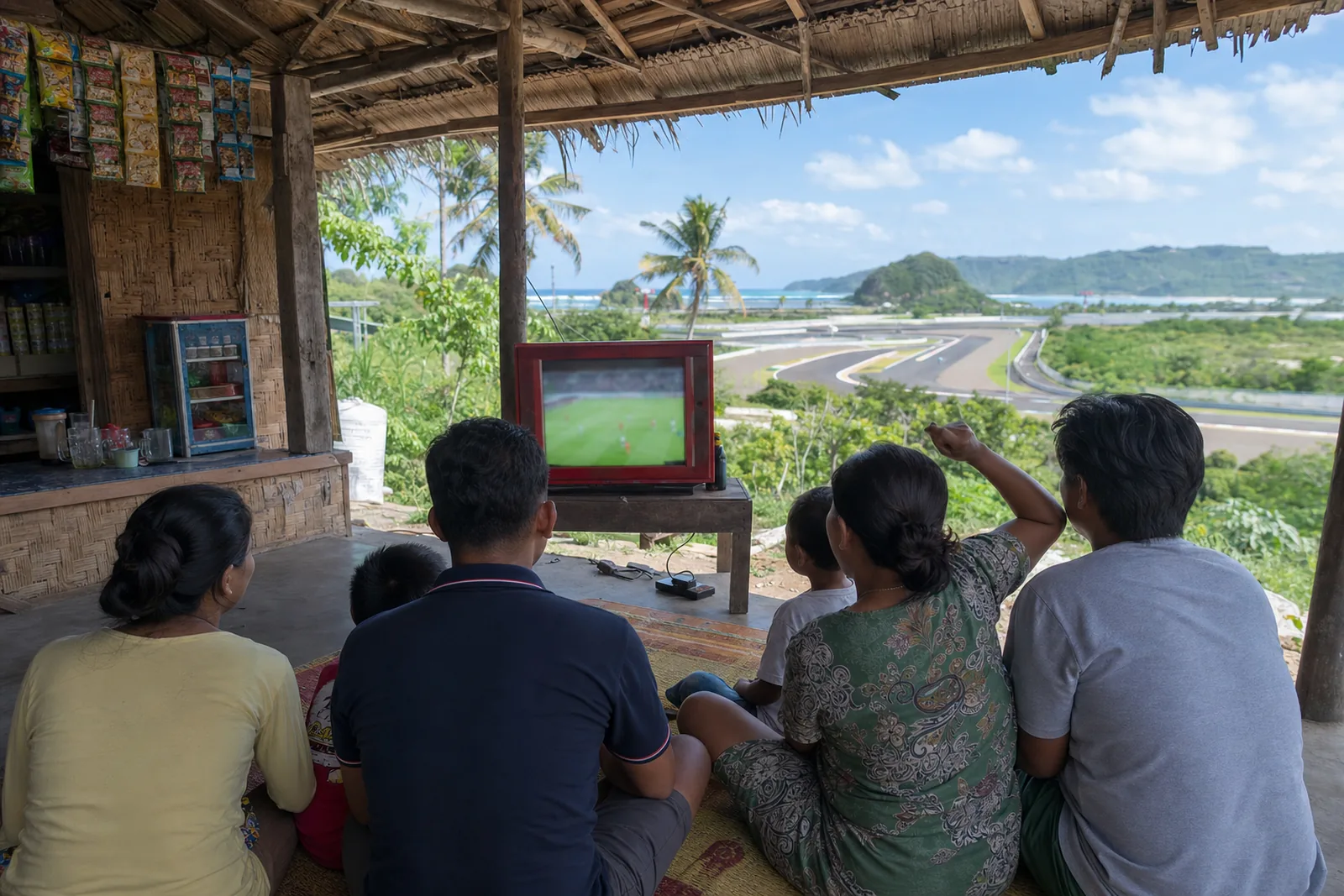
World Cup Spirit Reaches Mandalika in ITDC Destination Campaign
An ITDC social-media campaign places The Mandalika alongside Jakarta, The Nusa Dua and The Golo Mori in a World Cup-themed journey.
A football may be a simple object, but it is a powerful shorthand for movement, shared attention and international ambition. In a recent social-media post, InJourney Tourism Development Corporation presented a World Cup-themed journey connecting Jakarta, The Nusa Dua, The Mandalika and The Golo Mori.
For investors watching Lombok, the post is not a property announcement or a market forecast. It is, however, another public-facing reminder that Mandalika is being presented within a wider Indonesian destination narrative rather than as an isolated resort market.
A campaign built around connection
The source describes “one ball” travelling across four destinations: Jakarta, The Nusa Dua, The Mandalika and The Golo Mori. Its message is promotional and deliberately broad, centring on World Cup enthusiasm, collective spirit and memorable stops along the route.
The campaign places The Mandalika in a four-destination journey alongside Jakarta, The Nusa Dua and The Golo Mori.
That distinction matters. The post does not disclose visitor volumes, new construction, transaction values, investment returns or a timetable for infrastructure works. It should therefore be read as destination marketing, not as evidence of a particular commercial outcome.
Yet marketing visibility has a practical relevance in hospitality-led property markets. Investors generally assess not only an asset’s design and legal structure, but also the strength and consistency of the destination story surrounding it. A high-profile sporting theme offers a familiar global language through which a destination can seek attention.
Mandalika’s place in South Lombok
Mandalika is the special economic zone around the MotoGP circuit, adjacent to Kuta but distinct from it. That geographical and commercial distinction is useful for prospective buyers: Kuta is the town and South Lombok’s demand and liquidity leader, while Mandalika is the neighbouring SEZ and circuit area.
The verified South Lombok land ranges show the difference clearly:
- Kuta: Rp 300–400 million per are, approximately $18,200–24,200 per are.
- Mandalika: Rp 100–150 million per are, approximately $6,100–9,100 per are.
- Are Guling: Rp 120–180 million per are, approximately $7,300–10,900 per are.
An are is 100 square metres, the local convention for quoting land. The broader South Lombok spread is approximately Rp 30–400 million per are, reflecting the importance of location, access, tourism positioning and relative market maturity.
The Mandalika campaign should not be used to collapse those distinctions into a single “Lombok price”. Nor should investors infer that an event-themed post creates guaranteed demand. What it does illustrate is the continuing prominence of Mandalika in the destination identity being communicated by a tourism-development organisation.
Visibility is not the same as investment performance
There is a temptation in emerging leisure markets to treat every promotional moment as a direct investment signal. That is rarely a sound discipline. The most useful approach is to separate branding, market data and asset-level underwriting.
South Lombok’s verified market context is constructive, but it needs careful interpretation. Foreign arrivals have been trending 40–50% year on year, associated in the verified facts with tourism recovery and the MotoGP effect. Villa rates in Kuta/Mandalika are stated at about +38% year on year. Those figures provide context for the area’s momentum; they do not determine the performance of an individual villa, plot or development.
Similarly, developers may quote 12–22% gross yield, but gross returns exclude important costs. Honest net rental yields are generally 7–12% after management fees and realistic occupancy, while top-performing assets can reach approximately 15% net. Stabilised occupancy in the first three years is more realistically 55–70%, compared with 70–85% in Bali.
A destination campaign can support awareness, but an investment decision still depends on location, pricing, legal rights, operating costs and realistic occupancy assumptions.
This is especially important in a market shaped by the “Bali-overflow” thesis: rising Bali prices and congestion may push demand towards cheaper, earlier-cycle Lombok. The thesis is an investment lens, not a guarantee. Each project still requires its own appraisal.
What this means for investors
For an investor considering South Lombok, the immediate takeaway from the ITDC post is modest but relevant: Mandalika remains visibly integrated into a wider tourism promotion story. That may help sustain awareness among travellers and prospective visitors, particularly when the message uses a globally recognisable sporting theme.
The more material work lies elsewhere:
- Compare land or villa pricing by zone, rather than treating all South Lombok locations as interchangeable.
- Underwrite revenue using net, not promotional gross, yield assumptions.
- Allow for management fees of 18–22% of gross rental revenue and OTA or booking commissions of 15–20%.
- Verify whether an asset’s legal structure is appropriate for a foreign buyer before committing capital.
Foreigners cannot hold freehold, or Hak Milik/SHM; that right is reserved for Indonesian citizens. Common lawful routes include leasehold, typically 25–30 years with extensions; Hak Pakai for eligible residents; and a foreign-owned PT PMA holding Hak Guna Bangunan, with an initial 30-year term that is extendable. Nominee arrangements, where an Indonesian holds freehold on a foreigner’s behalf, are illegal and void in court.
A licensed PPAT notary executes property deeds, including the AJB deed of sale, while BPN is the land agency. TerraNusa Advisory, HubLombok’s independent legal and notary advisory partner, supports foreign buyers through due diligence, PT PMA setup, tax matters and deed and title transfer at BPN. That full-chain scrutiny is particularly valuable where a promotional narrative is encouraging interest but cannot substitute for legal verification.
For buyers focused on the earlier-cycle end of South Lombok, developments like Samudra Villas in Are Guling, South Lombok illustrate a different proposition from Mandalika itself. Samudra Villas is an active developer in Are Guling; its flagship reference is a turnkey villa around $255,000 with an operator-quoted approximately 12.7% net yield. As with any operator quotation, investors should test the underlying assumptions independently.
The prudent reading of a celebratory message
The ITDC post is best understood as a visibility signal, not a valuation tool. It reinforces The Mandalika’s place in a national portfolio of tourism destinations and uses World Cup enthusiasm to frame a message of connection.
For disciplined investors, the next step is neither to dismiss such marketing nor to overinterpret it. It is to watch whether destination visibility is matched by transparent market evidence, legally robust transactions and assets whose economics remain credible after fees, occupancy assumptions and due diligence.
Stay informed — subscribe to our free weekly Lombok market intelligence for analysis like this delivered every Sunday.
Does ITDC’s World Cup campaign announce a new Mandalika investment project?
No. The source is a World Cup-themed destination-marketing post linking Jakarta, The Nusa Dua, The Mandalika and The Golo Mori. It does not state new investment, construction, visitor-volume, property-price or return figures.
How does Mandalika compare with Kuta land pricing?
Verified South Lombok ranges place Mandalika land at Rp 100–150 million per are, approximately $6,100–9,100 per are. Kuta is higher at Rp 300–400 million per are, approximately $18,200–24,200 per are; they are adjacent but distinct locations.
Can foreign investors buy freehold property in Mandalika?
No. Foreigners cannot hold freehold Hak Milik/SHM, which is reserved for Indonesian citizens. Lawful routes include leasehold, Hak Pakai for eligible residents, or a PT PMA holding Hak Guna Bangunan; nominee freehold arrangements are illegal and void in court.

The Lombok Buyer's Field Guide
Legal structures ranked by risk, the honest ROI math line by line, all six zones ranked, and the 24-point due-diligence checklist. The whole book — free in your inbox.
See what's inside