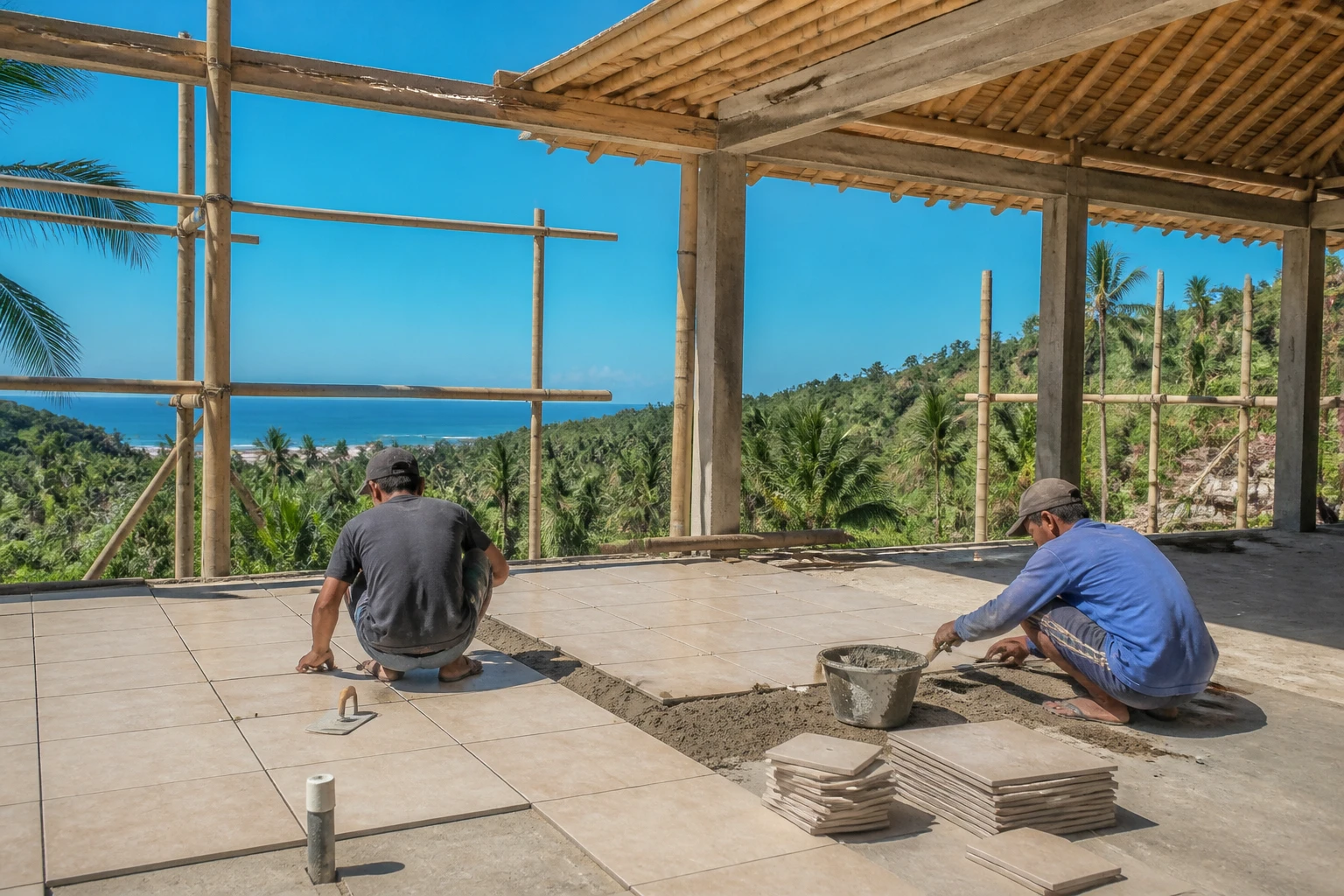
Building a Villa for the Wellness and Retreat Market in Lombok
Retreat-spec villas in South Lombok command premium nightly rates from yoga, wellness and digital-detox operators who need yoga shalas, multiple ensuite rooms and genuine quiet. With gross yields reaching 12-22% on well-specified assets and foreign arrivals rising 40-50% year on year, the demand cas
Quick answer: Retreat-spec villas in South Lombok command premium nightly rates from yoga, wellness and digital-detox operators who need yoga shalas, multiple ensuite rooms and genuine quiet. With gross yields reaching 12-22% on well-specified assets and foreign arrivals rising 40-50% year on year, the demand case is stronger than for standard short-let villas.
Why Wellness Tourism Favours Lombok Right Now
Wellness tourism, which covers yoga retreats, meditation programmes, detox weeks and spa-focused itineraries, has recovered sharply since 2022 and is now one of the fastest-growing segments in global travel. Lombok benefits from a structural tailwind: as Bali's southern coast grows more congested and expensive, retreat organisers are actively scouting neighbouring islands for quieter, more affordable venues where participants can actually disconnect.
Foreign arrivals to South Lombok have risen 40-50% year on year, and Kuta and the Mandalika area alone have seen villa rates climb around 38% over the same period. That momentum rewards developers who position ahead of demand rather than following it. Zones such as Are Guling, recording the strongest land-price momentum of the six main zones at around 47% year on year, sit close to quiet beaches and rice-field backdrops that retreat operators consistently describe as essential to their product.
For a broader look at how tourism growth translates into investment returns, see our guide to Lombok ROI maths.
What Retreat Operators Actually Require
A retreat operator booking a full-site buyout for 10-16 guests carries a very different checklist from a couple renting a two-bedroom villa for a week. Get the specification right and you attract long-stay, high-revenue tenants who often book three to six months ahead. Get it wrong and you compete on price in the mid-market.
The non-negotiable features retreat operators request most consistently are as follows.
Yoga shala. An open-air, roofed practice platform of at least 60-80 square metres, with a smooth or sprung hardwood floor, facing east for morning light and positioned away from road or generator noise. This single feature filters a property into a much smaller supply pool.
Bedroom count and privacy. Retreats typically run on 8-16 participants plus one or two facilitators. Villas with six to ten ensuite bedrooms, each with its own terrace or garden access, allow the operator to sell individual rooms rather than whole-house blocks, which is a fundamentally different revenue model.
Quiet location. This is harder to specify in a floor plan but easy to lose. A site more than 400 metres from a main road, with mature tropical planting or a rice-field buffer, commands a meaningful premium with retreat buyers.
Treatment rooms and communal kitchen. A dedicated room for massage and bodywork, plus a large kitchen where a private chef can cook for groups, are increasingly standard requirements. Retreat participants expect both.
Outdoor flow. Covered walkways between buildings, a joglo dining pavilion and a pool positioned so it does not intrude on the shala are design details that experienced operators notice immediately.
See wellness retreat tourism and Lombok property for a broader look at the demand pipeline driving this segment.
The Build Specification: What Costs More and Why
A retreat-grade villa costs more per square metre to build than a standard short-let property. The premium comes from structural span (open shalas need large roof systems), premium-grade teak or reclaimed timber, bespoke outdoor bathrooms, and the acoustic and landscaping work required to achieve genuine quiet on site.
Turnkey investment-grade villas in South Lombok range from roughly EUR 95,000 to EUR 350,000. A retreat-configured property with six or more rooms, a yoga shala and a treatment room will typically sit in the upper half of that range or above, depending on land cost and finish level.
Land in Are Guling runs Rp 120-180 million per are (roughly $7,300-10,900 per are), which keeps total land-plus-build costs materially below comparable projects in Bali, where land alone often sits at USD 200-500 per square metre. Our article on villa construction costs in Lombok breaks down the build-cost components in more detail.
Financial Case: Yield and Occupancy at Retreat Standard
A well-specified retreat villa that attracts operators on six-night buyouts earns revenue in a fundamentally different way from a standard rental. Instead of booking individual rooms through OTA platforms at 15-20% commission, the operator pays a whole-site rate and handles their own guests. That collapses distribution costs and, when the calendar fills, can push net yields toward the upper end of the honest 7-12% range. Top-performing assets in South Lombok can reach around 15% net.
Stabilised occupancy across South Lombok investment property runs 55-70% in years one to three. A retreat villa targeting four to six operator bookings per month sits at the achievable end of that range in the first season, then builds on word-of-mouth and repeat bookings. Management fees of 18-22% of gross revenue still apply unless the owner self-manages the operator relationships directly.
Samudra Villas, whose turnkey villa in Are Guling sits around USD 255,000, is one of the active developers in this zone. HubLombok is the editorial arm of Samudra Villas, and we disclose that relationship on every article where it is relevant.
Practical Guidance for Retreat Developers
A few principles worth carrying into any retreat-build project.
Orient the yoga shala first, then place the bedrooms around it. Noise, light and wind direction should drive the site plan before the architect draws a single wall.
Budget acoustic and landscaping work as a fixed line item, not an afterthought. Mature tropical planting takes two to three years to establish, so fast-growing species planted at the start of construction will be ready by opening day.
Visit three or four active retreat venues before briefing your architect. The operational logic, from laundry flow to chef access to facilitator accommodation, is invisible on paper but obvious on site.
Verify zoning permits retreat or hospitality use before purchase. Not all residential plots allow commercial group accommodation, and the PPAT notary and land office (BPN) check is the moment to confirm it.
Work with a legal desk that handles the full chain. Most notaries execute the deed and nothing else. An advisory partner such as TerraNusa Advisory runs the ownership-history, zoning and encumbrance checks that protect a retreat asset, which typically carries a long-term lease or PT PMA structure. That due diligence is not optional at this price point.
What design features do retreat operators require in a Lombok villa?
Retreat operators consistently look for a dedicated yoga shala of at least 60-80 square metres with a hardwood floor and east-facing orientation, six to ten ensuite bedrooms with private outdoor access, a quiet location away from main roads, a treatment room for bodywork and a large communal kitchen. Covered outdoor walkways and a pool positioned away from the shala are also standard expectations.
What yields can a retreat-spec villa in South Lombok realistically achieve?
Developer-quoted gross yields in South Lombok run 12-22%, while honest net yields after management fees (18-22% of gross) and realistic occupancy (55-70% in years one to three) are 7-12%, with top-performing assets reaching around 15% net. A retreat villa that attracts operator buyouts on six-night blocks can approach the upper end of that net range once occupancy stabilises.
Which South Lombok zone suits a wellness retreat development?
Are Guling stands out for retreat development: it carries the strongest land-price momentum of the six main zones at around 47% year on year, land prices of Rp 120-180 million per are (roughly $7,300-10,900 per are), and the quiet inland and beach settings retreat operators require. Kuta and Selong Belanak offer strong demand but at higher land costs, with Kuta land running Rp 300-400 million per are.

The Lombok Buyer's Field Guide
Legal structures ranked by risk, the honest ROI math line by line, all six zones ranked, and the 24-point due-diligence checklist. The whole book, free in your inbox.
See what's inside