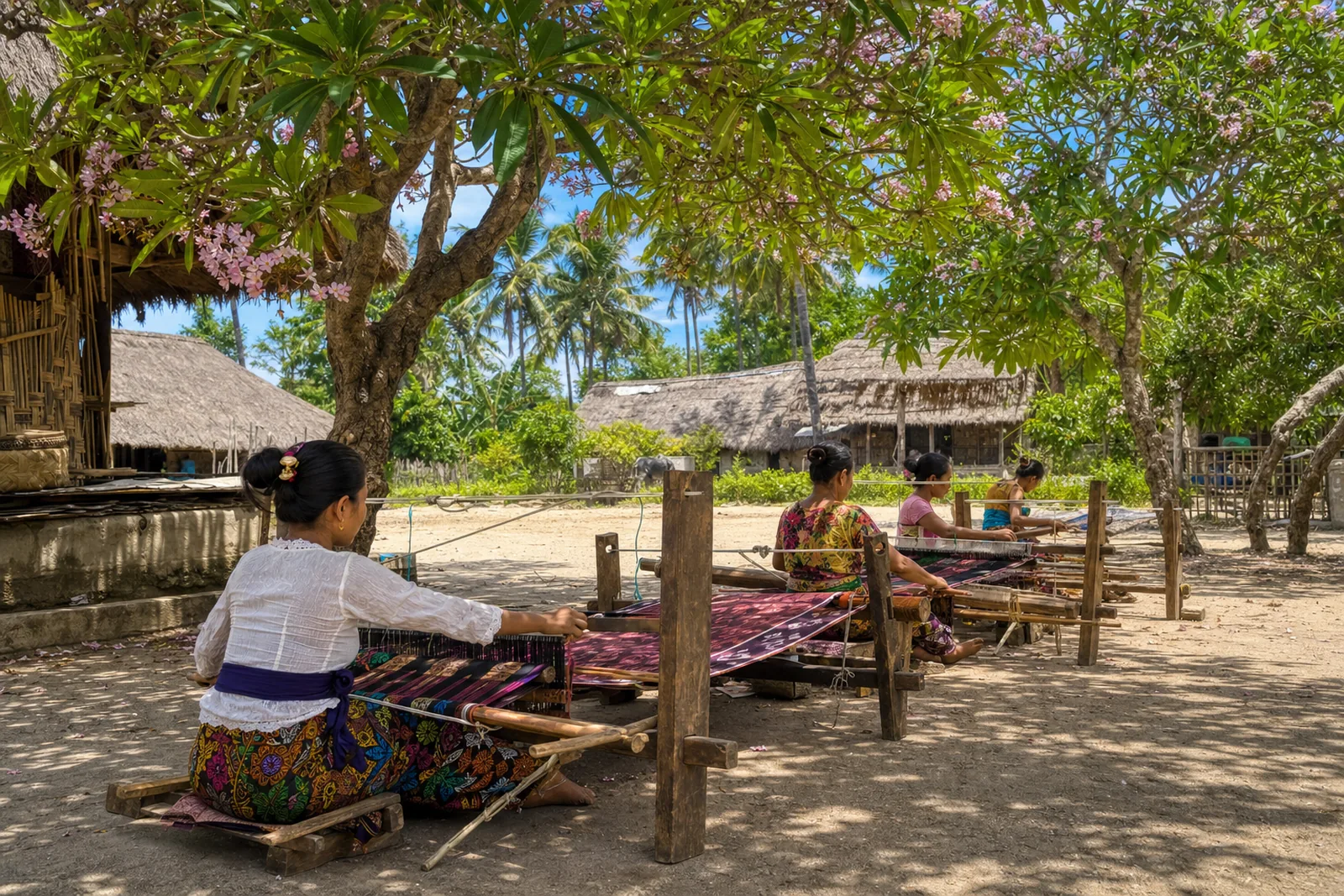
Sukarare Festival Puts Sasak Weaving and Ngendang Back in Focus
A July festival celebrates Sukarare weaving and the revival of Ngendang, a Sasak tradition of collective participation.
The beauty of Sukarare weaving carries a deeper story: a Sasak cultural inheritance maintained across generations. A festival beginning on 7 July 2026 places that inheritance in public view, pairing the region’s renowned textile tradition with the revival of Ngendang.
A living inheritance in Sukarare
According to Official Instagram communications from Go Mandalika / Dispar Lombok Tengah, the Festival Sukarare Begawe Jelo Nyesek is intended to bring several traditions back to life. Its central cultural setting is Sukarare weaving, presented not simply as an attractive craft but as a heritage preserved from one generation to the next.
That framing matters. Visitors often encounter a textile first through its visual appeal—its colour, pattern and apparent workmanship. The source instead directs attention to continuity: the cultural knowledge, communal memory and inherited traditions behind the finished fabric.
Key date: Festival Sukarare Begawe Jelo Nyesek began on 7 July 2026.
For Lombok’s tourism story, this is an important distinction. A destination’s appeal is not confined to beaches, accommodation or headline events. Cultural traditions can offer visitors a more grounded way to understand the island, provided they are approached as living practices rather than as mere scenery.
Ngendang returns as a tradition of togetherness
One of the traditions highlighted by the festival is Ngendang. The source describes it as a tradition of togetherness that had once nearly disappeared and is now re-emerging through cultural preservation efforts.
The emphasis on collective participation gives Ngendang a particular resonance. In an era when travel can be reduced to a sequence of shareable images, communal traditions offer a different kind of encounter: one centred on participation, recognition and the continuity of local practice.
The festival’s message is therefore not only celebratory. It is also protective. By bringing Ngendang into the programme, organisers are signalling that preservation requires visibility and renewal, especially for traditions that have faced the risk of fading from public life.
More than a visual attraction
Sukarare’s weaving is the immediate draw, but the official message places it within a broader Sasak cultural context. It invites people to come, learn more closely about local traditions and help keep ancestral heritage alive for future generations.
That invitation asks for a more attentive form of tourism. For visitors, it means recognising that cultural heritage has value beyond an itinerary. For businesses serving travellers, it suggests the importance of presenting local traditions with care, accurate attribution and respect for the communities that sustain them.
A useful distinction for visitors is between the two cultural elements foregrounded by the festival:
- Sukarare weaving: a Sasak heritage expressed through textiles and preserved across generations.
- Ngendang: a tradition of togetherness that, according to the source, was once close to disappearing and is now being revived.
Neither should be treated as interchangeable. Together, however, they show how tangible craft and communal practice can sit within the same wider cultural inheritance.
What this means for investors
Investors assessing Lombok’s tourism economy should read cultural programming with discipline. A festival announcement is not evidence of visitor volumes, revenue growth or investment returns, and none should be inferred from this source. It does, however, identify the kind of destination narrative local tourism communications are choosing to foreground: Sasak heritage, intergenerational preservation and participation in local traditions.
For hospitality, retail and experience-led businesses, the practical implication is qualitative rather than financial. Operators that engage with local culture should do so through credible local relationships and accurate storytelling, rather than using heritage as generic decoration. Authenticity is not a marketing asset that can simply be imported; it depends on the people and traditions being represented.
Prospective investors should also separate cultural relevance from commercial assumptions. Due diligence on any Lombok opportunity still requires its own assessment of legal structure, operating model, costs and demand. The festival is a useful signal of cultural activity, not a substitute for that work.
A festival with a longer horizon
The Festival Sukarare Begawe Jelo Nyesek presents preservation as an active process. By highlighting weaving alongside Ngendang, Go Mandalika / Dispar Lombok Tengah is drawing attention to traditions that are sustained when people encounter, value and carry them forward.
As Lombok continues to welcome visitors seeking a richer connection with the island, the most enduring stories may be those that leave room for Sasak culture to speak in its own terms.
Stay informed — subscribe to our free weekly Lombok market intelligence for analysis like this delivered every Sunday.
What is the Festival Sukarare Begawe Jelo Nyesek?
Festival Sukarare Begawe Jelo Nyesek is a cultural festival that began on 7 July 2026. Official Go Mandalika / Dispar Lombok Tengah communications say it brings several traditions into focus, including Sukarare weaving and the revived Sasak tradition of Ngendang.
What is Ngendang in the context of this festival?
Ngendang is described by the official source as a Sasak tradition of togetherness. It had once nearly disappeared, according to that source, and is now being revived as part of wider efforts to preserve Lombok’s cultural heritage for future generations.
Does this festival indicate tourism investment returns in Lombok?
No. The festival announcement identifies cultural programming and preservation priorities, but it does not provide visitor, revenue, occupancy or investment-return figures. Investors should treat it as cultural context and conduct separate legal, commercial and operating due diligence for any opportunity.
The Lombok Buyer's Field Guide
Legal structures ranked by risk, the honest ROI math line by line, all six zones ranked, and the 24-point due-diligence checklist. The whole book — free in your inbox.
See what's inside