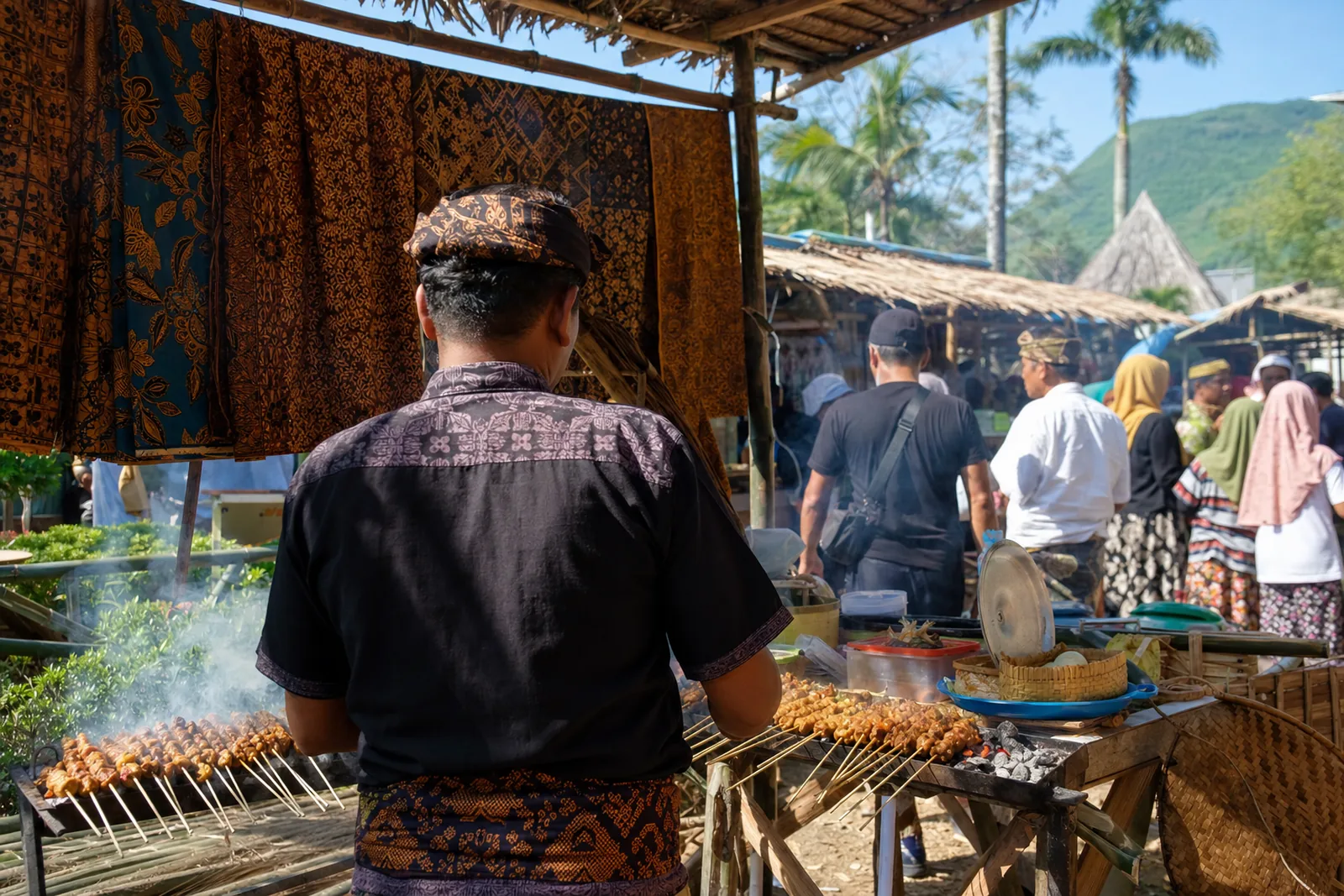
Mandalika Street Food Festival Puts Local Flavour Centre Stage
A free-entry food, music and community festival was scheduled for Mandalika, underlining the destination’s widening visitor offer.
The Mandalika Street Food Festival was scheduled to bring food, music, coffee and community activity to Bazaar Mandalika from 10–12 July 2026. Promoted by the Official Facebook account of Dinas Pariwisata NTB, the free-entry event positioned local culinary discovery alongside a broader family-friendly visitor experience.
For investors following South Lombok, the announcement is a useful reminder that a destination is built not only through accommodation and beaches, but also through reasons for visitors to linger, explore and return. An event listing alone is not evidence of rental performance, but it is part of the evolving tourism proposition around Mandalika.
A food-led programme in Mandalika
According to Dinas Pariwisata NTB’s promotion, the festival was to take place at Bazaar Mandalika over three days, with free entry. The programme was described as combining legendary and viral culinary offerings with live music, coffee and community activity, a children’s zone and a pop-up market.
That mix matters because it broadens the occasion beyond a conventional food market. The source presents the festival as an event for families, friends and community groups, with food operating as the central attraction but not the only one.
Event details announced by Dinas Pariwisata NTB: Mandalika Street Food Festival, Bazaar Mandalika, 10–12 July 2026, free entry.
The public-facing message is emphatically experiential: eat, explore and celebrate. For a tourism destination, such programming can help give travellers an additional reason to spend time locally rather than treating an area solely as a stop between hotel, beach and airport.
Mandalika’s role in the South Lombok visitor economy
Mandalika is the special economic zone around the MotoGP circuit, while Kuta is the adjacent town; they are separate places. Both sit within the wider South Lombok market watched by hospitality and property investors.
The verified market backdrop is one of recovery and growing attention. Foreign arrivals have been trending 40–50% year on year, attributed in the market data to tourism recovery and the MotoGP effect. That trend does not establish the financial outcome of any individual event, villa or development. It does, however, provide context for why local authorities and tourism businesses are investing attention in experiences that supplement the area’s core natural attractions.
Mandalika land is quoted at Rp 100–150 million per are, approximately $6,100–9,100 per are. The range is below Kuta’s Rp 300–400 million per are, approximately $18,200–24,200 per are, illustrating the differing market positions within a relatively compact destination.
- Mandalika: an SEZ around the MotoGP circuit, with quoted land at Rp 100–150 million per are.
- Kuta: the town and South Lombok’s demand and liquidity leader, with quoted land at Rp 300–400 million per are.
- Are Guling: an early-cycle frontier, quoted at Rp 120–180 million per are and showing about +47% year-on-year momentum in the verified market data.
Events are a signal, not an underwriting model
A street-food festival should be read with appropriate discipline. A social-media announcement can show the type of visitor experience being promoted; it cannot demonstrate visitor numbers, spending, occupancy, or future rental income. None of those figures is supplied in the source announcement.
For property buyers, that distinction is particularly important in a market where promotional yield figures can obscure the costs of operating accommodation. Developer-quoted gross yields of 12–22% exclude costs, while honest net rental yields are stated at 7–12% after management fees and realistic occupancy. Top-performing assets can reach around 15% net, but that is not a base case.
Management fees are typically 18–22% of gross rental revenue, while OTA and booking commissions are typically 15–20%. Realistic stabilised occupancy in the first three years is 55–70%. These are the numbers against which an investor should assess any hospitality investment thesis, rather than extrapolating from the presence of a single festival.
What this means for investors
The practical takeaway is constructive but measured. Mandalika’s food festival adds to the destination narrative at a time when South Lombok is seeking more varied visitor experiences. For investors, it is best treated as qualitative market intelligence rather than a performance forecast.
A sensible review should include:
- whether a property’s location benefits from the wider Mandalika and Kuta visitor ecosystem;
- whether projected income uses realistic occupancy, management and booking costs;
- whether the asset is positioned for the visitor profile it seeks to serve;
- whether the buyer has selected a lawful ownership structure and completed full due diligence.
Foreigners cannot hold freehold Hak Milik, or SHM; it is reserved for Indonesian citizens. Available routes include leasehold, Hak Pakai for eligible residents, and a PT PMA holding HGB. Nominee arrangements, in which an Indonesian party holds freehold on a foreign buyer’s behalf, are illegal and void in court.
Due diligence should cover the relevant land certificate, ownership history, zoning and encumbrances, alongside taxes and the transfer process. TerraNusa Advisory is HubLombok’s independent licensed-notary and legal advisory partner for foreign buyers in Lombok, covering this chain from due diligence through company setup where relevant and title transfer at BPN.
HubLombok is the editorial arm of Samudra Villas, an active developer in Are Guling, South Lombok. That disclosure is relevant whenever readers consider the wider South Lombok property market and developments like Samudra Villas in Are Guling, South Lombok.
The wider investment question is therefore not whether one festival changes values overnight. It is whether a growing calendar of local experiences, together with the area’s tourism recovery, strengthens the long-term appeal of South Lombok for the right type of visitor and appropriately underwritten hospitality asset.
Stay informed — subscribe to our free weekly Lombok market intelligence for analysis like this delivered every Sunday.
When and where was the Mandalika Street Food Festival scheduled?
Dinas Pariwisata NTB promoted the Mandalika Street Food Festival for 10–12 July 2026 at Bazaar Mandalika. The announcement stated that entry was free and that the programme would include culinary offerings, live music, coffee and community activity, a children’s zone and a pop-up market.
Does the festival prove rental income potential in Mandalika?
No. The festival announcement describes an event and does not provide visitor, spending, occupancy or rental-income data. Investors should assess accommodation using realistic stabilised occupancy of 55–70%, management fees of 18–22% of gross rental revenue and OTA commissions of 15–20%.
Can a foreign investor buy freehold property in Mandalika?
No. Foreigners cannot hold freehold Hak Milik or SHM, which is reserved for Indonesian citizens. Lawful routes include leasehold, Hak Pakai for eligible residents, and a PT PMA holding HGB. Nominee structures are illegal and void in court.
The Lombok Buyer's Field Guide
Legal structures ranked by risk, the honest ROI math line by line, all six zones ranked, and the 24-point due-diligence checklist. The whole book — free in your inbox.
See what's inside