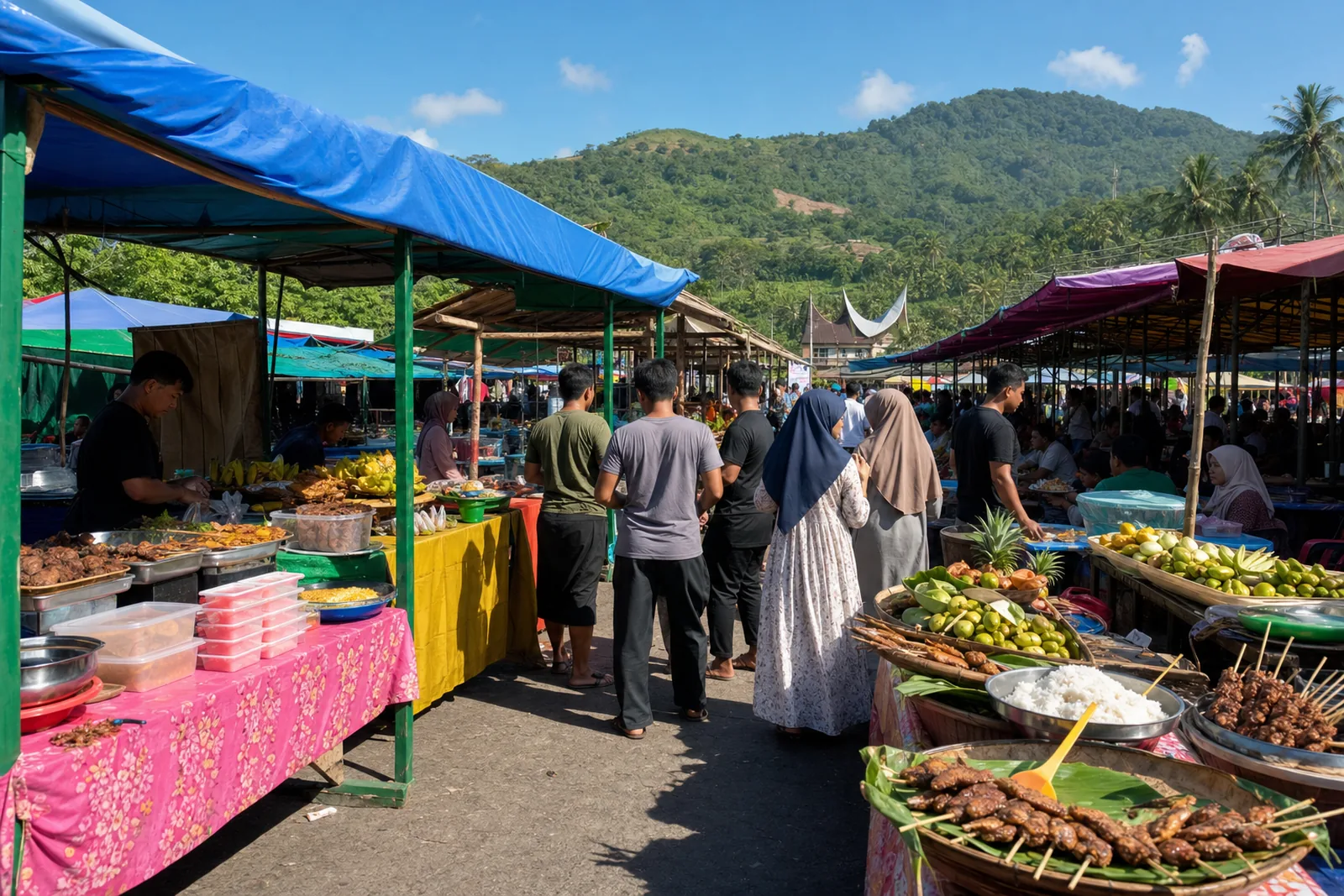
Mandalika Street Food Festival Puts Local Culture on the Visitor Agenda
An official tourism post promoted Mandalika’s free-entry street-food festival, combining culinary stalls, music and community programming.
The Mandalika Street Food Festival was promoted by the Official Facebook account of Dinas Pariwisata NTB as a free-entry gathering centred on food, music and community activity. Scheduled for 10–12 July 2026 at Bazaar Mandalika, the programme offers a useful reminder that destination appeal is built not only through property and infrastructure, but also through reasons for visitors to spend time locally.
For investors assessing South Lombok, such programming should be read with discipline. A festival announcement is not evidence of rental performance or a guarantee of future visitor demand. It is, however, part of the wider visitor proposition that operators and property owners must understand: a destination needs places to stay, but it also needs experiences that make a stay feel purposeful.
A free-entry programme with a broad audience
According to the tourism office’s post, the festival brings together a range of established and viral culinary offerings, live music, coffee and community activity, a children’s zone and a pop-up market. The invitation is explicitly social and family-oriented, encouraging visitors to attend with family, friends and wider social circles.
Mandalika Street Food Festival
Venue: Bazaar Mandalika
Dates: 10–12 July 2026
Entry: Free
That combination matters because it presents the event as more than a narrowly defined food market. The stated programme spans dining, entertainment, retail-style pop-ups and family activity. For a tourism destination, such a mix can broaden the appeal of a visit across different travel groups without requiring investors to assume that every attendee is a high-spending guest.
The official post’s language is promotional, describing “good food”, “great vibes” and “unforgettable moments”. Those are the tourism office’s own characterisations, rather than independently measured outcomes. The more useful investment observation is simpler: the festival’s design seeks to create an accessible shared experience around Mandalika.
Mandalika’s place in the South Lombok map
Mandalika is the special economic zone around the MotoGP circuit, while Kuta is the adjacent town; they are separate places. For property analysis, that distinction is important. A Mandalika event may support the broader South Lombok visitor story, but it should not be used to blur the different land markets, pricing and investment cases across nearby zones.
Authoritative South Lombok land ranges place Mandalika at Rp 100–150 million per are, approximately $6,100–9,100 per are at around Rp 16,500 to the US dollar. One are equals 100 square metres. Kuta, by contrast, is priced at Rp 300–400 million per are, approximately $18,200–24,200 per are, and is identified as the demand and liquidity leader.
- Mandalika: Rp 100–150 million per are, or roughly $6,100–9,100 per are.
- Kuta: Rp 300–400 million per are, or roughly $18,200–24,200 per are.
- Are Guling: Rp 120–180 million per are, or roughly $7,300–10,900 per are.
These figures do not make one location automatically preferable to another. They instead underline why investors should match a property decision to a clearly defined location, access pattern and target guest. An event held in Mandalika may be relevant to a villa in the surrounding South Lombok market, yet it does not erase the practical differences between the zones.
Experiences are part of the accommodation equation
A villa investment is ultimately exposed to its operating reality. South Lombok’s realistic stabilised occupancy in years one to three is 55–70%, compared with 70–85% in Bali. Honest net rental yields are generally 7–12% after management fees and realistic occupancy, while top-performing assets can reach around 15% net.
Those distinctions are particularly relevant when an event is used in marketing material. Developers may quote gross yields of 12–22%, but gross returns exclude costs including management and booking commissions. Management fees are typically 18–22% of gross rental revenue, while OTA and booking commissions are typically 15–20%.
A street-food festival cannot, on its own, resolve those operating costs or occupancy assumptions. Nor does the official announcement provide attendance, spending or accommodation data. Investors should therefore avoid converting a cultural calendar item into a revenue forecast.
Still, a destination with public-facing food, music, coffee, children’s and pop-up-market activity gives guests an additional reason to explore beyond their accommodation. This is especially relevant for family and group travel, which the festival’s own invitation directly addresses. The investment value lies in the cumulative visitor experience, not in a single promotional weekend.
What this means for investors
The prudent conclusion is constructive but measured. Mandalika’s festival programme is a positive illustration of local destination activity, not a substitute for underwriting.
Investors considering South Lombok should separate three questions:
- Is the property in the right zone for the intended guest and stay pattern?
- Are projected returns expressed as gross or as net income after realistic costs?
- Does the area offer enough experiences to complement the accommodation proposition?
The first two questions require property-specific evidence. The third can be informed by official programming such as the Mandalika Street Food Festival, alongside the broader visitor environment. South Lombok foreign arrivals are reported to be up 40–50% year on year, while Kuta/Mandalika villa rates are about 38% higher year on year. These are market-context indicators, not guarantees for an individual asset.
For investors looking beyond the immediate Mandalika area, developments like Samudra Villas in Are Guling, South Lombok sit within a different zone and should be assessed on their own land, operating and legal fundamentals. HubLombok is the editorial arm of Samudra Villas, an active developer in Are Guling.
The festival’s underlying message is straightforward: Mandalika is being presented as a place to eat, explore and gather. For investors, the more enduring task is to judge whether that evolving destination character is being translated into a property proposition with realistic assumptions and a clearly understood location.
Stay informed — subscribe to our free weekly Lombok market intelligence for analysis like this delivered every Sunday.
When and where was the Mandalika Street Food Festival scheduled?
The Official Facebook account of Dinas Pariwisata NTB promoted the Mandalika Street Food Festival for 10–12 July 2026 at Bazaar Mandalika. The post stated that entry was free and listed food, live music, coffee and community activity, a children’s zone and a pop-up market.
Does the festival prove that Lombok villas will achieve a certain return?
No. The official festival post does not provide attendance, accommodation or spending data, so it cannot establish a rental forecast. In South Lombok, honest net rental yields are generally 7–12% after management fees and realistic occupancy, with top-performing assets reaching around 15% net.
How does Mandalika land pricing compare with Kuta?
Authoritative ranges place Mandalika land at Rp 100–150 million per are, roughly $6,100–9,100 per are. Kuta is a separate adjacent town and is priced at Rp 300–400 million per are, roughly $18,200–24,200 per are.

The Lombok Buyer's Field Guide
Legal structures ranked by risk, the honest ROI math line by line, all six zones ranked, and the 24-point due-diligence checklist. The whole book — free in your inbox.
See what's inside