Rupiah Volatility and South Lombok: Why Today Is Not 1998
Recent rupiah movements have revived memories of 1998, but economic fundamentals tell a different story. Here is what currency swings mean for South Lombok property investors.
Quick answer: Recent rupiah softening to Rp 18,198 per US dollar reflects short-term external pressures rather than structural insolvency. For foreign real estate investors holding US dollars, euros, or Australian dollars, temporary currency dips expand purchasing power for rupiah-denominated land acquisitions across South Lombok without undermining long-term tourism yields or hospitality demand fundamentals.
Financial markets possess long memories, but they frequently draw the wrong historical parallels. When the Indonesian rupiah experienced recent pressure, softening to Rp 18,198 against the US dollar, casual market commentators inevitably revived references to the 1998 Asian financial crisis. For international investors deploying capital into frontier property markets such as South Lombok, separating cyclical currency turbulence from systemic macroeconomic vulnerability is the prerequisite for disciplined capital allocation.
The Context
Official statements from Jakarta have sought to place current currency movements into perspective. Indonesia's Deputy Coordinating Minister for Economic Affairs observed that fluctuations in the rupiah exchange rate driven by geopolitical and political developments differ fundamentally from the structural collapse experienced during the 1998 Asian financial crisis. Market turbulence triggered by political uncertainty or global monetary shifts is typically transient unless an economy faces deep institutional insolvency.
At the opening of trading, the rupiah weakened by 49 points, or 0.27 percent, to Rp 18,198 per US dollar from its previous close of Rp 18,149. Bank Indonesia reported that pressure on the currency stemmed from a confluence of global and domestic dynamics. Externally, expectations regarding United States monetary policy and potential interest rate adjustments have strengthened the greenback across emerging markets. Domestically, market sentiment absorbed discussions regarding a possible reclassification of Indonesia's equity market weighting by global index provider MSCI, coupled with seasonal corporate demand for foreign exchange toward the close of the calendar year.
"Market fluctuations are normal during periods of political uncertainty, but they generally do not last long unless the situation resembles the 1998 Asian financial crisis, which was a very different situation."
Historical context validates this distinction. In 1997 and 1998, Indonesia suffered from severe private-sector foreign debt unhedged against currency risk, an undercapitalised banking system, and brittle monetary governance. By contrast, the contemporary Indonesian economy maintains substantial foreign reserves, an autonomous central bank with sophisticated intervention tools, and corporate debt levels that are closely monitored and predominantly hedged.
Macroeconomic Foundations: Why 2026 Differs from 1998
To evaluate what currency fluctuations mean for tangible assets, one must examine the macroeconomic architecture supporting the sovereign currency. During the late 1990s, systemic distress emerged because domestic commercial banks faced immediate liquidity dry-ups, while sovereign debt reached destabilising proportions relative to gross domestic product.
Today, Bank Indonesia operates with an established policy toolkit designed precisely to smooth exchange rate volatility without choking domestic liquidity. The current foreign exchange movements represent a classic macro adjustment to shifting international yield differentials. When global capital responds to interest rate expectations in the United States, emerging market currencies naturally adjust. Crucially, domestic business operations continue without structural disruption, supported by stable consumption patterns and strong domestic supply chains.
Furthermore, the physical economy continues to expand in critical high-growth sectors. Tourism across the Indonesian archipelago has shown remarkable resilience, with foreign arrivals recording an expansion of 40 to 50 percent year-on-year. This structural influx of international travellers provides an organic, recurring inflow of hard currency that directly underpins the hospitality and leisure real estate sectors in premier island destinations.
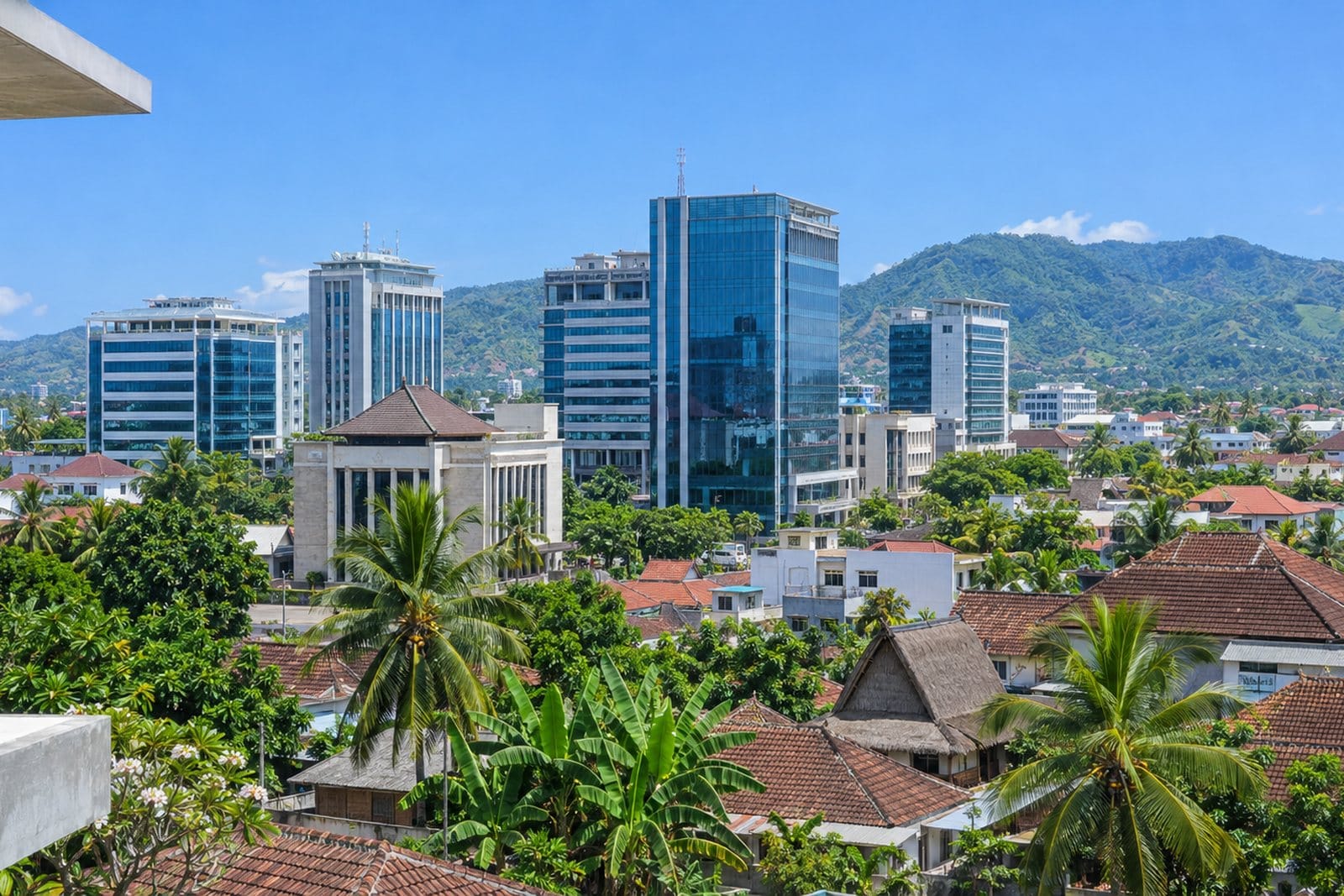 Rupiah Volatility and South Lombok · Illustration: HubLombok (AI-generated)
The Offshore Balance Sheet: Currency Mechanics for Real Estate
For foreign private investors and family offices deploying capital from Australia, Europe, and North America, exchange rate movements alter the investment equation in distinct ways. Property development and acquisition in South Lombok operate across two primary financial layers: local asset acquisition and international guest revenue.
Land in Indonesia is legally transacted in local currency and calculated according to local standards. In South Lombok, land is quoted per are (where 1 are equals 100 square metres), never in four-figure US dollar per square metre units. When the rupiah softens against major global currencies, the foreign currency cost of securing prime land parcels declines in direct proportion. An offshore buyer converting US dollars, euros, or Australian dollars acquires a larger land footprint or secures prime locations with lower upfront capital requirements.
| Location / Zone | Local Land Price (Rp / are) | Approximate Equivalent (USD / are) | Gross Yield Range | Momentum (YoY) | | :--- | :--- | :--- | :--- | :--- | | Kuta | Rp 300-400M | $18,200-$24,200 | 14-22% | +38% | | Selong Belanak | Rp 150-250M | $9,100-$15,200 | 13-19% | +22% | | Are Guling | Rp 120-180M | $7,300-$10,900 | 17-25% | +47% | | Mandalika | Rp 100-150M | $6,100-$9,100 | Established SEZ | Tourism Hub | | Mawun | Rp 50-80M | $3,000-$4,800 | Emerging Bay | Early Cycle | | Bumbang | Rp 30-50M | $1,800-$3,000 | Frontier Entry | Capital Growth |
Across South Lombok, overall land prices span from Rp 30 million to Rp 400 million per are, representing roughly USD 90 to 240 per square metre at baseline conversion levels of approximately Rp 16,500 per US dollar. By comparison, prime development land in neighbouring Bali commands between USD 200 and USD 500 per square metre, demonstrating the substantial entry-level arbitrage available in Lombok.
Equally compelling is the revenue dynamic. While land acquisition and local construction labour are contracted in rupiah, high-end hospitality real estate generates cash flow heavily benchmarked to foreign tourists. In premier lifestyle enclaves, nightly villa rates are indexed directly or indirectly to hard currency equivalents. In Kuta and Mandalika, villa rental rates have demonstrated strong pricing power, climbing by approximately 38 percent year-on-year.
Prudent financial modelling demands transparency between gross projections and net returns. Developer marketing frequently promotes gross rental yields between 12 and 22 percent. However, institutional-grade underwriting must account for professional management fees of 18 to 22 percent of gross revenue, online travel agency commissions of 15 to 20 percent, and realistic stabilised occupancy rates of 55 to 70 percent during years one through three (compared with 70 to 85 percent in mature Bali markets). Net yields reliably settle within the honest range of 7 to 12 percent, with exceptional, top-performing assets reaching around 15 percent net only as explicit outliers.
What This Means for Investors
Periods of transient currency weakness provide strategic entry points for foreign investors who understand Indonesian corporate and property law. Foreign capital cannot acquire freehold title (Hak Milik), which remains the exclusive preserve of Indonesian citizens. Attempts to bypass this statutory reality through nominee arrangements are strictly illegal and legally void in Indonesian courts.
Sophisticated international buyers access South Lombok real estate through clear, legal channels:
- PT PMA (Foreign-Owned Company): Establishing a foreign investment company allows direct corporate ownership of commercial property under a Hak Guna Bangunan (HGB) title, valid for 30 years and legally extendable.
- Hak Sewa (Long-Term Leasehold): A pure contractual lease agreement, typically running 25 to 30 years with pre-negotiated extension clauses, offering structural flexibility without corporate maintenance overheads.
- Hak Pakai (Right to Use): Available to resident foreign individuals holding valid KITAS or KITAP permits, granting direct, titled rights over land while preserving sovereign land laws.
In transactional practice, buyers must budget for the official land transfer tax (BPHTB) at approximately 5 percent of the assessed transaction value, executed before a licensed Land Deed Official (PPAT notary) and registered with the national land office (BPN).
When evaluating off-plan turnkey investment-grade villas, entry capital requirements in South Lombok range between EUR 95,000 and EUR 350,000. To procure a comparable luxury specification in southern Bali requires an outlay of USD 400,000 to USD 800,000. A temporary softening of the rupiah sharpens this entry advantage, reducing the effective conversion cost for development milestones while capitalising on an island economy experiencing 40 to 50 percent annual growth in foreign arrivals.
Short-term currency volatility is an inevitable feature of dynamic emerging economies. Rather than signaling structural distress, the rupiah's orderly adjustment underscores the maturity of Indonesia's modern monetary regime. For discerning investors seeking tangible asset security, favourable demographic momentum, and realistic net yields of 7 to 12 percent, the macroeconomic backdrop remains solidly constructive.
Stay informed: subscribe to the free Lombok Briefing, published twice a month (the 1st and 15th), for market intelligence like this.
Does rupiah volatility increase the risk of property investment in Lombok?
No, because Indonesia's macroeconomic foundations remain sound, unlike in 1998. Foreign buyers transacting in hard currencies actually benefit from improved purchasing power when acquiring rupiah-denominated land parcels, while hospitality assets generate revenues backed by international tourism arrivals.
How does currency weakness affect rental yields in South Lombok villas?
Villa rental rates in tourist hubs like Kuta track international travel pricing, rising roughly 38 percent year-on-year. While operating costs remain in rupiah, honest net rental yields stay between 7 and 12 percent after management fees and realistic occupancy.
Can foreign investors own land outright in Indonesia during market downturns?
Foreigners cannot hold freehold Hak Milik title under any circumstances. However, investors can safely secure assets via long-term leasehold (Hak Sewa) or through a foreign-owned PT PMA holding a registered Hak Guna Bangunan (HGB) title via a licensed PPAT notary.
The Lombok Buyer's Field Guide
Legal structures ranked by risk, the honest ROI math line by line, all six zones ranked, and the 24-point due-diligence checklist. The whole book, free in your inbox.
See what's inside