
Rupiah Strengthens as Softer US Inflation Pressures the Dollar
A modest rupiah gain puts currency discipline back at the centre of Lombok investment decisions.
Quick answer: The rupiah strengthened to Rp18,063 per US dollar on Thursday morning, according to Antara Business. For Lombok investors, the immediate effect is modest, but it is a live reminder that foreign-currency returns, acquisition budgets and rental-income expectations must be assessed in both rupiah and the investor’s home currency.
A five-point move is not a property-market turning point. Yet currency shifts matter precisely because they arrive quietly: before a transfer is made, a construction payment is scheduled, or a projected return is converted back into euros, Australian dollars or US dollars. Antara Business attributed Thursday morning’s firmer rupiah to softer US inflation weakening the dollar.
The Context
Antara Business reported that the Indonesian rupiah strengthened by five points, or 0.03%, to Rp18,063 per US dollar on Thursday morning. The source’s framing is important: this was a dollar-led move, linked to softer US inflation, rather than a claim about a change in Lombok’s local property fundamentals.
That distinction is worth preserving. Exchange rates and real estate are connected in an international buyer’s spreadsheet, but they are not the same market. A firmer rupiah may alter the foreign-currency cost of a rupiah-denominated obligation; it does not, on its own, establish a new land value, a new rental rate or a new level of demand in South Lombok.
For investors considering Indonesia from abroad, the practical question is therefore not whether 0.03% is dramatic. It plainly is not. The sharper question is whether currency assumptions have been made explicit in the investment case.
A Lombok purchase can contain several different currency exposures:
- the currency in which an investor holds capital;
- the rupiah price of land, construction, fees or local operating costs;
- the currency in which holiday rentals are marketed or settled; and
- the currency in which the investor eventually measures return.
None of those exposures is removed by a small daily move. But Thursday’s trading is a useful live prompt to separate operational confidence from exchange-rate confidence. An asset may perform as expected in rupiah while producing a different outcome once translated into another currency.
Antara Business reported the rupiah at Rp18,063 per US dollar, up five points on Thursday morning.
The source gives no basis for claiming that this move will persist, reverse, or reshape Indonesian property pricing. A premium investment brief should resist that temptation. Currency markets are capable of moving for reasons that sit outside a villa’s location, quality, operator or legal structure.
A Small Currency Move, a Material Due-Diligence Signal
The immediate investor implication is one of process, not prediction. Buyers should ensure that each major amount is recorded in its actual contractual currency, then consider the conversion outcome separately. It is a simple discipline, but it prevents a common analytical blur: treating a foreign-currency presentation of a property as though it were the same thing as the local-currency obligation.
South Lombok’s investment case already requires clear distinctions. Market material may describe developer-quoted gross yields of 12-22%, while honest net rental yields of 7-12% are measured after management fees and realistic occupancy. Top-performing assets can reach about 15% net, but that should not be treated as a standard outcome. Currency conversion is another layer on top of those operating assumptions, not a substitute for them.
The same caution applies to pricing. Turnkey investment-grade villas in South Lombok have an entry range of EUR 95,000-350,000. Prime tourist-zone land is generally quoted locally per are, with an are equal to 100 m². These are market-reference ranges, not evidence that a daily exchange-rate movement has changed an individual seller’s terms.
A sound live response to the rupiah’s move is therefore deliberately unglamorous:
- confirm the currency stated in the reservation, sale or construction agreement;
- identify which expenses are genuinely rupiah-denominated;
- distinguish gross operating claims from net return assumptions; and
- avoid presenting an exchange-rate move as a forecast for property values.
For a foreign buyer, that discipline is particularly valuable when a transaction is staggered. A sum paid now and a sum paid later can carry different conversion outcomes even where the rupiah amount is unchanged. The source does not say how the exchange rate will behave next; the appropriate response is to make the exposure visible rather than to assume it away.
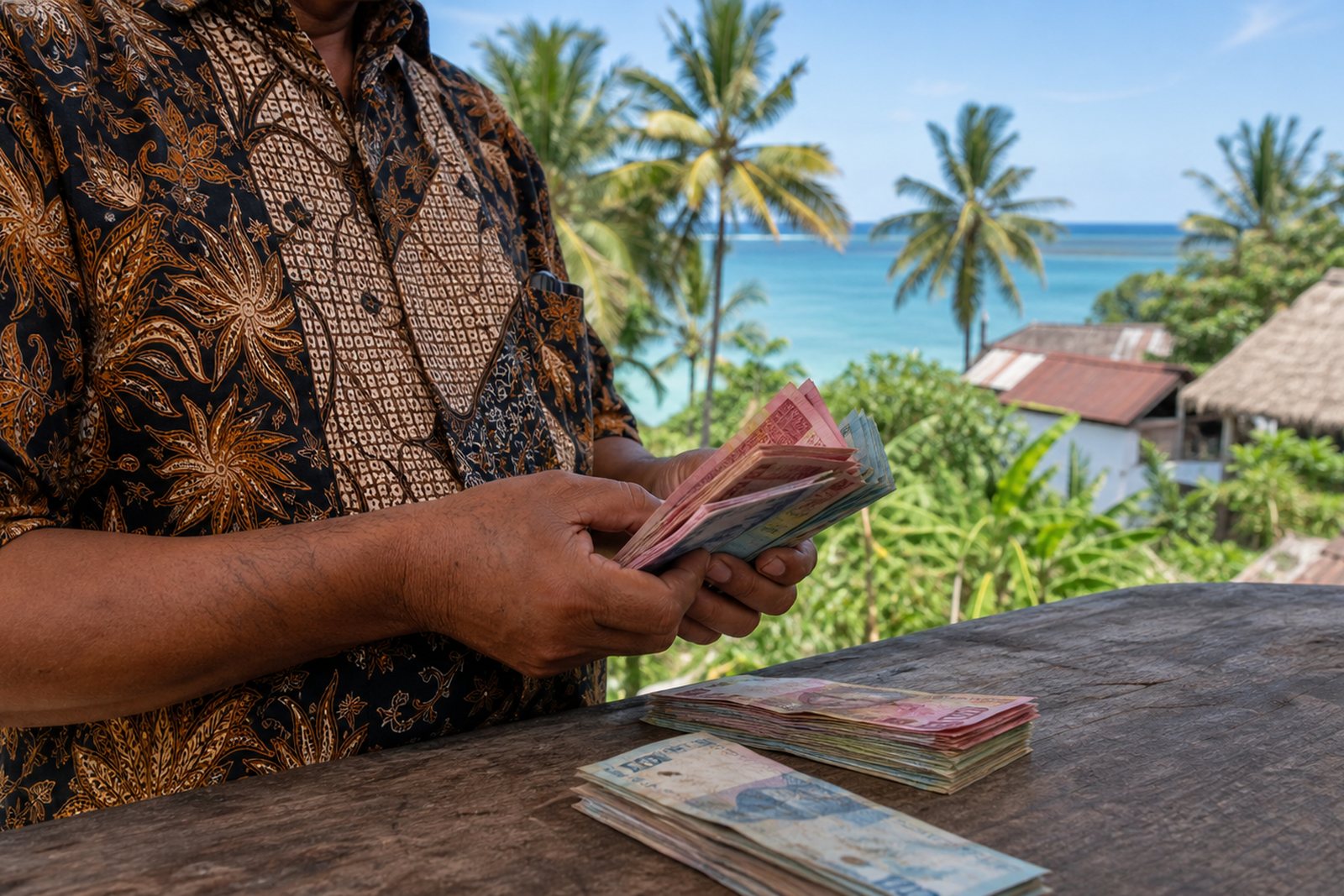 Rupiah Strengthens as Softer US Inflation Pressures the Dollar · Illustration: HubLombok (AI-generated)
Reading Lombok Through Two Lenses
The local market and the foreign-exchange market should be read together, but independently. Lombok’s tourism and property proposition is shaped by location, supply, legal structure, operating execution and the price paid. The exchange rate shapes what those rupiah amounts mean to an overseas balance sheet at a particular moment.
That matters especially because foreign buyers cannot hold freehold, or Hak Milik/SHM; it is reserved for Indonesian citizens. Available routes include leasehold, typically 25-30 years with extensions; Hak Pakai for eligible residents; and a foreign-owned PT PMA holding Hak Guna Bangunan, or HGB, for 30 years with extension options. A favourable or unfavourable currency move does not soften the need to select an appropriate structure.
Nor does it replace diligence. Deeds are executed by a licensed PPAT notary, the deed of sale is an AJB, and the land agency is BPN. Buyer transfer duty, BPHTB, is about 5% of assessed value. Nominee arrangements, in which an Indonesian citizen holds freehold on a foreigner’s behalf, are illegal and void in court.
In other words, the currency screen belongs within a wider investment screen. It should sit beside title, zoning, ownership history, encumbrances, tax treatment and contractual protections. TerraNusa Advisory, HubLombok’s independent licensed-notary and legal advisory partner, handles due diligence across SHM/HGB certificates, ownership history, zoning and encumbrances, as well as PT PMA setup and BPN title-transfer work. Its role is advisory; it is not a substitute for an investor’s own decision-making.
The current move also reinforces a useful reporting convention for readers: quote the underlying local price, then state the conversion basis and date where a foreign-currency comparison is necessary. That approach makes later comparisons more honest. It avoids turning a changing exchange rate into a false impression that the underlying rupiah asset price itself has changed.
What This Means for Investors
Thursday’s 0.03% strengthening is a live market signal, not a reason to rush a Lombok decision. The most sensible response is to revisit the model with the reported Rp18,063 per US dollar reference in mind, while keeping the model’s assumptions clearly labelled.
For a buyer already near a payment milestone, the relevant question is practical: what currency must be delivered, and when? For a buyer still assessing opportunities, the question is comparative: is the advertised return presented in gross or net terms, in rupiah or another currency, and which costs have been included? For an owner, the question is reporting: is performance being measured consistently in the asset’s operating currency and in the currency that matters to the investor?
There is no evidence in the supplied report that Lombok land or villas have repriced because of Thursday morning’s move. Investors should not manufacture that connection. Rather, they should use the episode to improve their readiness: retain currency buffers where appropriate, ask for clear payment schedules, and obtain legal advice before committing to a structure or title path.
The attraction of an international property market lies partly in its diversification; so does its complexity. Antara Business’s report is a concise reminder that a return is never just a headline yield. It is also the legal route, the operating reality, the timing of cash flows and, for overseas capital, the exchange rate at which those cash flows are ultimately understood.
Stay informed, subscribe to the free Lombok Briefing for market intelligence like this, published twice a month.
What happened to the rupiah on Thursday morning?
Antara Business reported that the Indonesian rupiah strengthened by five points, or 0.03%, to Rp18,063 per US dollar on Thursday morning. The report attributed the firmer rupiah to softer US inflation weakening the dollar.
Does the rupiah move change Lombok property values?
The supplied report does not establish a change in Lombok land or villa values. A currency move can affect an overseas buyer’s conversion cost, but it does not by itself alter a property’s local rupiah price, legal status or operating performance.
How should foreign buyers respond to this currency move?
Foreign buyers should confirm the contractual currency of each payment, separate gross yield claims from net-return assumptions, and model conversion outcomes independently. They should also complete appropriate title, zoning, ownership and legal due diligence before committing to an Indonesian property transaction.

The Lombok Buyer's Field Guide
Legal structures ranked by risk, the honest ROI math line by line, all six zones ranked, and the 24-point due-diligence checklist. The whole book, free in your inbox.
See what's inside