
PLN Fast-Tracks Bali Energy Independence Push
PLN is accelerating a renewable-energy push for Bali. For Lombok investors, the immediate signal is regional: energy resilience is moving higher on the development agenda.
Quick answer: PT PLN is accelerating a renewable-energy drive intended to strengthen Bali’s energy independence. For Lombok investors, the immediate implication is not a confirmed local project or market change, but a timely regional signal: electricity resilience, renewable supply and infrastructure readiness are becoming more central to investment appraisal across the island economy.
PLN’s latest move is a Bali story first. Yet it arrives in a market where the practical quality of infrastructure increasingly shapes the value of hospitality, residential and mixed-use assets. Investors assessing Lombok should therefore read the announcement neither as a reason for instant conclusions nor as a remote policy curiosity, but as a live reminder to test the infrastructure assumptions beneath every investment case.
The Context
According to Antara Business, the state-run electricity company PT PLN is accelerating Bali’s energy-independence push through renewable-energy development. The report is brief, but the direction is unambiguous: energy independence is being treated as an active objective rather than a distant aspiration.
That matters because energy is not simply an operating line in a spreadsheet. It is part of the physical framework that allows tourism, homes, construction sites, businesses and public services to function with confidence. Where an island economy depends on reliable electricity, decisions about generation, supply and resilience have consequences far beyond the power sector.
The source does not set out the individual renewable projects, their timetable, their capacity, their cost or their operational status. It also does not claim a corresponding initiative in Lombok. Investors should preserve those distinctions. The announcement supports a clear reading of PLN’s direction in Bali; it does not by itself establish a new forecast for property prices, rental income, visitor demand or power availability elsewhere.
Still, policy direction has value when it is interpreted with discipline. A push for energy independence signals that the quality and security of electricity supply are receiving attention at a strategic level. For investors, this is especially relevant in island settings, where infrastructure cannot be treated as an invisible utility. It must be examined as a live part of an asset’s operating environment.
Renewable-energy development is now central to PLN’s stated push for Bali’s energy independence, Antara Business reports.
The useful question for Lombok is therefore not whether one short report rewrites the market. It plainly does not. The better question is whether it sharpens the diligence that investors, developers and operators should already be carrying out before committing capital.
Energy Independence Is an Investment Issue
A property may look compelling on a site plan and still rely on assumptions that deserve scrutiny. Electricity is one of them. Investors in hospitality-led markets are accustomed to examining title, access, construction quality, management arrangements, demand and exit options. Infrastructure belongs in the same conversation.
The connection is practical. A guest experience, a villa operation, a construction programme and a commercial tenant all depend on systems that work consistently. When energy policy becomes more prominent, it gives investors a reason to ask not only whether a site is connected, but how its energy arrangements fit into the wider network and how clearly responsibilities are allocated.
PLN’s Bali push offers several questions worth carrying into Lombok underwriting:
- What is the current electricity arrangement for the asset or proposed site?
- Which party is responsible for connection, installation, ongoing service and any upgrades?
- How are energy-related operating costs treated in rental, management or service agreements?
- What contingency arrangements exist during construction and operation?
- Are claims about sustainability supported by the project’s actual design and operating plan?
- Has the buyer distinguished a developer’s ambition from a documented infrastructure commitment?
These are not reasons to assume difficulty. They are reasons to replace generic reassurance with evidence. In a premium property purchase, the relevant standard is not whether an answer sounds plausible. It is whether it is specific to the parcel, the development, the contractual structure and the intended use.
The same applies to renewable-energy language. The term can describe an important strategic direction, as it does in the Antara Business report. But it should not become a loose marketing substitute for due diligence. Investors should ask what is planned, what is installed, what is approved, what is operating and who bears responsibility for each element. If the answer is unclear, the uncertainty belongs in the investment decision.
This is particularly important where an investment thesis rests on hospitality income. An owner is not buying a view alone; they are buying a functioning operating environment. The more a projected return depends on smooth guest stays, reliable systems and professional management, the more infrastructure details deserve careful attention.
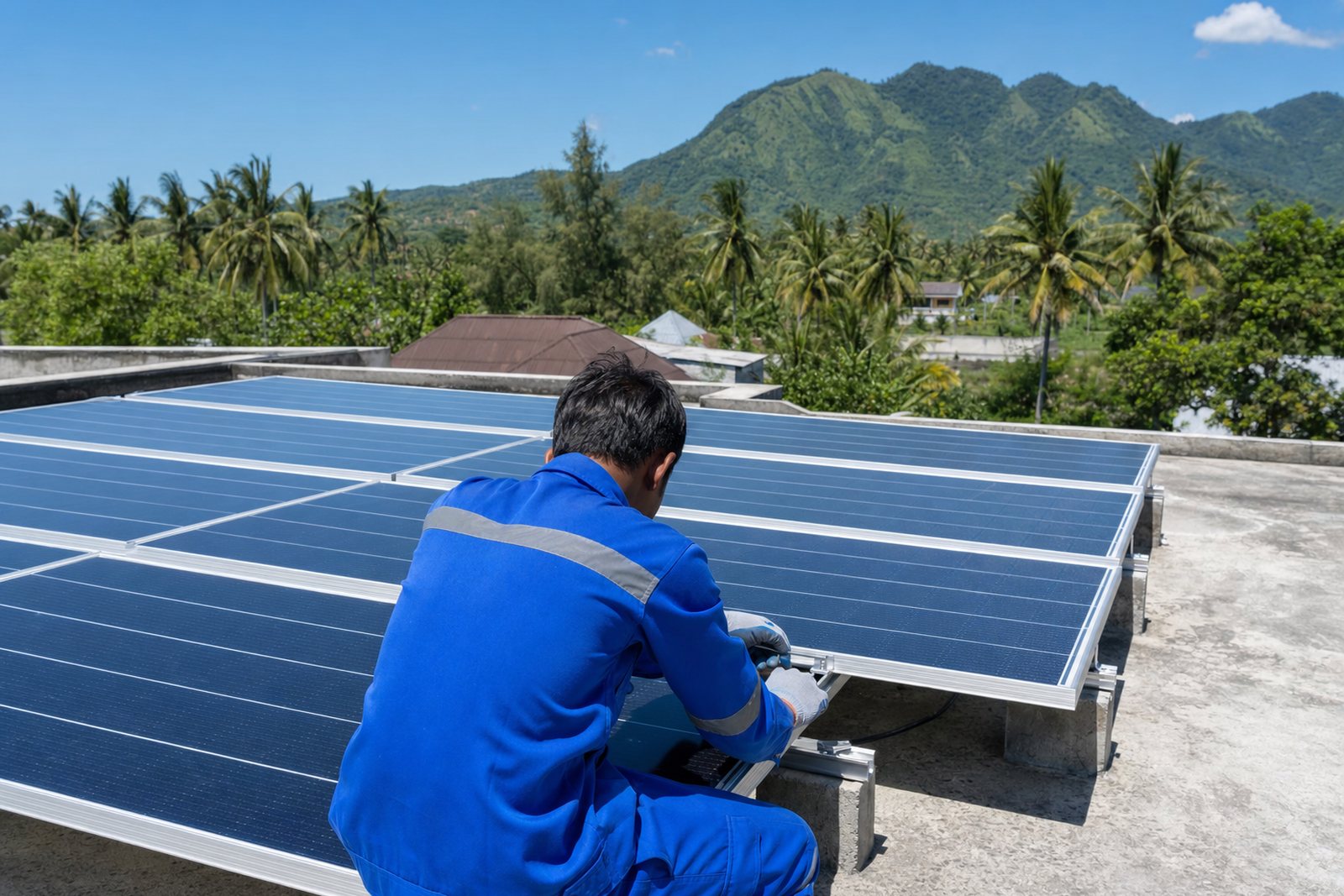 PLN Fast-Tracks Bali Energy Independence Push · Illustration: HubLombok (AI-generated)
What the Report Does, and Does Not, Establish
The speed implied by PLN’s announcement is itself noteworthy. “Fast-tracks” conveys urgency. Yet urgency should not be confused with completion. The source says PLN is accelerating a renewable-energy development push for Bali’s energy independence. It does not provide sufficient detail to treat individual outcomes as settled facts.
That distinction is essential in investment writing. Announcements can indicate priorities. They can prompt more searching questions. They can change the context in which a project is assessed. But they do not automatically deliver a finished asset, a completed network improvement or a measurable commercial outcome.
For Lombok, this means separating three layers of analysis.
| Layer | What an investor can reasonably conclude | |---|---| | Bali announcement | PLN is pursuing renewable-energy development in support of Bali’s energy independence. | | Regional relevance | Energy resilience is a material infrastructure theme for island-economy investment analysis. | | Lombok asset decision | A specific site still requires its own evidence, documentation and professional diligence. |
The temptation in a fast-moving news cycle is to turn regional developments into instant property narratives. That is rarely the strongest approach. A more credible investor response is to observe the signal, identify the relevant diligence questions and avoid pretending that an announcement has already resolved them.
There is also a broader lesson in the source’s framing. Energy independence is not solely an environmental phrase. It is a resilience phrase. It concerns the ability of an economy to support its activity with greater confidence in the systems that underpin it. Investors need not make claims about outcomes that have not yet been demonstrated to recognise that this objective has direct relevance to the quality of an investment environment.
For asset owners and prospective buyers, the practical implications may differ. An operating owner may want to review service arrangements, cost allocation and management reporting. A buyer of an off-plan or newly completed property may want written clarity on connections, equipment, responsibility and future operating arrangements. A land buyer may need to understand whether infrastructure considerations have been properly accounted for before construction assumptions are accepted.
None of this is glamorous. It is, however, where durable investment decisions are made. The premium end of real estate often rewards specificity: a precise title position, a clear construction obligation, an accountable operator and a documented plan for the services that make a property usable. Energy belongs on that list.
What This Means for Investors
For investors with Bali exposure, PLN’s announcement is a live policy and infrastructure development to monitor. The immediate task is to follow subsequent disclosures for project-specific detail rather than extrapolating beyond the report.
For investors considering Lombok, the announcement should sharpen diligence rather than trigger a rush. Ask whether the investment memorandum addresses electricity plainly. Request project-specific documentation. Test whether operating projections include clear assumptions for utility arrangements. Where a developer or operator presents a sustainability proposition, seek evidence of what that proposition means in practice.
The core discipline is simple: distinguish a regional signal from an asset-level fact. Bali’s energy-independence push does not automatically change Lombok’s investment fundamentals. It does, however, reinforce the importance of reviewing infrastructure as closely as investors review legal structure, construction scope and management terms.
That is the considered response to breaking infrastructure news. The value is not in declaring a new market verdict before the evidence exists. It is in recognising the direction of travel and using it to ask better questions before capital is committed.
PLN’s accelerated renewable-energy push places energy resilience firmly in the regional investment conversation. For Lombok investors, the most valuable takeaway is measured: keep watching the policy developments, insist on asset-specific proof, and treat reliable infrastructure as a fundamental part of investment quality.
Stay informed, subscribe to the free Lombok Briefing for market intelligence like this, published twice a month.
What did PLN announce for Bali?
Antara Business reported that state-run electricity company PT PLN is accelerating a renewable-energy development push aimed at strengthening Bali’s energy independence. The supplied report does not provide project-level capacity, cost, timetable or operational details.
Does PLN’s Bali announcement confirm a new Lombok energy project?
No. The supplied report concerns PLN’s energy-independence push in Bali and does not confirm a corresponding project in Lombok. Lombok investors should treat it as a regional infrastructure signal, while carrying out asset-specific electricity and service diligence.
How should Lombok property investors respond to this news?
Investors should request clear, project-specific evidence on electricity connections, responsibilities, operating arrangements and any sustainability claims. PLN’s Bali announcement does not change a Lombok asset’s fundamentals by itself, but it reinforces why infrastructure belongs in investment due diligence.

The Lombok Buyer's Field Guide
Legal structures ranked by risk, the honest ROI math line by line, all six zones ranked, and the 24-point due-diligence checklist. The whole book, free in your inbox.
See what's inside