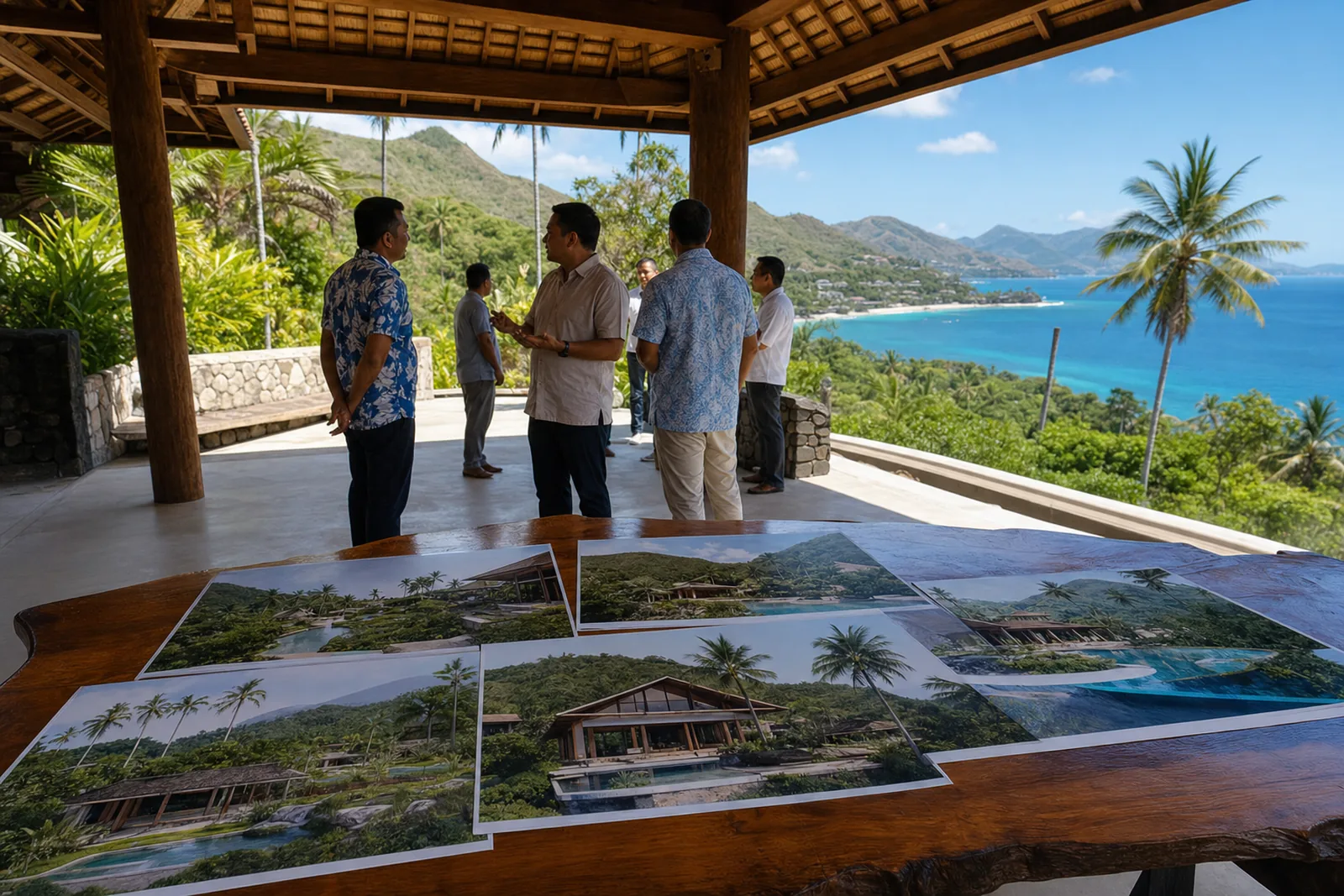
NTB’s Oman Investment Pitch Puts Lombok in a Wider Economic Frame
NTB’s meeting with Oman’s ambassador highlights a broader investment agenda spanning renewable energy, tourism and marine industries.
Quick answer: NTB’s official investment discussion with Oman signals a broader effort to present Lombok and the province as a multi-sector destination for international capital. For investors, the immediate significance is context rather than a completed transaction: tourism property now sits alongside renewable energy and marine-economy opportunities in the province’s official pitch.
Lombok investment is often discussed through a single, appealing lens: hospitality, beaches and the gradual re-pricing of land around established tourism corridors. An official meeting in Mataram on 18 June offers a useful corrective. According to DPMPTSP Provinsi NTB, the provincial government presented a portfolio that connected tourism accommodation with energy infrastructure and marine production.
That does not amount to an announced investment or a forecast of new capital. It does, however, show how the provincial administration is choosing to frame its offer to overseas counterparts. For investors assessing Lombok, that framing matters. A market’s long-term appeal is shaped not only by individual villas or hotel sites, but by the breadth, credibility and administrative coherence of the economic agenda surrounding them.
The Context
According to the official DPMPTSP Provinsi NTB post, Governor Lalu Muhamad Iqbal received Mohamed Ahmed Salim, the Ambassador of the Sultanate of Oman to Indonesia, in Mataram. The governor was accompanied by the provincial heads responsible for energy and mineral resources, investment and one-stop integrated services, and marine affairs and fisheries.
The meeting was presented as an opportunity to introduce investment opportunities in three areas:
- renewable energy;
- tourism; and
- marine affairs and fisheries.
This is a notably wider proposition than a tourism-only invitation. The official account identified a 20 MW solar-power project in Sengkol, Central Lombok; wind power in Jerowaru, East Lombok; and floating solar and hydro development at a number of regional reservoirs. It also listed hotel and premium-accommodation projects in Mandalika, Gili Gede and Kerakas Beach, alongside aquaculture opportunities in seaweed, lobster and freshwater fish.
DPMPTSP Provinsi NTB described the discussion as a chance to strengthen investment co-operation between NTB and countries in the Middle East.
For an investor, the useful reading is restrained. The source does not say that Oman committed funds, selected a project or agreed a timetable. Nor does it identify project valuations, delivery dates, counterparties or commercial terms. What it does establish is that the provincial government is actively placing a range of named opportunities before an international diplomatic audience.
That distinction is essential. Official investment promotion can be meaningful without being evidence of a completed deal. It is a signal of intent and institutional positioning, not a substitute for project-level due diligence.
From Tourism Asset to Provincial Investment Proposition
Tourism remains a central part of the presentation. Mandalika was among the strategic areas identified for hotel and premium-accommodation projects, alongside Gili Gede and Kerakas Beach. For investors focused on Lombok real estate, this matters because it situates accommodation within a wider provincial capital agenda rather than treating it as an isolated lifestyle market.
South Lombok already has a distinct investment vocabulary. Prime tourist-zone land is commonly discussed in local units of are, with 1 are equal to 100 m². Across the market, land spans roughly Rp 30-400 million per are, although location, legal status, access, zoning and infrastructure remain decisive variables.
The range across selected South Lombok zones illustrates why broad provincial narratives must be translated carefully into local underwriting:
| Zone | Authoritative land range | Approximate USD range per are | |---|---:|---:| | Kuta | Rp 300-400 million/are | $18,200-24,200/are | | Mandalika | Rp 100-150 million/are | $6,100-9,100/are | | Are Guling | Rp 120-180 million/are | $7,300-10,900/are | | Selong Belanak | Rp 150-250 million/are | $9,100-15,200/are |
Mandalika, the adjacent special economic zone and circuit area, is therefore one named tourism location within a market that is far from uniform. Kuta is the town and a separate place; it is the demand and liquidity leader in the verified market data. An investor should not allow a provincial investment announcement to blur those practical distinctions.
The same discipline applies to income expectations. Developers may quote gross yields of 12-22%, but those figures exclude costs that an investor ultimately bears. Honest net rental yields are assessed at 7-12% after management fees and realistic occupancy, with top-performing assets capable of reaching around 15% net. Management fees are typically 18-22% of gross rental revenue, while online travel-agent and booking commissions are typically 15-20%.
These are not objections to the tourism thesis. They are the arithmetic that keeps the thesis investable. Provincial ambition may improve the narrative around a destination, but a property purchase still depends on the asset, its operator, its legal structure and its cash-flow assumptions.
 NTB’s Oman Investment Pitch Puts Lombok in a Wider Economic Frame · Illustration: HubLombok (AI-generated)
Energy and Marine Opportunities Change the Questions
The official post’s energy and marine components are important precisely because they expand the questions investors should ask. If tourism is the visible face of Lombok’s international appeal, renewable energy and marine production represent different forms of economic activity, different approval pathways and different risk profiles.
The source names solar, wind, floating solar and hydro opportunities, but supplies no information on land control, procurement structure, power offtake, environmental permissions, capital requirements or construction schedule. It would be premature to infer investability from a project being offered. Yet the inclusion of these sectors is still significant as an expression of provincial priorities.
For hotel and villa investors, this wider framing may be relevant indirectly. A destination economy is more resilient when it is not reliant on one visitor segment or one type of investor. That is a general analytical principle, not a claim that the listed projects will deliver a particular outcome. The official source itself says that NTB is seeking quality investment capable of supporting economic growth and employment.
Marine affairs and fisheries add another layer. DPMPTSP Provinsi NTB referred to seaweed, lobster and freshwater-fish cultivation, describing available cultivation land as extensive and not yet optimally utilised. Again, that language is promotional and should be treated as the provincial administration’s view. It is not, on its own, a measure of commercial feasibility, biological output or export demand.
The practical lesson is that Lombok should increasingly be assessed at two levels:
- The asset level: title, contract, access, construction quality, operating model, occupancy assumptions and exit liquidity.
- The provincial level: policy direction, investment facilitation, sector breadth and the seriousness with which institutions engage international investors.
Neither level can replace the other. A credible provincial pitch cannot repair weak documentation on an individual site. Equally, an attractive villa cannot be evaluated entirely apart from the economic and administrative environment in which it operates.
Foreign buyers should be especially disciplined on legal structure. Foreigners cannot hold freehold Hak Milik or SHM; that right is reserved for Indonesian citizens. Available routes include leasehold, typically 25-30 years with extensions; Hak Pakai for eligible residents; and a foreign-owned PT PMA holding Hak Guna Bangunan, which runs for 30 years and is extendable. Nominee arrangements, in which an Indonesian national holds freehold on a foreign buyer’s behalf, are illegal and void in court.
A licensed PPAT notary executes deeds, including the AJB deed of sale, while BPN is the land agency. Buyer transfer duty, BPHTB, is about 5% of assessed value. TerraNusa Advisory, HubLombok’s legal and notary advisory partner, assists foreign buyers with certificate, ownership-history, zoning and encumbrance checks, as well as PT PMA setup, taxes and transfer at BPN. Its role is relevant because an investment narrative is valuable only when it is matched by a verifiable route to ownership or use rights.
What This Means for Investors
The immediate implication is not that investors should rush towards a named sector or location. It is that NTB’s official messaging now deserves to be read as a joined-up invitation: energy, tourism and marine industries are being presented together to international counterparts.
For European, Australian and American investors considering Lombok, that creates a more sophisticated research agenda. Hospitality buyers should follow tourism projects, but also observe the provincial approach to permits and investment assistance. Infrastructure-minded investors should distinguish a government-offered opportunity from a bankable project. Investors in land or villas should preserve their focus on local price discipline and legal due diligence.
DPMPTSP head H. Irnadi Kusuma said in the official post that NTB has investment projects ready to be offered to global investors, and that the province is committed to facilitating licensing and investment assistance so investors can feel secure and comfortable. That is an official commitment, not a guarantee of an outcome in any individual transaction. The appropriate response is constructive scepticism: welcome institutional engagement, then verify each commercial and legal detail independently.
Lombok’s investment case has often been described through Bali-overflow: higher Bali prices and congestion directing attention towards a cheaper, earlier-cycle neighbouring market. The Oman meeting adds a more expansive perspective. The province is not presenting Lombok solely as an alternative holiday destination; it is presenting NTB as a place where tourism sits within a broader economic portfolio.
For patient investors, that is the notebook entry worth retaining. The value of the meeting lies less in a headline about a single foreign delegation than in the revealed ambition behind it. NTB is seeking to speak to international capital in several languages at once. The work for investors is to determine which of those opportunities has the documentation, economics and governance to justify conviction.
Stay informed, subscribe to the free Lombok Briefing for market intelligence like this, published twice a month.
Did Oman announce an investment in Lombok or NTB?
No announcement of a committed Omani investment appears in the official DPMPTSP Provinsi NTB post. It says NTB presented opportunities in renewable energy, tourism, and marine affairs and fisheries during a meeting with Oman’s ambassador to Indonesia.
Which Lombok tourism locations did NTB present to Oman?
According to DPMPTSP Provinsi NTB, the tourism presentation included hotel and premium-accommodation projects in Mandalika, Gili Gede and Kerakas Beach. The post does not provide project values, timelines, investors or commercial terms for those opportunities.
What should foreign property investors verify before buying in Lombok?
Foreign buyers should verify the legal route, certificate, ownership history, zoning, encumbrances and transfer process. Foreigners cannot hold freehold Hak Milik or SHM; common routes include leasehold, Hak Pakai for eligible residents, or a PT PMA holding HGB.

The Lombok Buyer's Field Guide
Legal structures ranked by risk, the honest ROI math line by line, all six zones ranked, and the 24-point due-diligence checklist. The whole book, free in your inbox.
See what's inside