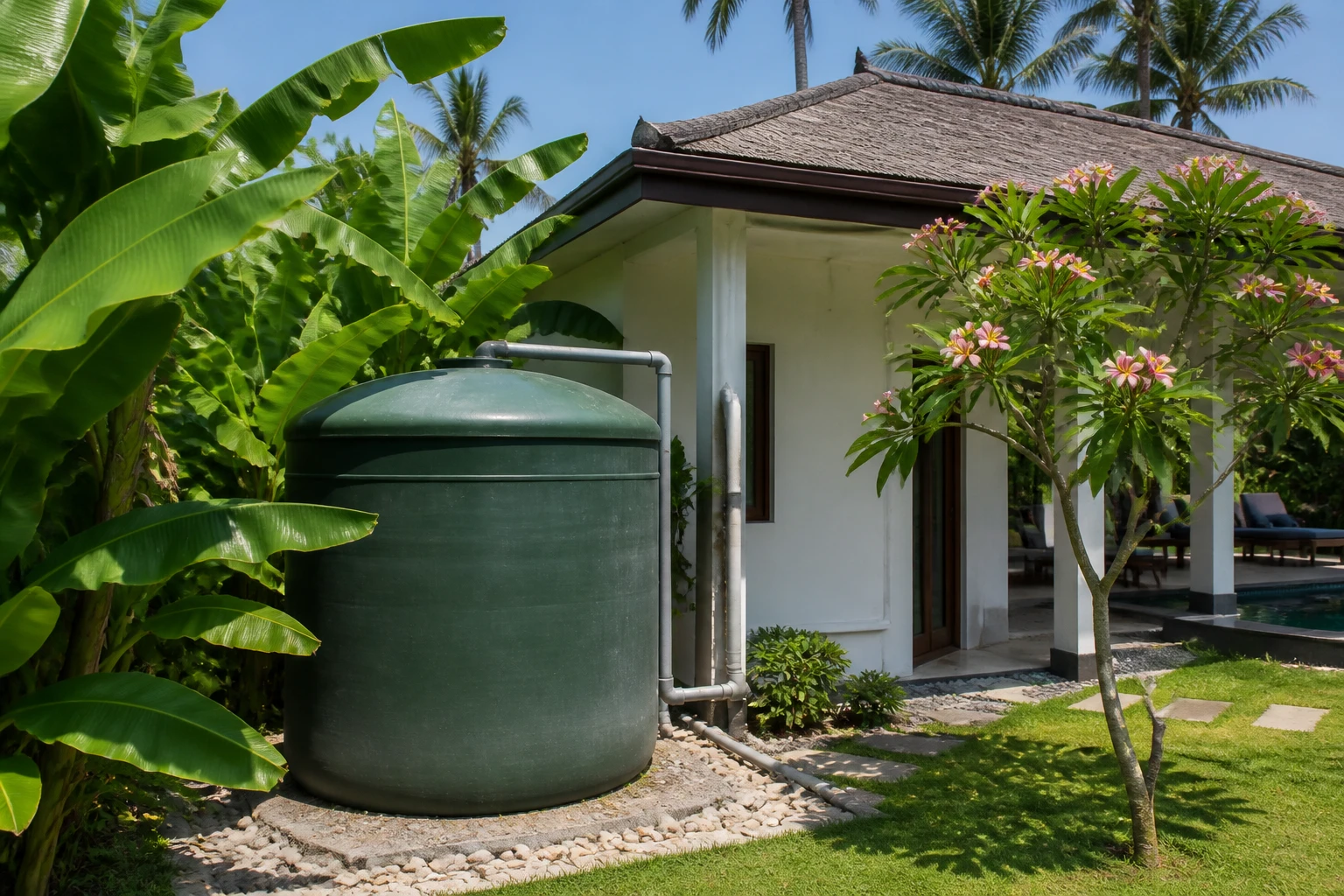
Rainwater Harvesting and Water Reuse for a Lombok Villa
Lombok's wet season delivers enough rainfall to supply a well-sized villa year-round if captured and stored correctly. A rainwater harvesting system paired with basic greywater reuse can cut reliance on trucked water by 60 to 80 percent, lower operating costs and signal the eco-credentials that comm
Quick answer: Lombok's wet season delivers enough rainfall to supply a well-sized villa year-round if captured and stored correctly. A rainwater harvesting system paired with basic greywater reuse can cut reliance on trucked water by 60 to 80 percent, lower operating costs and signal the eco-credentials that command premium rental rates from today's sustainability-conscious guests.
How much rain does Lombok actually get?
South Lombok receives roughly 1,500 to 2,500 mm of rainfall per year, concentrated in a wet season that runs from November to April. By contrast, the dry season from May to October can see weeks pass with almost no precipitation at all. This extreme seasonality is the central challenge for any villa owner: there is more water than you can use for half the year, and almost none for the other half.
The good news is that a villa roof is a surprisingly effective collection surface. A 200 m2 catchment area receiving 2,000 mm of annual rain yields approximately 360,000 litres of collectable water before accounting for losses to first-flush discard and evaporation. Even at 70 percent capture efficiency, that is around 250,000 litres a year, enough to cover the annual domestic water needs of a family of four with generous margins.
Sizing your storage tank
The rule of thumb for tropical villas in Indonesia is to hold enough water to bridge the dry season, typically 120 to 150 days. A four-bedroom villa with a private pool will use roughly 2,000 to 3,500 litres per day when occupied, accounting for guests, staff, landscaping and pool top-up.
Working backwards, a 150-day dry season at 3,000 litres per day requires approximately 450,000 litres of on-site storage. In practice, most villa developers split this across underground ferrocement or reinforced-concrete cisterns, which are significantly cheaper than above-ground polyethylene tanks at scale. In Lombok, a poured-concrete underground cistern of 50,000 litres typically costs between Rp 25 and 40 million to build, including labour. Ten such tanks reach the target at a total cost of Rp 250 to 400 million, or roughly USD 15,000 to 24,000 at current exchange rates. That is a material but manageable line item within a villa budget that typically sits in the EUR 95,000 to 350,000 range.
A pre-filter combining a coarse mesh and a first-flush diverter, plus a post-filter of sand and activated carbon, are essential before the water reaches drinking or cooking use. UV sterilisation units, which run on a trickle of solar power, add another layer of assurance and cost around USD 300 to 600 installed.
For further context on how water availability shapes site selection and long-term viability, see Water security and drought risk in South Lombok.
Greywater reuse: showers, sinks and laundry
Greywater, the relatively clean wastewater from showers, baths, handbasins and laundry, typically accounts for 50 to 65 percent of a household's total water output. Unlike blackwater from toilets, greywater can be recycled on-site with modest treatment. A simple constructed wetland or planted filter bed removes soaps and suspended solids, producing water suitable for toilet flushing, garden irrigation and pool make-up.
In a four-bedroom Lombok villa, a correctly sized greywater system can divert 800 to 1,200 litres per day back into the irrigation circuit, reducing the draw on the rainwater cistern and extending dry-season autonomy by several weeks. The system itself, a settlement tank, a planted reed bed and a collection sump, can be built by a competent local contractor for Rp 15 to 25 million and requires almost no ongoing maintenance beyond an annual clear-out.
Combining rainwater capture with greywater reuse routinely achieves the 60 to 80 percent reduction in external water dependency described above. The remaining gap is usually covered by a shallow bore well where the water table permits, or a minimal scheduled delivery from a water truck during the driest weeks.
The sustainability premium
Sustainability features have shifted from a nice-to-have to a meaningful differentiator in the Lombok villa rental market. Guests paying premium nightly rates increasingly ask about solar panels, composting, plastic-free policies and, specifically, water self-sufficiency. A villa that can credibly claim it does not draw on Lombok's strained municipal supply, and does not rely on weekly water-truck deliveries, is a genuine marketing asset.
This matters most for operators targeting European and Australian guests, where environmental expectations are higher and where third-party certification platforms such as Green Key or EarthCheck carry real weight with booking platforms. Water self-sufficiency is one of the easier boxes to tick because the underlying infrastructure is straightforward, local contractors understand it, and Lombok's seasonal rainfall pattern makes the approach genuinely viable.
Samudra Villas, which develops investment-grade properties in Are Guling and provides the editorial context for much of HubLombok's property coverage, incorporates rainwater harvesting and greywater systems as standard in its current build pipeline, treating water infrastructure as a core operational cost rather than an optional upgrade.
For a broader look at how sustainability features affect demand and rental pricing across the island, see Eco and sustainable villa demand in Lombok. If you are planning a new build from the ground up, the full practicalities of water, power and materials are covered in our guide to building a villa in Lombok.
Practical guidance
Water infrastructure is not glamorous, but it is one of the highest-leverage investments a Lombok villa owner can make. The priority order is straightforward: size cisterns generously during construction because retrofitting is expensive, install a first-flush diverter and basic filtration from day one, and add a greywater reed bed once the garden is established.
Budget Rp 250 to 500 million (roughly USD 15,000 to 30,000) for a complete system covering a four-bedroom villa. Spread across a 25-year leasehold, that works out to under USD 1,200 per year. Against the cost of trucked-water deliveries, which in more remote zones can run to USD 50 to 100 per delivery, the payback period is typically three to five years.
Do not overengineer the filtration stack for toilet and irrigation use. Simple is reliable. Reserve the UV steriliser for drinking and cooking lines only, keep the maintenance burden low, and you will have a system that a villa manager can run without specialist support year after year.
How big a rainwater storage tank does a four-bedroom Lombok villa need?
A four-bedroom villa using roughly 3,000 litres per day at occupancy needs approximately 450,000 litres of storage to bridge a 150-day dry season. Builders typically use multiple 50,000-litre underground concrete cisterns, each costing around Rp 25 to 40 million in Lombok, for a cistern subtotal of Rp 250 to 400 million.
Can I reuse greywater from a Lombok villa for garden irrigation?
Yes. Greywater from showers, basins and laundry accounts for roughly 50 to 65 percent of domestic water output and can be recycled on-site after passing through a simple constructed wetland or planted filter bed. The treated water is suitable for garden irrigation, toilet flushing and pool top-up, and can extend dry-season water autonomy by several weeks.
What does a complete rainwater harvesting system cost for a villa in Lombok?
A complete system, including underground cisterns, first-flush diversion, sand and carbon filtration, UV sterilisation and a greywater reed bed, typically costs Rp 250 to 500 million (roughly USD 15,000 to 30,000) for a four-bedroom villa. Against the alternative of regular trucked-water deliveries at USD 50 to 100 each, most owners recover that cost within three to five years.
The Lombok Buyer's Field Guide
Legal structures ranked by risk, the honest ROI math line by line, all six zones ranked, and the 24-point due-diligence checklist. The whole book, free in your inbox.
See what's inside