Water Security in South Lombok: Wells, PDAM and Drought Risk
South Lombok's dry season runs roughly from May to October, and water supply varies sharply by location. PDAM mains reach some tourist corridors but coverage is patchy beyond them. Most villas rely on bore wells, which perform reliably when properly sited and sized. Buyers should verify well depth,
Quick answer: South Lombok's dry season runs roughly from May to October, and water supply varies sharply by location. PDAM mains reach some tourist corridors but coverage is patchy beyond them. Most villas rely on bore wells, which perform reliably when properly sited and sized. Buyers should verify well depth, yield testing and storage capacity before committing.
The Dry Season Reality
South Lombok sits in one of the drier parts of Indonesia. The island's topography channels most rainfall to the northern and central highlands, and the south coast, where tourist development is concentrated, receives markedly less precipitation. The dry season typically runs from May through to October, with July and August being the most acute months. During this period, shallow water tables drop and intermittent streams dry out entirely.
This matters for property buyers because water stress in the dry season is not a fringe scenario. It is a predictable annual event that good infrastructure manages and poor infrastructure fails to address. The question to ask of any plot or finished villa is not whether water is available today, but whether the supply system is engineered to last through a ten-week dry spell without interruption.
PDAM Coverage: What It Reaches and Where It Stops
PDAM, Indonesia's state piped-water utility, is gradually expanding its network across South Lombok, following the surge in tourist arrivals and the investment associated with the Mandalika SEZ and MotoGP circuit. Coverage is most reliable along the Kuta town corridor and in the immediate vicinity of the circuit, where infrastructure spending has been concentrated.
Outside these corridors, PDAM service becomes intermittent or absent entirely. Many areas around Are Guling, Mawun and Bumbang have little to no mains connection, and even where pipes reach a property boundary, pressure and supply hours can vary by season. Developers selling off-plan villas in frontier zones will often cite PDAM connection as a future amenity, but buyers should treat this as aspirational unless a live service agreement is already in place.
PDAM water also requires a connection fee and a monthly tariff. In rural settings, quality can require additional filtration before it is safe for drinking. Connection timelines on new developments have historically slipped by one to three years in less-serviced zones.
Bore Wells: Depth, Yield and the Limestone Factor
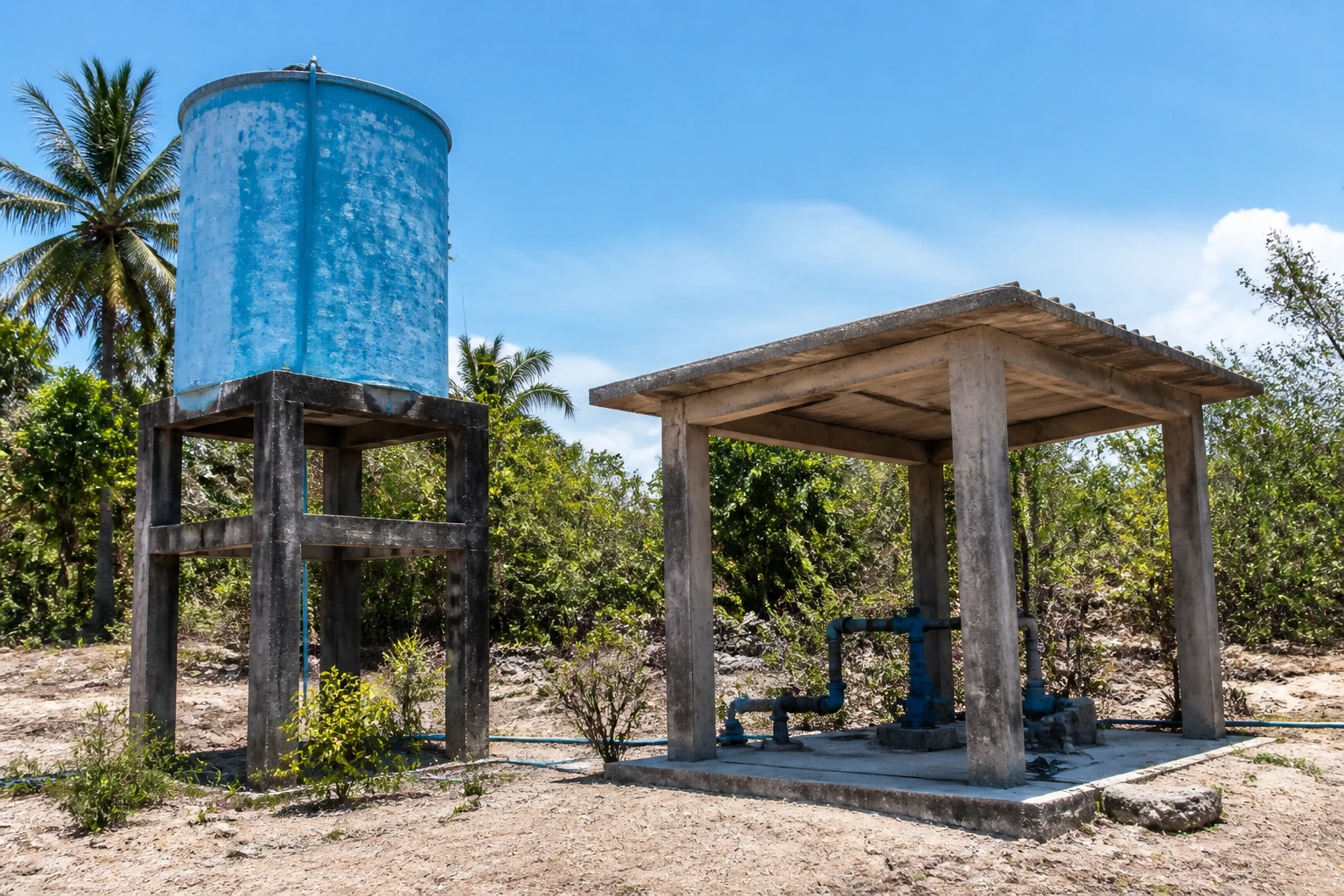
The majority of quality villa developments in South Lombok rely on bore wells (sumur bor) as their primary water source. When correctly sited and drilled to adequate depth, these are reliable year-round. When done cheaply, they fail precisely when you need them most.
South Lombok's geology is predominantly limestone karst. This creates uneven aquifer distribution: water collects in fractures and cavities rather than in uniform sandy layers, which means a well drilled ten metres from a productive one can be nearly dry. Professional hydrogeological survey before drilling is not standard practice on small plots, but it is worth requesting for any significant investment.
Practical depth guidance from builders and operators in the region suggests that wells under 20 metres tend to be unreliable through the dry season. Wells reaching 30 to 50 metres or deeper, into bedrock aquifers, provide more consistent year-round yield. Yield testing, which measures actual flow rate in litres per minute under sustained pumping, is the only reliable way to assess whether a well can supply a villa's peak demand.
For a typical two to four bedroom villa with a pool, daily consumption at high occupancy can reach 1,500 to 2,500 litres. A well yielding under 10 litres per minute may be adequate if paired with sufficient storage, but marginal wells are a risk that compounds over time as the water table drops during drought years.
Storage: The Underrated Safeguard
Experienced developers and operators in South Lombok treat storage capacity as the single most important buffer against dry-season disruption. A well-designed system typically includes a below-ground cistern to capture and hold large volumes, alongside a rooftop or elevated day tank for pressure delivery.
Ground-level concrete storage tanks of 5,000 to 20,000 litres are common in quality builds. Some properties in drier zones install tanker-fill connections as a backup, so water can be trucked in during extended dry spells or periods of well maintenance. Tanker supply is available across most of the southern corridor and is a practical, cost-effective fallback rather than a last resort.
Solar-powered pumping, which runs bore wells during daylight hours and tops up storage passively, is increasingly standard on new villa builds. It reduces operating costs compared to diesel or grid-dependent systems, and it removes reliance on PLN power stability, which is a separate utility risk in frontier zones.
What to Verify Before Buying or Building
Due diligence on water supply deserves the same rigour as due diligence on land title. The complete due diligence guide for Lombok covers the wider checklist, but for water specifically, ask for or commission the following before signing.
Bore-well documentation. Request the drilling record, including depth, geology log and yield test results. A professional driller will supply these without hesitation. An absence of documentation is a warning sign.
Dry-season performance. Ask when the well was last tested, and whether it was tested during July or August specifically. Ask the local RT or RW village head what water stress has looked like historically in that area.
Storage volume. Calculate whether installed storage covers at least five to seven days of peak consumption independently of the well. Smaller buffers leave no margin for repair delays.
PDAM status. If the developer or agent mentions PDAM, ask to see the actual connection permit and active service agreement, not a plan or a projected timeline.
Tanker access. Confirm that the access road and plot layout physically allow a tanker to deliver if needed.
For buyers evaluating off-plan villas, including projects by Samudra Villas in Are Guling (HubLombok's parent developer), water supply specification should form part of the technical schedule attached to any sale and purchase agreement. A villa priced around USD 255,000 should come with documented bore-well performance data and a storage system sized for year-round resilience. See the buying and running a villa article for how utilities are typically bundled into developer specifications, and the villa-building guide if you are planning to construct from land and need to commission infrastructure from scratch.
Water in South Lombok is manageable. It is not Bali, where mains infrastructure is more mature and widespread, but the gap is bridgeable with the right engineering. The properties that disappoint buyers are the ones where water was treated as an afterthought. Verify early, verify during the dry season if you can, and build storage margins into any specification you sign off.
Is PDAM piped water available across South Lombok?
PDAM coverage is most reliable in the Kuta town corridor and around the Mandalika SEZ. Many areas further west and east, including Are Guling, Mawun and Bumbang, have limited or no mains connection. Most quality villas outside the main tourist corridor rely on bore wells and storage tanks as their primary water supply, with PDAM as a future supplement rather than a current guarantee.
How deep should a bore well be to supply a villa in South Lombok through the dry season?
Wells under 20 metres tend to struggle during July and August in South Lombok's limestone terrain. Reliable year-round supply typically requires 30 to 50 metres or deeper, reaching bedrock aquifers below the seasonal water table. A professional yield test, measuring actual flow rate in litres per minute under sustained pumping, is the only way to verify a well's performance before you depend on it.
What storage capacity does a holiday villa in South Lombok need?
A practical buffer for a two to four bedroom villa is five to seven days of peak consumption without any well input. In practice that means a ground-level cistern of at least 5,000 to 10,000 litres alongside an elevated day tank for pressure delivery. Quality builds in drier zones also install a tanker-fill connection so water can be trucked in during extended dry spells or maintenance periods.

The Lombok Buyer's Field Guide
Legal structures ranked by risk, the honest ROI math line by line, all six zones ranked, and the 24-point due-diligence checklist. The whole book, free in your inbox.
See what's inside