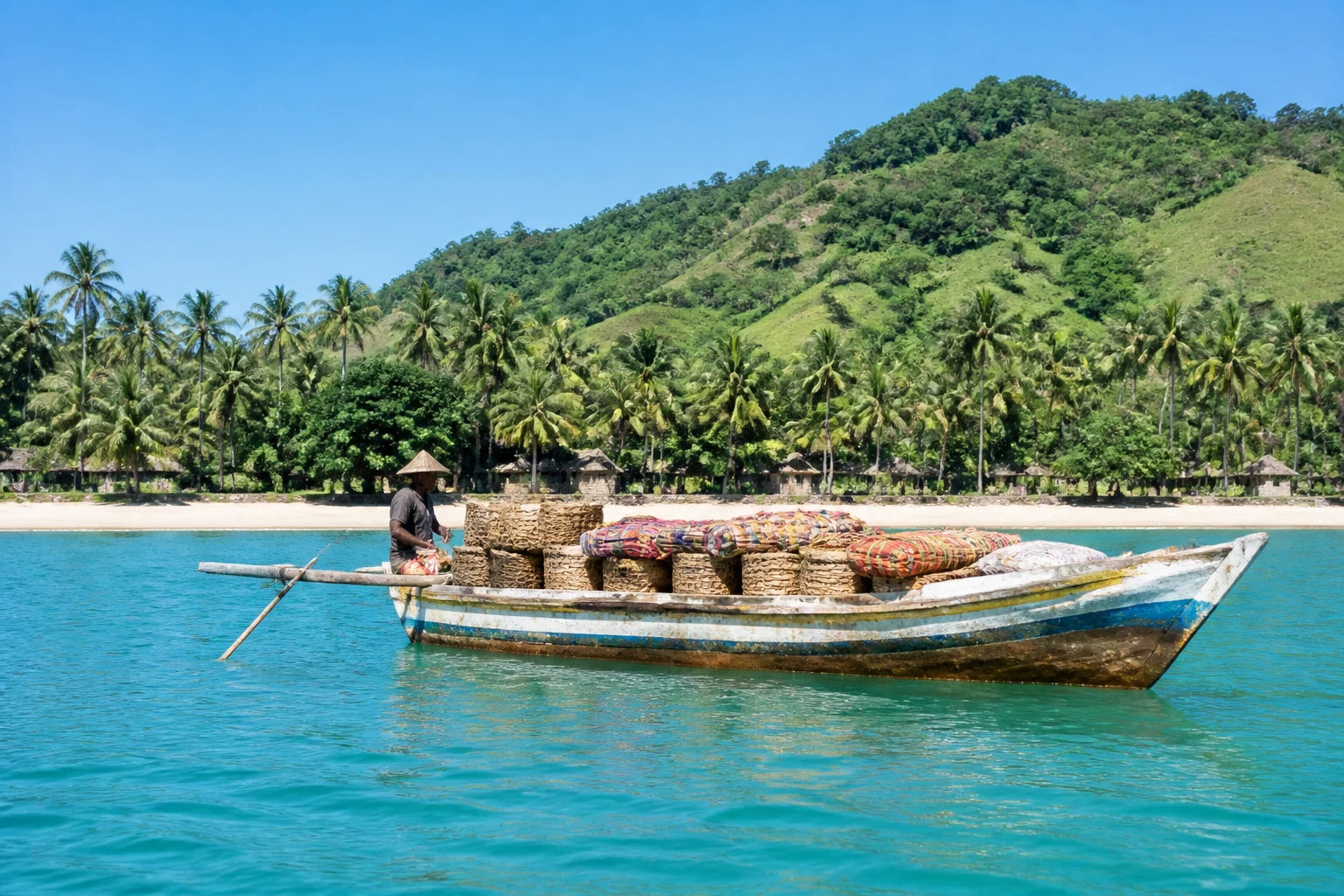
Shipping Furniture and Household Goods to Lombok: Customs, Costs, and When to Buy Local
Most buyers find that shipping a full container to Lombok costs more than it saves. Indonesian customs duties, local handling fees, and a growing regional furniture market mean buying locally or sourcing from Bali usually offers better value. Shipping makes sense only for specialist items, heirlooms
Quick answer: Most buyers find that shipping a full container to Lombok costs more than it saves. Indonesian customs duties, local handling fees, and a growing regional furniture market mean buying locally or sourcing from Bali usually offers better value. Shipping makes sense only for specialist items, heirlooms, or equipment that cannot be sourced in the region.
The Customs Reality: What Indonesia Charges
Indonesia's customs authority, Bea Cukai (the Directorate General of Customs and Excise), applies import duties to most household goods and furniture shipped from abroad. Duty rates vary by product category and Harmonised System (HS) code: furniture typically falls in the 5 to 20 per cent range, while some appliances and electronics attract higher rates depending on classification.
Value-added tax (PPN) of 11 per cent is applied on top at the time of import. For a full household shipment, the combined tax burden can reach 15 to 30 per cent of the declared customs value, depending on how goods are classified and whether the consignment is selected for physical inspection.
The key exception is the personal effects exemption. Foreign nationals who hold a valid KITAS (temporary stay permit) or KITAP (permanent stay permit) and can demonstrate they lived abroad continuously for at least one year may import used household goods duty-free. The route requires advance coordination with a licensed customs broker (known in Indonesia as a PPJK), careful documentation of ownership before departure, and a shipment arrival timed to coincide with the holder's relocation. Timing is strict: arriving before or significantly after the permit activation window can forfeit the exemption entirely.
Container Shipping to Lombok: Costs and Logistics
Lombok receives commercial cargo primarily through the port of Lembar, on the south-west coast of the island, roughly 22 km from Mataram. There is no direct deep-water container service from Europe or Australia; virtually all shipments transit through regional hubs, most commonly Singapore, Port Klang (Malaysia), or Surabaya in East Java, before a feeder vessel continues to Lembar.
A standard 20-foot container holds approximately 28 to 33 cubic metres of usable space, enough for the contents of a well-furnished apartment. Ocean freight from northern Europe to Indonesia typically takes 25 to 35 days at sea. The full door-to-door cost, covering freight, destination port handling, customs clearance, broker fees, and inland trucking to South Lombok, can easily reach USD 5,000 to 10,000 or more, depending on origin, cargo volume, current freight market rates, and how smoothly customs clearance proceeds.
Australian origins offer shorter transit times but do not guarantee a lower total landed cost, as destination charges and duties apply regardless of where goods are shipped from. Engaging a PPJK-licensed customs broker based in Mataram is not optional: they navigate Bea Cukai documentation, Lartas (import restriction) checks, and physical inspection coordination. Budget conservatively and confirm all destination charges in writing before signing a shipping contract.
For buyers also working through the visa and permit process, see the guide to relocating to Lombok for context on KITAS, KITAP, and what residency status affects.
What Is Worth Importing, and What Is Not
The economics favour importing only when an item is irreplaceable locally, carries sentimental or personal value, or is a high-specification piece that would cost substantially more to source regionally even after duty and freight are counted.
Items that frequently justify the logistics:
- High-specification kitchen appliances with exacting requirements (Indonesia runs on 220V/50Hz, consistent with most European equipment, so voltage compatibility is usually not the obstacle)
- Custom or bespoke furniture that cannot be replicated in Bali or Mataram workshops
- Specialist outdoor, diving, or marine equipment not readily stocked on the island
- Personal studio, workshop, or professional equipment tied to a specific brand or configuration
Items that rarely justify the cost:
- Mid-market sofas, beds, dining tables, and wardrobes, all produced at scale in Bali and available to ship to Lombok within days
- White goods: refrigerators, washing machines, and air-conditioning units are widely available through Indonesian and regional retailers
- Generic lighting, soft furnishings, and cookware
- Standard audio or home-cinema equipment available from electronics retailers in Mataram
Indonesian antiques and cultural artefacts are subject to strict export controls under Indonesian law. Importing such items purchased overseas adds a separate documentation layer and is rarely straightforward; take specific legal advice if this applies to your situation.
Buying Locally: Bali, Mataram, and Lombok Suppliers
The furniture industry centred on Bali, particularly around Denpasar, Gianyar, and the workshops in the Ubud corridor, is one of Southeast Asia's most developed. Handcrafted teak, reclaimed-wood pieces, rattan, woven textiles, and stone carving are produced to export standard and sold at prices that remain highly competitive relative to European equivalents, even before any shipping savings are counted. Overland-and-ferry or short sea freight from Bali to Lombok takes one to two days and is inexpensive by comparison with any international shipping option.
Mataram, Lombok's commercial capital, has a growing strip of furniture and homeware retailers along its main commercial corridors. Quality varies, but mid-range to good-specification pieces are achievable at accessible prices. Villa developers working in South Lombok, including the team at Samudra Villas (HubLombok's editorial partner and the developer behind the Are Guling project we cover), typically combine Bali suppliers with local craftspeople for their turnkey fit-outs. Buyers working independently can replicate this model without a developer intermediary, and most Bali suppliers are accustomed to shipping directly to Lombok addresses.
For a practical breakdown of fit-out costs and sourcing categories, see furnishing a Lombok villa on a realistic budget.
Practical Guidance
Before committing to a shipping contract, calculate the full landed cost: ocean freight, marine transit insurance (typically 1 to 2 per cent of declared cargo value), destination port handling charges, customs duty and PPN, broker fees, and inland trucking to the property. Compare this figure honestly against the cost of equivalent items sourced from Bali or Mataram. For most standard furniture and appliances, the Bali route wins on both cost and convenience.
If you hold, or are in the process of acquiring, a KITAS or KITAP, take legal advice on the personal effects exemption before signing any shipping agreement. The eligibility window is strict, and missing it means paying full duty on goods that could have entered duty-free.
For most buyers of a villa or investment property in South Lombok, the practical approach is to ship only what cannot be replaced or replicated regionally, and to furnish the bulk of the property from Bali suppliers or local makers. The quality of regional production is high, the logistics are predictable, and the savings compared with full-container international shipping are substantial.
For orientation around the island once you are on the ground, see getting around South Lombok.
Do I have to pay customs duty on furniture and household goods imported to Lombok?
Most imported household goods and furniture attract Indonesian customs duty, typically 5 to 20 per cent depending on the product category, plus 11 per cent value-added tax (PPN) applied on top. Foreign nationals with a valid KITAS or KITAP who are relocating after at least one continuous year abroad may qualify for a personal effects exemption, allowing used household goods to enter duty-free, subject to documentation and strict timing requirements.
Is it cheaper to ship furniture from Europe or Australia, or to buy locally in Bali?
For most standard items, buying from Bali is cheaper once you account for ocean freight, Indonesian import duties, destination port handling charges, customs broker fees, and final delivery to Lombok. Shipping from abroad makes financial sense mainly for specialist, bespoke, or sentimental pieces that cannot be sourced or replicated in the region.
Which port handles containerised cargo shipments to Lombok?
Most containerised cargo arrives at the port of Lembar, on Lombok's south-west coast, approximately 22 km from Mataram. There is no direct deep-water service from Europe or Australia; shipments transit through regional hubs such as Singapore, Port Klang, or Surabaya before a feeder vessel continues to Lembar. A licensed customs broker (PPJK) based in Mataram is essential for navigating clearance, documentation, and inland delivery.
The Lombok Buyer's Field Guide
Legal structures ranked by risk, the honest ROI math line by line, all six zones ranked, and the 24-point due-diligence checklist. The whole book, free in your inbox.
See what's inside