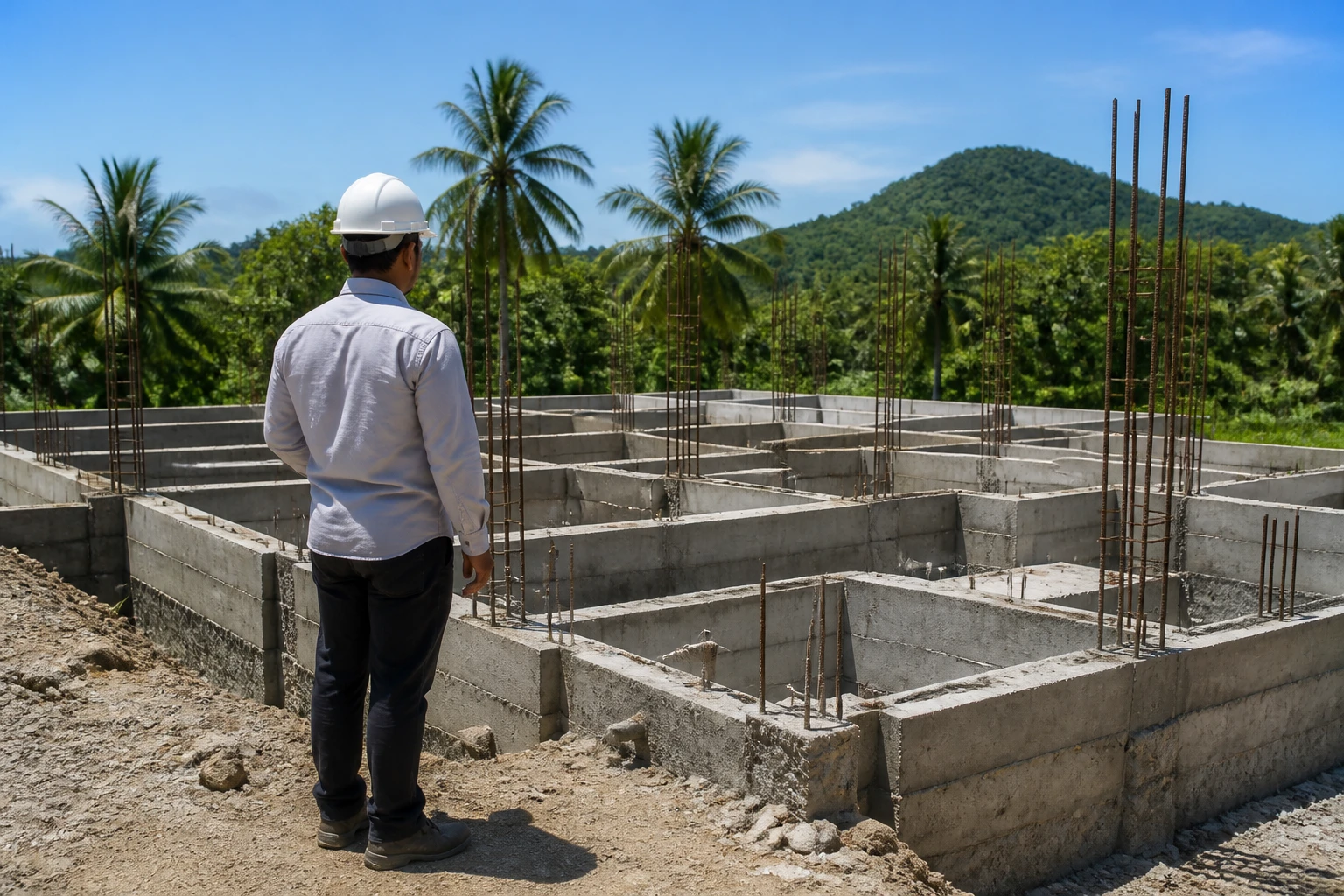
Quality control during a Lombok villa build: inspections that pay off
Hiring an independent site supervisor and scheduling inspections at four critical stages, foundation, structural frame, waterproofing and fit-out, is the most reliable way to catch defects before they become costly repairs. In tropical Lombok conditions, problems found early can be fixed for a fract
Quick answer: Hiring an independent site supervisor and scheduling inspections at four critical stages, foundation, structural frame, waterproofing and fit-out, is the most reliable way to catch defects before they become costly repairs. In tropical Lombok conditions, problems found early can be fixed for a fraction of what they cost once walls are plastered and tiled.
Why independent supervision matters on a remote site
Building a villa in South Lombok is increasingly attractive for foreign investors, with turnkey entry prices ranging from around EUR 95,000 to EUR 350,000. The economics only work, however, if the build quality matches the price paid.
The challenge is that most foreign buyers are not in Lombok during construction. Contractors in any market, not just Indonesia, tend to apply less scrutiny when no one is monitoring consistently. A local architect or developer's site manager is useful but carries an obvious conflict of interest: they are commercially aligned with the builder, not the buyer.
An independent owner's representative, sometimes called an OPM (owner's project manager) or QC supervisor, sits outside that relationship. Their job is to document each stage, flag non-conformances in writing, and attend inspections before concrete is poured or cavities are closed. For a build in the EUR 150,000 to EUR 300,000 range, a competent OPM typically charges 3-5% of the contract value. That fee is usually recovered on the first significant defect they prevent.
For a broader introduction to the contractor relationship and how to structure your agreements before breaking ground, see working with an architect and contractor in Lombok.
Four inspection stages that make the difference
Foundation and substructure. Before any slab is poured, an inspector verifies that pile depths or spread footings match the structural drawings, that reinforcement bar (rebar) spacing and diameter are correct, and that the ground has been compacted and graded properly. Errors here are cheapest to fix and most expensive to ignore: a poorly reinforced foundation cannot be corrected once concrete has cured.
Structural frame and columns. Once the columns and ring beams are in place, a second inspection checks vertical plumb, correct rebar overlap at joints, and whether tie columns have been added where the drawings specify. In seismically active regions, including South Lombok, the tie-column requirement is not optional. Any shortcut here creates risk to the whole structure.
Waterproofing and drainage. Before roof tiles and ceiling linings go in, an inspector verifies that membrane waterproofing has been applied to all flat or low-pitch roof sections, that all pipe penetrations are sealed, and that surface drainage slopes direct water away from the structure. A 24-hour flood test on flat roofs, documented with photographs, is a reasonable standard to require before sign-off.
Fit-out and services. The final inspection covers electrical installation (earthing, circuit-breaker sizing, conduit runs), plumbing waste gradients, tile adhesion confirmed by tapping for hollows, door and window sealing, and the quality of applied finishes. This phase is the most visible but also the most vulnerable to rushed finishing when a handover date is imminent.
Common tropical build defects and where they hide
South Lombok's heat, humidity and seasonal rainfall create conditions where certain defects appear reliably. Incomplete waterproofing on flat roofs and parapets is the most frequent source of callbacks, usually emerging in the first wet season, three to six months after handover. Rising damp from inadequate ground-level damp-proof membrane affects ground-floor walls and is costly to address once plastering is complete.
Hollow tiles, caused by insufficient adhesive coverage or substrate movement before grouting, are a comfort and safety concern in high-traffic areas. Undersized electrical circuits, particularly for split air-conditioning units, cause nuisance tripping and, in poorly earthed installations, can present genuine safety hazards.
Rebar substitution, where a contractor replaces specified 12mm diameter rod with 10mm to reduce material cost, is difficult for a non-specialist to identify. An experienced OPM can verify specifications against supplier delivery notes and on-site measurements before the frame is closed.
The article common build defects in tropical Lombok goes deeper on each defect category and the remediation options available once a problem has been identified.
What catching problems late actually costs
A defect found before concrete is poured might be resolved with a few hours of rebar work. The same structural shortcoming discovered after walls are rendered requires breaking out concrete, re-specifying, re-pouring and replastering. Defect remediation costs in construction grow non-linearly with each stage of progress.
Waterproofing failures found at the fit-out stage, rather than during the dedicated waterproofing inspection, can damage timber ceilings, cause mould growth in insulation and affect bespoke joinery. What might have cost a modest sum in materials early on can become a significant fit-out redo once finishes are in place.
Investors buying through a developer, as Samudra Villas buyers in Are Guling do, typically benefit from contractual defect liability periods and construction warranties. Independent stage inspections complement those protections by giving buyers contemporaneous documentary evidence of the build at each phase, which is valuable both within the defect period and at resale.
Practical steps before ground breaks
Appoint your OPM before construction begins, not after the first problem appears. Agree in writing which stages trigger an inspection hold: no concrete pour without a signed-off foundation report, for example. Request that your contractor provides materials delivery records and mix-design documentation for all structural concrete. Budget 3-5% of your construction contract for independent site supervision.
Quality control is not a luxury on a remote tropical build. It is the mechanism by which the price you pay for a villa corresponds to the asset you actually receive. The cost of catching a problem early is almost always a small fraction of the cost of finding it after the walls go up.
For a complete framework covering how to read drawings, appoint professionals and structure stage payments, the guide to building a villa in Lombok is the place to start.
Do I need an independent inspector if the developer already has a site manager?
Yes. The developer's site manager works for the developer, not for you. An independent owner's representative has no commercial conflict and reports directly to the buyer, providing unbiased documentation at each build stage. Even where developer contracts include defect liability periods, independent inspections give you contemporaneous evidence that is useful if disputes arise.
At what build stage is it too late to commission a quality inspection?
It is never too late to commission an inspection, but the value diminishes once a stage is closed. If walls are already plastered, waterproofing layers and rebar cannot be verified visually. An inspection at final fit-out can still identify electrical, plumbing and surface defects, but those found during the relevant structural or waterproofing stage are far cheaper to correct.
What should I look for in an OPM or site supervisor in Lombok?
Look for someone with demonstrable experience on residential builds in Indonesia, ideally South Lombok specifically, and the ability to read structural and MEP drawings. They should be willing to provide written stage reports with photographs rather than verbal updates only. Independence from your contractor and developer is the non-negotiable requirement: the supervisor must have no financial relationship with the building team.

The Lombok Buyer's Field Guide
Legal structures ranked by risk, the honest ROI math line by line, all six zones ranked, and the 24-point due-diligence checklist. The whole book, free in your inbox.
See what's inside