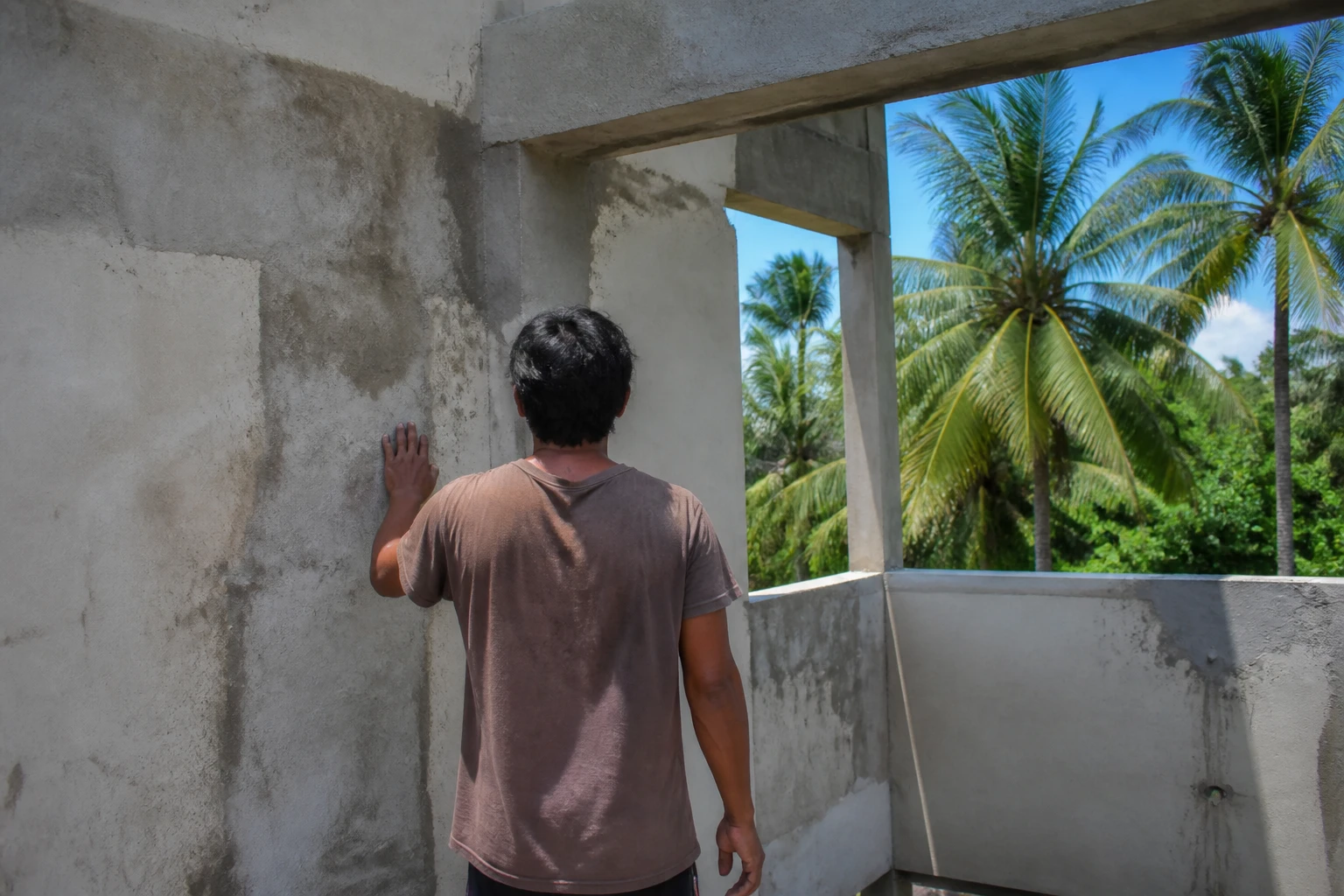
Common Villa Build Defects in Lombok's Tropical Climate
Lombok villas face five recurring build failures: rising damp, black mould, termite penetration, salt-driven steel corrosion, and roof drainage overload. Each stems from under-specifying materials or skipping tropical-detail work. The good news: every one is preventable at design stage for a fractio
Quick answer: Lombok villas face five recurring build failures: rising damp, black mould, termite penetration, salt-driven steel corrosion, and roof drainage overload. Each stems from under-specifying materials or skipping tropical-detail work. The good news: every one is preventable at design stage for a fraction of the retrofit cost.
Moisture and Mould: The Silent Structural Threat
Lombok's south coast receives over 1,500 mm of rainfall annually, most of it concentrated between November and March. Combined with year-round humidity that rarely drops below 75%, moisture is the dominant enemy of any permanent structure here.
The most common failure is rising damp in ground-floor slabs. Builders using standard hollow-block cavity walls without a proper damp-proof membrane allow groundwater to wick upward, saturating plasterwork and spawning black mould colonies within twelve to eighteen months. Once mould is established inside wall cavities, remediation means stripping render back to block, treating with biocide, and replastering. A competent build specifies a continuous waterproof membrane beneath the slab and a damp-proof course at the first bed joint, adding perhaps 2 to 3% to foundation costs.
Flat or near-flat roof sections compound the problem. Any ponding water, even shallow, works through slab joints and around pipe penetrations. The fix is straightforward: a minimum roof pitch of 5 to 10 degrees to all drainage outlets, closed-cell insulation under roof decks to prevent condensation cycling, and penetrations sealed with fibre-reinforced bitumen flashing rather than silicone alone. Silicone degrades in UV within three to four years in a tropical climate.
Termites and Timber: Building for the Enemy
Termite pressure in South Lombok is severe. The subterranean species Coptotermes gestroi builds invisible mud tubes from soil to timber framing, consuming structural members from the inside. A timber roof truss can be hollow while still looking intact from outside. Inspections that tap and probe are essential.
The answer is not to avoid timber entirely, which would eliminate the warmth and character buyers want, but to specify it correctly. All timber should be graded, kiln-dried hardwood (kayu jati or similar), treated with a borate-based preservative that penetrates the full cross-section. Structural columns should sit on stainless or galvanised base plates, never directly on concrete, so the end grain is protected and any moisture beneath the column cannot wick upward. Roof voids should be designed for inspection access so annual surveys are practical, not theoretical.
Chemical soil treatment at foundation stage is standard practice across Southeast Asia and adds under 1% to total build cost. Without it, termite damage often appears within five years of handover. For a detailed walkthrough of structural quality checks during construction, see the quality-control guide for Lombok villa builds.
Salt Corrosion and Coastal Exposure
Within two kilometres of the coast, salt-laden air accelerates corrosion at a rate that surprises buyers accustomed to European or Australian conditions. Standard mild steel in concrete reinforcement can begin to corrode within three to five years when cover depth is inadequate, causing concrete to crack and spall as the rust expands.
Correct practice is a minimum 40 mm concrete cover over all reinforcement, using low water-cement ratio concrete (0.45 or below) to reduce porosity. For exposed metalwork, including balustrades, hinges, fixings and structural steelwork, specify marine-grade 316 stainless steel or hot-dip galvanised with a protective coating. The cheaper 304 stainless loses its corrosion resistance in high-salt coastal environments, often within three to four years.
Plumbing and electrical conduit at or below slab level are equally at risk. Rigid PVC conduit with solvent-welded joints outperforms flexible conduit in damp ground. For a practical review of how utilities are run in well-specified Lombok villas, see water, power and internet in a Lombok villa.
Roof and Drainage Failures
A tropical rainstorm on Lombok's south coast can deliver 80 to 100 mm of rainfall in under two hours. Standard residential drainage calculations from temperate climates are entirely inadequate for this intensity. Undersized gutters and downpipes create waterfalls over exterior walls, saturating perimeter foundations and, on sloped sites, channelling sheet flow directly under the building.
The practical spec: size gutters for a rainfall intensity of at least 100 mm per hour, use minimum 110 mm diameter downpipes at intervals of no more than 5 to 6 metres of gutter run, and route all downpipes to a below-ground soakaway or perimeter drain sized for site-specific soil permeability. Sloped sites need cut-off drains uphill of the building footprint to intercept surface water before it reaches the structure.
Roof flashings at parapet junctions and at the wall-to-roof interface are frequent leak points. Standard galvanised flashings deteriorate in salt air within five to seven years. Specify aluminium or stainless steel, dressed continuously and mechanically fixed, not simply bedded in mortar.
Specifying Your Way Out of the Problem
Every defect described above has a cost-effective design solution available at the time of build. The common thread is that budget developers omit these details to win the contract price, and buyers discover the consequences eighteen to thirty-six months after handover, outside any meaningful warranty window.
For buyers working with a developer on a turnkey villa, the complete building guide for Lombok sets out the full specification checklist. Ask your developer to provide a written materials schedule covering concrete grade, reinforcement cover depth, timber treatment standard, and waterproofing membrane specification. If they cannot supply this document, treat the gap as a significant warning sign.
As the editorial arm of Samudra Villas, an active developer in Are Guling, we encounter these issues regularly on competing builds that cut specification corners. The villas that hold their rental yield and resale value are, without exception, those built to a proper tropical standard from day one.
Before accepting handover of any villa, commission an independent inspection from a qualified structural surveyor. Budget around USD 500 to 1,000 for this service. It is the least expensive insurance you will buy on a six-figure asset.
What is the most common build defect in Lombok villas?
Rising damp, caused by missing or inadequate damp-proof membranes beneath ground-floor slabs, is the most frequently reported failure. It typically manifests as black mould on interior wall surfaces within twelve to eighteen months of handover and is costly to remediate once established inside wall cavities.
How do I protect a Lombok villa from termite damage during construction?
Specify kiln-dried, borate-treated structural hardwood for all timber elements, install stainless or galvanised base plates so columns never sit directly on concrete, and have the soil chemically treated at foundation stage. Design roof voids to allow annual inspection access. Chemical soil treatment adds under 1% to build cost and is far cheaper than post-infestation remediation.
Which grade of stainless steel should I specify for a coastal Lombok villa?
Marine-grade 316 stainless steel for all exposed metalwork, including balustrades, fixings, hinges and structural steelwork. Standard 304 stainless loses its corrosion resistance in high-salt coastal environments, typically within three to four years, and is not suitable for sites within two kilometres of the coast.
The Lombok Buyer's Field Guide
Legal structures ranked by risk, the honest ROI math line by line, all six zones ranked, and the 24-point due-diligence checklist. The whole book, free in your inbox.
See what's inside