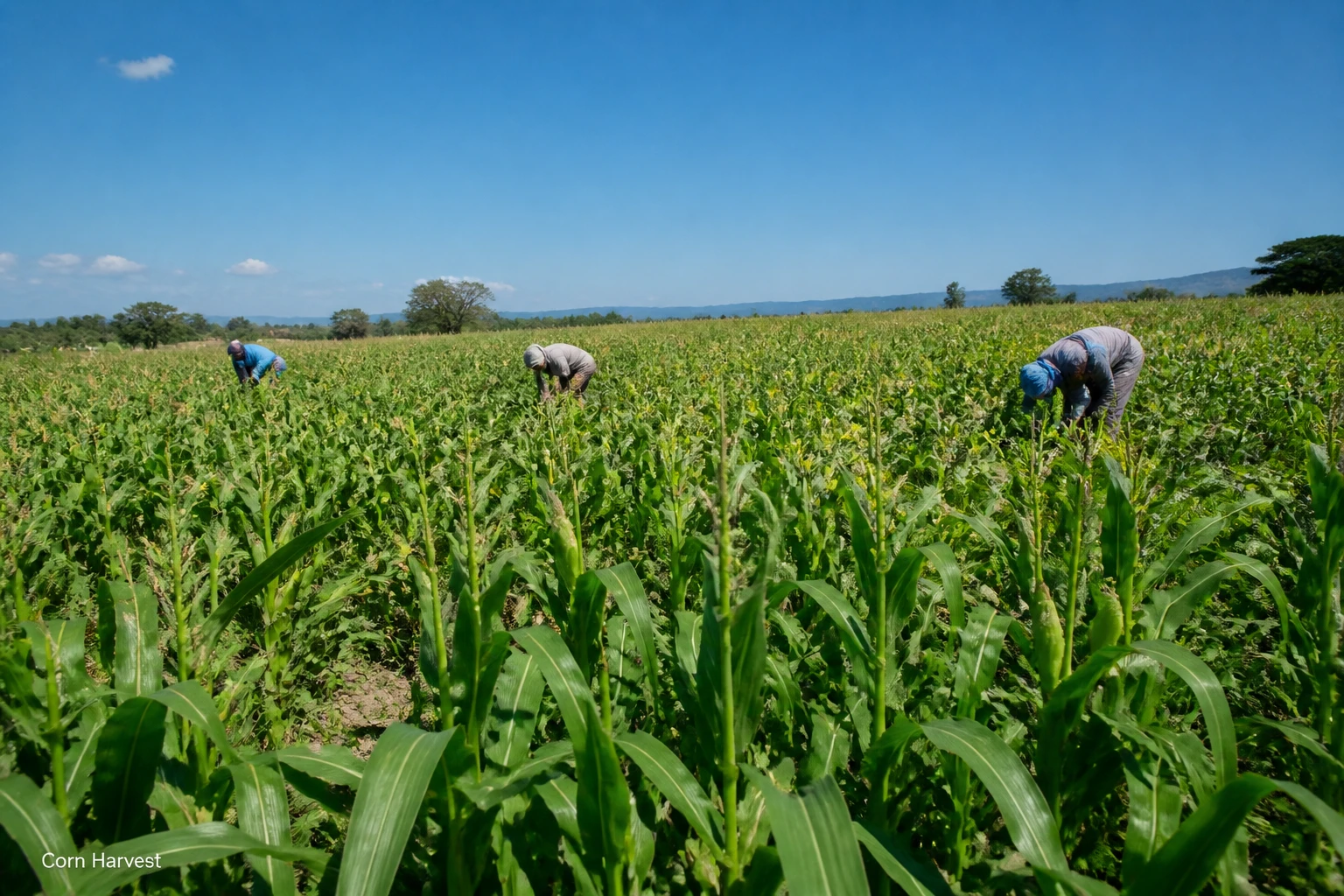
Prabowo Launches Corn Harvest Festival: Agricultural Productivity Fuels Rural Demand
President Prabowo's Q2 2026 corn harvest festival signals strong agricultural productivity across regions. For Lombok investors, robust harvests mean rural income growth and accelerated property deman
President Prabowo Subianto launched the second-quarter 2026 nationwide corn harvest festival this week, a ceremonial signal with real implications: regional agricultural productivity is tracking well enough to warrant a public celebration. For Lombok property investors tracking rural economic fundamentals, this matters more than it appears.
The Context
Corn harvest festivals are not random policy theater. They're government confirmation that agricultural yields are meeting or exceeding expectations at a regional scale. When a president personally launches such an event, it signals confidence in sector momentum and typically precedes follow-up agricultural support spending, input subsidies, infrastructure improvements, market access enhancements.
The Q2 timing is significant. Indonesia's corn harvest cycles run roughly April through July depending on region. A festival launched in May is essentially a mid-season progress check. If yields are tracking well enough to publicize, it suggests:
- Regional harvest projections are robust across the producing areas Prabowo chose to highlight
- Government expects final-quarter completion of harvest cycle to be strong
- Agricultural credit and input spending are flowing as planned
For secondary regions like West Nusa Tenggara (Lombok's province), corn is a significant crop alongside rice. A strong harvest season directly translates to farmer incomes, rural savings accumulation, and local purchasing power, the exact conditions under which cooperatives (operationalized 1,061 units just announced days ago) gain traction.
Agricultural Productivity and Rural Property Demand
 Prabowo Launches Corn Harvest Festival · Photo by Rakibul alam khan on Pexels
The causal chain is straightforward but often invisible to property investors focused on tourism flows:
Harvest strength → Farmer incomes rise → Rural savings grow → Cooperative savings products gain adoption → Local purchasing power concentrates → Secondary-town property demand accelerates
Lombok's property market has historically tracked tourism metrics: 40–50% YoY tourism growth, MotoGP arrivals up +47%, yields 12–22%, South Lombok entry €95–350K. That narrative is real and visible. But what's less visible is the parallel thread: rural income strength.
When a corn harvest is strong, smallholder farmers in Lombok's interior see 20–30% income gains relative to weak harvest years. That might not sound like much, but multiply it across thousands of farming households, aggregate it into cooperative savings pools, and suddenly you have real capital formation outside the tourism ecosystem.
Here's the repricing dynamic:
| Scenario | Property Type | Buyer Profile | Yield Range | Demand Driver | |----------|---------------|---------------|-------------|---------------| | Strong harvest + co-ops active | Secondary-town residential | Local professional | 15–18% | Rural income growth | | Weak harvest + limited credit | Secondary-town residential | Speculation-only | 20%+ | None (demand flat) | | Tourism boom | South Lombok villa | Foreign speculative | 12–15% | Bali overflow, MotoGP |
We're in the first scenario now: strong harvest signals + 1,061 cooperatives operational. This is the inflection point.
Why Timing Matters: The Convergence Window
Corn harvest festivals don't typically make property headlines, but this one does because of convergence timing. Consider the macro backdrop:
- Rural cooperatives are operationalized (1,061 active, targeting 30,000 by July)
- Agricultural harvests are tracking well (Prabowo wouldn't celebrate weak yields)
- Airport expansion 2025–26 is underway, improving regional accessibility
- Tourism demand remains strong (+40–50% YoY)
Each of these is independently significant. Together, they create a moment where secondary-town property in Lombok should be repricing upward, but hasn't yet because most investors are watching tourism metrics, not harvest reports.
The window is tactical: next 120 days (through August harvest completion). During this period:
- Farmer incomes will peak from final harvest sales
- Cooperative credit will expand as harvest receipts flow into savings pools
- Local wage employment in secondary towns will rise to service agricultural processing and logistics
- Property demand will shift from purely speculative (foreign tourism) to practical (local professional/wage earner)
After August, the repricing signal becomes visible and entry prices reset. The opportunity window closes.
What This Means for Investors
1. Mataram and secondary-town residential is the tactical play. Assets currently priced for agricultural Lombok (€80–150K range for non-tourism residential in secondary towns) should reprice upward 8–15% as local professional demand materializes. These aren't tourism plays, they're stability plays. Yields will compress from 20%+ toward 15–18%, but occupancy will firm from speculative to practical.
2. Harvest festival signals government confidence in supply. When presidents celebrate agricultural output, it typically precedes policy spending on downstream infrastructure: processing facilities, market aggregation, logistics. That spending creates jobs in secondary towns, exactly the demographic that drives residential property demand.
3. Cooperatives need harvests to scale. The 1,061 operational cooperatives announced days ago require membership buying participation and savings deposits to work. Strong harvests mean farmers have cash to save. Weak harvests mean cooperatives become empty institutions. The harvest festival is essentially confirmation that the cooperatives have the underlying economic fuel they need.
The convergence is real: Rural infrastructure (cooperatives) + Agricultural productivity (harvest) + Regional accessibility (airport expansion) + Tourism demand (backdrop support). This combination is rare. Property investors outside Lombok likely aren't seeing it yet.
Strategic action: If you're positioned in South Lombok villas (tourism dependent, 12–15% yields), this is not actionable, those positions are already priced. If you're watching secondary-town residential as too speculative, reconsider. The harvest report just upgraded the fundamentals.
The next few months will reveal whether rural income growth translates to visible property repricing. Prabowo's harvest festival celebration is essentially a public signal that the conditions are now in place.
Stay informed, subscribe to the free Lombok Briefing for market intelligence like this, published twice a month.
How does Indonesia's corn harvest affect property demand in Lombok?
A strong corn harvest raises smallholder farmer incomes by 20 to 30 percent relative to weak years. Aggregated across thousands of farming households and channelled through cooperatives, that capital formation drives demand for secondary-town residential property in Lombok, shifting the buyer profile from speculative to local professional and practical occupiers.
What property types and yields does rural income growth support in Lombok?
Rural income growth supports secondary-town residential assets currently priced in the 80,000 to 150,000 euro range. As local professional demand materialises, yields are expected to compress from above 20 percent toward 15 to 18 percent while occupancy firms. This contrasts with South Lombok villa plays, which are tourism-driven and priced at 95,000 to 350,000 euros entry.
Why are rural cooperatives relevant to Lombok property investment in 2026?
With 1,061 cooperatives now operational and a target of 30,000 by July, their growth depends on farmers having cash to deposit. A confirmed strong harvest, as signalled by President Prabowo's Q2 2026 festival launch, provides that savings fuel. Active cooperatives expand local credit access, supporting wage employment and residential demand in secondary towns.

The Lombok Buyer's Field Guide
Legal structures ranked by risk, the honest ROI math line by line, all six zones ranked, and the 24-point due-diligence checklist. The whole book, free in your inbox.
See what's inside