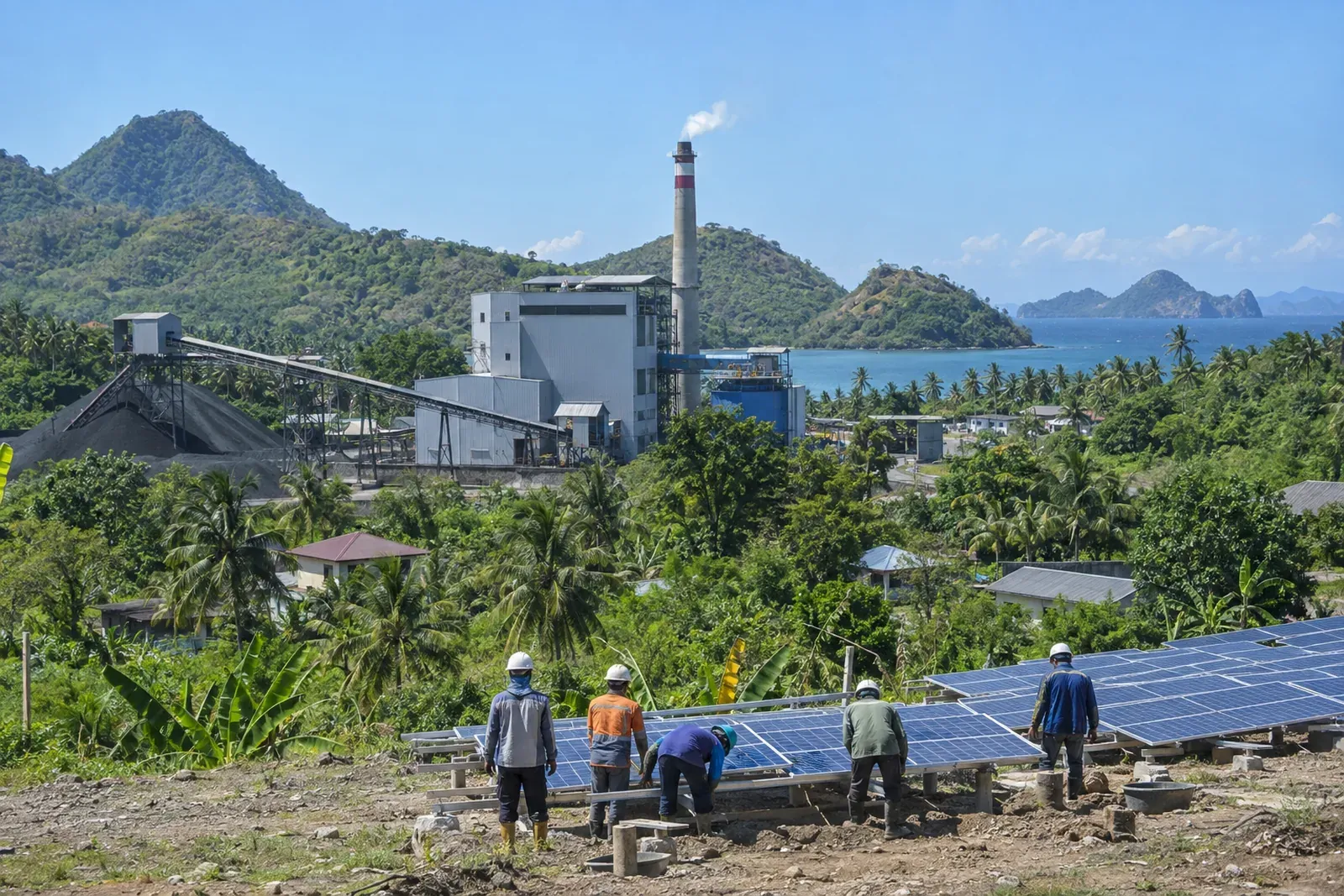
NTB Plans Solar Conversion for Six Small Coal Plants
West Nusa Tenggara is assessing the conversion of six small coal plants to solar facilities, with land and investment central to delivery.
West Nusa Tenggara’s proposed conversion of six small coal-fired power plants into solar facilities could become an important marker in the province’s energy transition. For investors watching Lombok and the wider NTB economy, the announcement is notable less for a finished project pipeline than for what it reveals about official priorities: renewable generation, private capital and the land needed to make both work.
The plan remains at the assessment stage, with no implementation timetable set. Yet it places power infrastructure alongside tourism and land-use planning in a province seeking to strengthen its positioning as a cleaner, more sustainable destination.
A proposed shift from coal to solar
According to Samsudin, head of West Nusa Tenggara’s Energy and Mineral Resources Office, state utility PLN presented the conversion proposal during a meeting with Governor Lalu Muhamad Iqbal. The initiative would replace six small coal-fired power plants with solar facilities across Lombok and Sumbawa.
PLN has identified 1.73 gigawatts of renewable-energy potential in NTB, principally from solar and wind power, according to the provincial government.
Samsudin said that estimated potential could increase as PLN’s plans to replace coal-fired generation with solar proceed. The source identifies Paokmotong, Ampenan, Baok Botok, Bima and Dompu among the coal-plant locations associated with the plan. It reports a six-plant conversion programme, while naming those facilities individually.
The proposal deliberately concerns smaller plants. Jeranjang, a larger facility in West Lombok, is excluded. That distinction matters: the announcement should not be read as a blanket commitment to replace all coal generation in the province, nor as confirmation that any particular plant has already been converted.
Technical assessment comes before construction
For now, the principal word is assessment. Samsudin said every conversion proposal is undergoing technical review, and officials have not announced a delivery schedule. This is an early policy and infrastructure initiative, rather than an operational solar programme.
That status carries a useful lesson for investors. Renewable-energy announcements can signal direction, but the investable details typically sit further downstream: site suitability, land rights, technical design, commercial arrangements and the ability to connect projects into the power system. None of those elements has yet been set out in the reported plan.
The province, PLN and district administrations intend to conduct field visits to map potential project sites and assess land availability. Local officials are also expected to work with district heads to identify suitable land and prepare what Samsudin described as a fair acquisition mechanism designed to protect communities while facilitating investment.
Land availability remains the central challenge identified by the provincial government.
This places land at the heart of the story. A solar project is not simply an energy asset; it is also a land-use proposition. The quality of local engagement, clarity of acquisition processes and suitability of individual sites will therefore be consequential to whether the proposal moves from assessment into execution.
Private capital is part of the official approach
The provincial government is encouraging PLN and investors to develop solar, wind and geothermal projects through the Independent Power Producer, or IPP, scheme. Samsudin said PLN would need to work with investors because the utility could not undertake the projects alone.
That is a meaningful policy signal, though not an invitation to assume that projects are immediately available for investment. No project allocations, terms, capital requirements or timelines were specified in the source. Nor were individual developers, investors or sites announced.
Still, the framework points towards a model in which public coordination and private participation could coexist. For international investors, the relevant question is likely to be whether future opportunities offer credible site access, sound legal documentation and commercially workable power arrangements. The announced field mapping and land assessment are the practical beginnings of that process.
Those considering any land-linked investment in Lombok should also keep the foreign-ownership rules distinct from the wider renewable-energy narrative. Foreigners cannot hold freehold land, known as Hak Milik or SHM; that right is reserved for Indonesian citizens. Available lawful routes include leasehold, Hak Pakai for qualifying residents, and a foreign-owned PT PMA holding Hak Guna Bangunan. Nominee arrangements, in which an Indonesian person holds freehold on a foreign buyer’s behalf, are illegal and void in court.
Cleaner energy and the tourism proposition
Samsudin linked the energy transition directly to NTB’s ambition to strengthen its standing as a sustainable, green tourism destination. That connection gives the plan a significance beyond electricity generation alone.
For Lombok’s hospitality, residential and tourism-facing property markets, energy policy can influence the broader investment narrative even before construction begins. It may shape how the province presents itself to visitors, operators and developers. But investors should distinguish an aspirational positioning statement from verified operational outcomes: the announced conversions are not yet complete, and the government has provided no timetable.
The clearest near-term implication is institutional alignment. The provincial government is framing renewable power, tourism and investment as mutually reinforcing priorities. The extent to which that alignment produces bankable projects will depend on the technical assessments, land mapping and future cooperation between PLN, investors and district administrations.
What this means for investors
The announcement is best viewed as an early-stage infrastructure signal rather than a completed energy transition.
- For infrastructure investors: NTB is explicitly encouraging participation in solar, wind and geothermal projects through the IPP scheme, but specific opportunities and commercial terms have not been announced.
- For land investors: land availability is the principal reported obstacle, making site selection, lawful tenure and community-sensitive acquisition central considerations.
- For tourism and property investors: officials see cleaner energy as part of NTB’s sustainable-tourism positioning, although no direct effect on individual developments or operating costs has been quantified.
- For risk assessment: six small coal-plant conversions are proposed and under technical review; there is no public implementation timetable.
The next evidence to watch will be practical rather than rhetorical: the outcome of technical assessments, the mapping of potential sites and the form of any future PLN-investor collaboration.
Stay informed, subscribe to the free Lombok Briefing for analysis like this, published twice a month.
Are the six NTB coal-to-solar conversions already approved or operating?
No. West Nusa Tenggara says the proposed conversion of six small coal-fired plants to solar facilities is undergoing technical assessment. Officials have not announced an implementation timetable, so the programme should be treated as an early-stage plan rather than an operating project.
Which coal plants are mentioned in NTB’s solar conversion plan?
The reported plan concerns six small plants across Lombok and Sumbawa. The source names Paokmotong, Ampenan, Baok Botok, Bima and Dompu among the locations involved, while stating that the larger Jeranjang plant in West Lombok is excluded.
What opportunity does the NTB plan create for private investors?
The provincial government is encouraging PLN and investors to develop solar, wind and geothermal projects through the Independent Power Producer scheme. However, no specific project allocations, investment terms, sites or delivery timetable have been announced in the reported plan.

The Lombok Buyer's Field Guide
Legal structures ranked by risk, the honest ROI math line by line, all six zones ranked, and the 24-point due-diligence checklist. The whole book, free in your inbox.
See what's inside