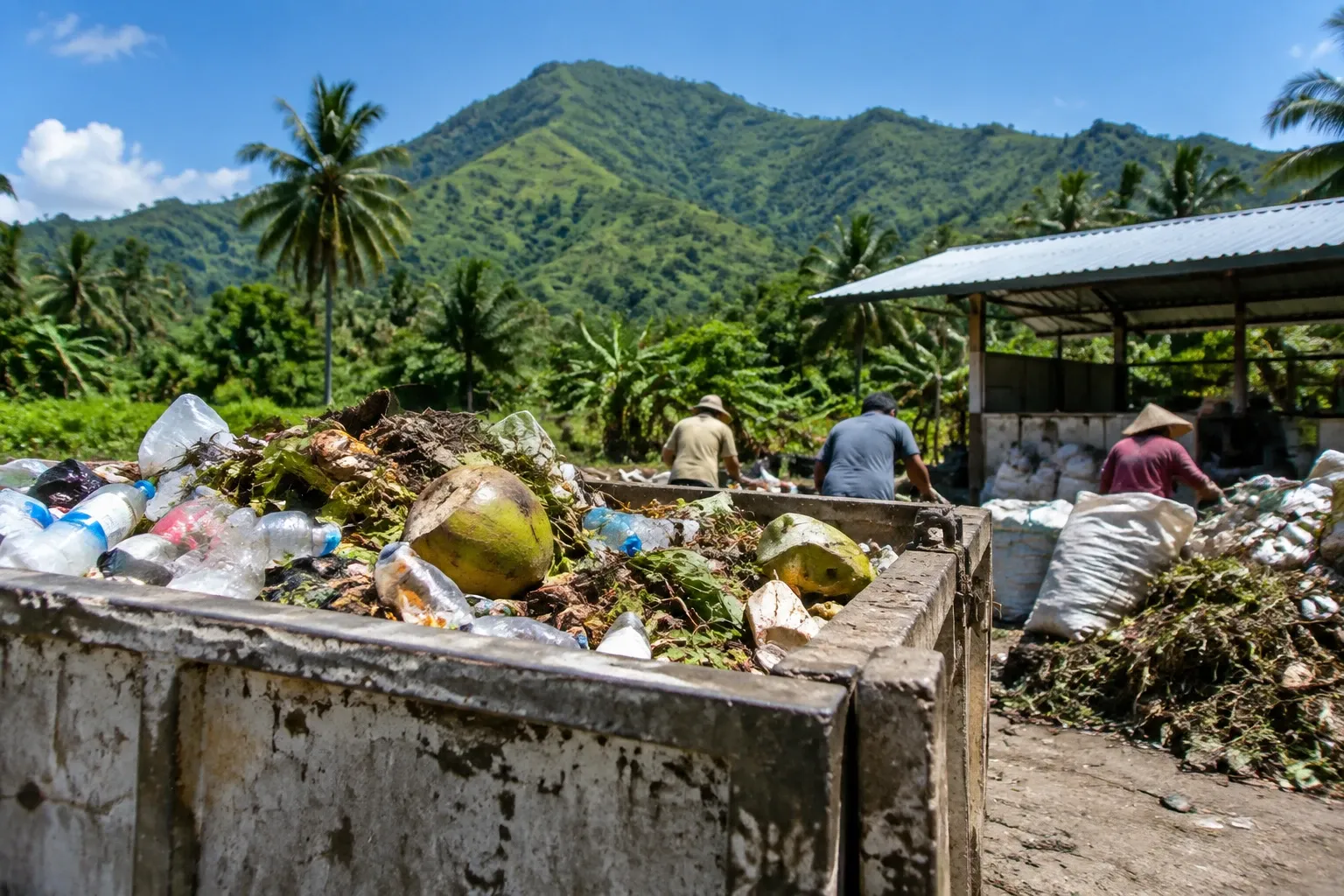
West Lombok Prepares to Reactivate 8 Waste Facilities: What It Signals for Investors
West Lombok's environment agency is preparing to reactivate eight TPS 3R waste-processing sites, following a central government directive to optimise regional waste infrastructure.
Waste management rarely makes headlines, yet it is one of the quieter infrastructure signals that seasoned property investors learn to watch. This week, West Lombok's environment agency confirmed it is preparing to bring eight dormant waste-processing facilities back online, a move triggered by a directive from Indonesia's central government.
Quick answer: The Lombok Barat (West Lombok) Environment Agency (DLH) is preparing to reactivate eight TPS 3R (Reuse, Reduce, Recycle) waste-processing facilities, following an instruction from the central government to optimise regional waste infrastructure. The physical buildings already exist; the agency is now working on getting them operational again.
What Is Being Reactivated
According to Radar Lombok, the Head of West Lombok's Environment Agency (Dinas Lingkungan Hidup, DLH), M Busyairi, confirmed that the agency is preparing the reactivation of TPS 3R sites, decentralised community-level facilities designed to process waste through reuse, reduction and recycling before it reaches landfill. Busyairi noted that the physical infrastructure, the buildings themselves, is already in place at these eight locations; what remains is the operational work of bringing them back into active use.
The move is explicitly described as a response to an instruction from Indonesia's central government aimed at optimising waste-processing capacity at the regional level. This frames the West Lombok initiative as part of a broader national push rather than an isolated local decision, though the source material does not detail the scope, funding, or timeline of that wider directive.
Why TPS 3R Facilities Matter
TPS 3R sites are a foundational layer of Indonesia's decentralised waste strategy. Rather than routing all household and commercial waste to central landfill sites, these community-scale facilities are designed to intercept and process a share of it locally, reducing the volume that ultimately needs transport and disposal elsewhere. When such facilities sit dormant, the practical result is more strain on landfill capacity and, in tourism-facing regions, a greater risk of visible waste accumulation in public and coastal areas.
For a district like West Lombok, which sits adjacent to South Lombok's fast-growing tourism corridor, functioning waste infrastructure is not a peripheral concern. It underpins the basic liveability and visual appeal that both residents and visitors expect, and it is precisely the kind of unglamorous public service that tends to lag behind faster-moving private investment in villas, hospitality and land.
The Broader Tourism Context
Lombok has been experiencing a pronounced rise in foreign arrivals, with the island's tourism recovery and the MotoGP-driven Mandalika effect contributing to a 40-50% year-on-year increase in foreign visitor numbers. Growth of that pace inevitably increases pressure on public infrastructure, waste management included, and it is reasonable to read a renewed push on TPS 3R capacity as part of local government catching up with that growth trajectory. The source article does not link the two directly, but the timing is consistent with a region managing rising visitor and resident volumes.
What This Means for Investors
Infrastructure stories like this one rarely move a market on their own, but they are a useful barometer for investors doing due diligence on a region rather than a single asset.
- Governance signal: A district agency acting on a central government directive, and being transparent enough to discuss it with local press, suggests at least a baseline level of administrative responsiveness. That matters more in emerging-market real estate than in mature markets, where institutional capacity is often taken for granted.
- Infrastructure catch-up, not infrastructure gap: The fact that the physical TPS 3R buildings already exist and simply need reactivation is a materially different story from a region needing to build waste infrastructure from scratch. It points to prior investment that lapsed rather than a fundamental capacity shortfall.
- Regional spillover: West Lombok's waste infrastructure is not South Lombok's, and investors should not conflate the two districts. That said, functioning regional systems, roads, utilities, waste, tend to correlate loosely across a wider island economy, and West Lombok includes the island's main airport gateway, Lombok International Airport, making its public services relevant to the broader visitor experience.
- Not a standalone thesis: This is a local government administrative update, not a demand, pricing or yield data point. It should inform a general read on regional governance and infrastructure trajectory, not be treated as evidence for or against any specific property or zone.
Investors evaluating South Lombok opportunities, whether turnkey villas, off-plan developments or land, should continue to rely on hard data such as verified land prices, occupancy trends and legal structuring, rather than adjacent infrastructure news, when making capital decisions. Stories like this one are best used as texture: a sign that the machinery of regional governance is, in this instance, moving to restore rather than neglect existing public assets.
Looking Ahead
No timeline for full reactivation of the eight TPS 3R sites has been disclosed, nor has the scale of central government funding or support behind the directive. HubLombok will continue monitoring West Lombok and South Lombok infrastructure developments as they relate to the island's broader investment case.
Stay informed, subscribe to the free Lombok Briefing for analysis like this, published twice a month.
What is a TPS 3R facility in Lombok?
TPS 3R stands for Reuse, Reduce, Recycle, a community-level waste-processing site in Indonesia designed to sort and process household and commercial waste locally before it reaches landfill, reducing overall disposal volume in the region.
Why is West Lombok reactivating these facilities now?
West Lombok's Environment Agency (DLH) says the move follows an instruction from Indonesia's central government to optimise regional waste-processing infrastructure. The eight facilities already exist physically; the agency is now working to bring them back into operation.
Does this affect property investment in South Lombok?
Not directly, this is a West Lombok district initiative, separate from South Lombok's tourism and property corridor. It is best read as a general signal of regional infrastructure management rather than a data point for any specific investment decision.

The Lombok Buyer's Field Guide
Legal structures ranked by risk, the honest ROI math line by line, all six zones ranked, and the 24-point due-diligence checklist. The whole book, free in your inbox.
See what's inside