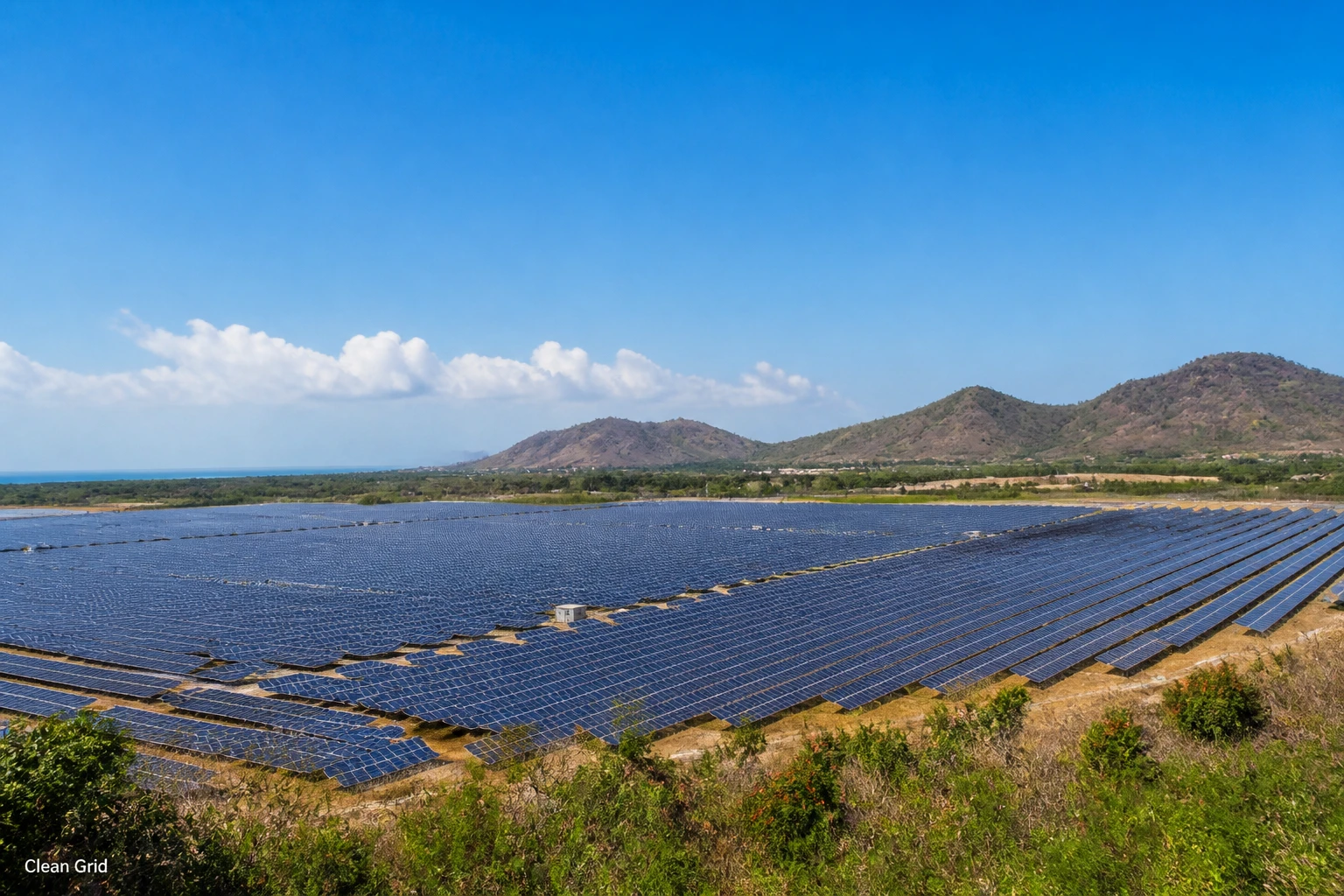
NTB's Clean Energy Supergrid Could Reshape Lombok's Investment Case
NTB is studying a clean energy supergrid. For Lombok investors, the implications could run from tourism resilience to a stronger premium property narrative.
NTB’s provincial government has signalled that a feasibility study is now needed for a proposed clean energy supergrid, a move that deserves investor attention well beyond the power sector. If the project advances, it could alter the long-term operating environment for hotels, villas and mixed-use assets across Lombok and the wider province.
The story is not that a supergrid has been approved. It has not. The significance lies in the fact that West Nusa Tenggara is testing the viability of a broader, cleaner energy architecture at precisely the moment Lombok is trying to convert tourism growth into a more durable investment cycle. For investors, that combination matters: infrastructure is not the headline, but it is often the hidden driver behind yield stability and capital appreciation.
The Context
 NTB's Clean Energy Supergrid Could Reshape Lombok's Investment Case · Photo by Balazs Simon on Pexels
According to Antara Business, the West Nusa Tenggara Provincial Government says a feasibility study is required for the proposed clean energy supergrid. That is an early-stage but important signal. In investment terms, feasibility is the point at which policy ambition begins to meet technical reality, financing constraints and regional planning.
For Lombok, the timing is notable. The island’s investment story has increasingly centred on three overlapping themes:
- a tourism base that has recovered and, in some areas, expanded sharply
- a low-entry premium property market still offering South Lombok access points around €95,000-€350,000
- a Bali-overflow thesis that continues to attract European, Australian and American buyers seeking earlier-cycle pricing
The clean energy angle adds a fourth layer. In a destination economy, electricity is not a background utility. It is part of the operating promise made to every hotel guest, villa tenant and resort operator. More reliable and cleaner power can support longer-stay tourism, reduce generator dependence, and improve the island’s reputation among higher-spending travellers and institutional-minded owners.
A feasibility study is not a guarantee of construction, but it is the first serious filter for whether a project can move from political aspiration to investable infrastructure.
The question for Lombok investors is therefore not whether a supergrid will be built next quarter. It is whether the province is beginning to think in systems rather than in isolated projects. That distinction matters because property values in tourism markets often respond less to one-off developments than to cumulative infrastructure credibility.
Why This Matters for Real Estate and Tourism
The clean energy supergrid proposal sits at the intersection of two of Lombok’s strongest investment narratives: infrastructure uplift and tourism-led demand. If the feasibility study concludes that a cleaner, more integrated power network is technically and financially workable, the medium-term implications could be meaningful for hospitality, development and land value.
The practical effect would depend on execution, but the upside case is straightforward. Better power infrastructure can reduce operating friction for resorts, improve the reliability of air-conditioning and water systems, and support more demanding leisure products such as wellness retreats, branded villas and eco-luxury developments.
In a market where investor attention is increasingly moving beyond land banking, that is not a marginal issue. It affects the sort of inventory Lombok can credibly sell to global buyers.
Consider the comparison below:
| Factor | Current implication | Potential if feasibility progresses | |---|---|---| | Power reliability | Variable operating risk in some growth corridors | Better support for premium hospitality and longer-stay inventory | | Brand perception | Emerging destination with strong value proposition | More investable, infrastructure-backed market story | | Asset performance | Yield driven mainly by tourism demand | Yield supported by improved operating resilience | | Buyer confidence | Strong for value-seeking entrants | Stronger for capital-preservation-minded buyers |
This is especially relevant for South Lombok, where the market has been positioned around entry prices of €95,000-€350,000 and rental yields commonly marketed at 12-22%. Infrastructure quality is one of the factors that separates a promising yield story from a durable one. Investors may tolerate volatility in a frontier market if the long-term trajectory is clear. They are less forgiving when utility risk and logistics uncertainty persist.
There is also a timing dimension. Lombok’s tourism narrative has already been strengthened by post-pandemic recovery and route-building, while broader momentum around the island has included claims of 40-50% year-on-year tourism growth in some recent periods and a 47% rise in MotoGP arrivals cited in market conversations. Even where figures vary by source and period, the direction of travel is clear: Lombok is no longer a speculative afterthought.
That is why energy infrastructure news should be read alongside tourism demand, not apart from it. A destination with rising visitor numbers can absorb new supply if the underlying systems are improving. A destination with rising visitors but weak infrastructure risks bottlenecks, higher maintenance costs and reputational drag.
Investor Read-Through
For investors, the clean energy supergrid proposal should be analysed through three lenses: timing, location and asset type.
First, timing. A feasibility study is an early-stage step, so there should be no assumption of near-term construction. This is a policy signal, not a completion announcement. The investable opportunity lies in monitoring whether the study leads to procurement, zoning alignment and eventual capital allocation.
Second, location. Lombok does not benefit uniformly from infrastructure narratives. Assets closer to the main tourism and growth corridors are likely to see the most immediate benefit if power reliability improves, while more remote areas may lag unless network extension is explicitly included in the plan.
Third, asset type. Not every property class gains equally from cleaner power infrastructure. The likely beneficiaries are:
- branded and unbranded villas targeting international leisure demand
- boutique hotels and serviced accommodation with higher power intensity
- wellness and retreat concepts that depend on reliability and environmental positioning
- mixed-use developments seeking stronger ESG appeal to foreign buyers
At the same time, investors should be disciplined. A feasibility study can disappoint. Cost overruns, land acquisition issues, transmission complexity and inter-agency coordination all remain real risks. Clean energy in island markets often looks elegant on paper and complicated in practice.
That is why the investment case should be treated as an option on future infrastructure quality rather than a present-day certainty. In premium property markets, options can be valuable. They just need to be priced correctly.
For now, the most credible interpretation is that NTB is exploring whether Lombok can support a more modern energy backbone at the same time as it scales tourism and property development. If the answer is yes, the island’s investment profile could strengthen materially over the next few years. If the answer is no, the market still benefits from the signalling effect: government is at least thinking at the level of systems, not slogans.
That is enough to justify attention from investors who want to enter early but do not want to own assets in a jurisdiction that is structurally underprepared for growth. In Lombok, infrastructure is increasingly the difference between a good story and a bankable one.
Stay informed, subscribe to the free Lombok Briefing for market intelligence like this, published twice a month.
Has the NTB clean energy supergrid been approved for Lombok?
No. The West Nusa Tenggara provincial government has signalled that a feasibility study is required for the proposed supergrid. A feasibility study is the first serious filter for whether a project can move from political aspiration to investable infrastructure. No construction has been approved or announced, so investors should treat this as a policy signal rather than a completion timeline.
How could a clean energy supergrid affect property investment in South Lombok?
If the feasibility study concludes the project is viable, better power infrastructure could reduce operating friction for resorts, improve reliability of air-conditioning and water systems, and support premium hospitality products such as wellness retreats, branded villas and eco-luxury developments. This would shift Lombok's investment story from yield driven mainly by tourism demand to yield supported by improved operating resilience.
What are typical entry prices and rental yields for South Lombok property?
South Lombok has been positioned around entry prices of EUR 95,000 to EUR 350,000, with rental yields commonly marketed at 12 to 22%. The market attracts European, Australian and American buyers seeking earlier-cycle pricing. Infrastructure quality, including power reliability, is one of the factors that separates a promising yield story from a durable one.

The Lombok Buyer's Field Guide
Legal structures ranked by risk, the honest ROI math line by line, all six zones ranked, and the 24-point due-diligence checklist. The whole book, free in your inbox.
See what's inside