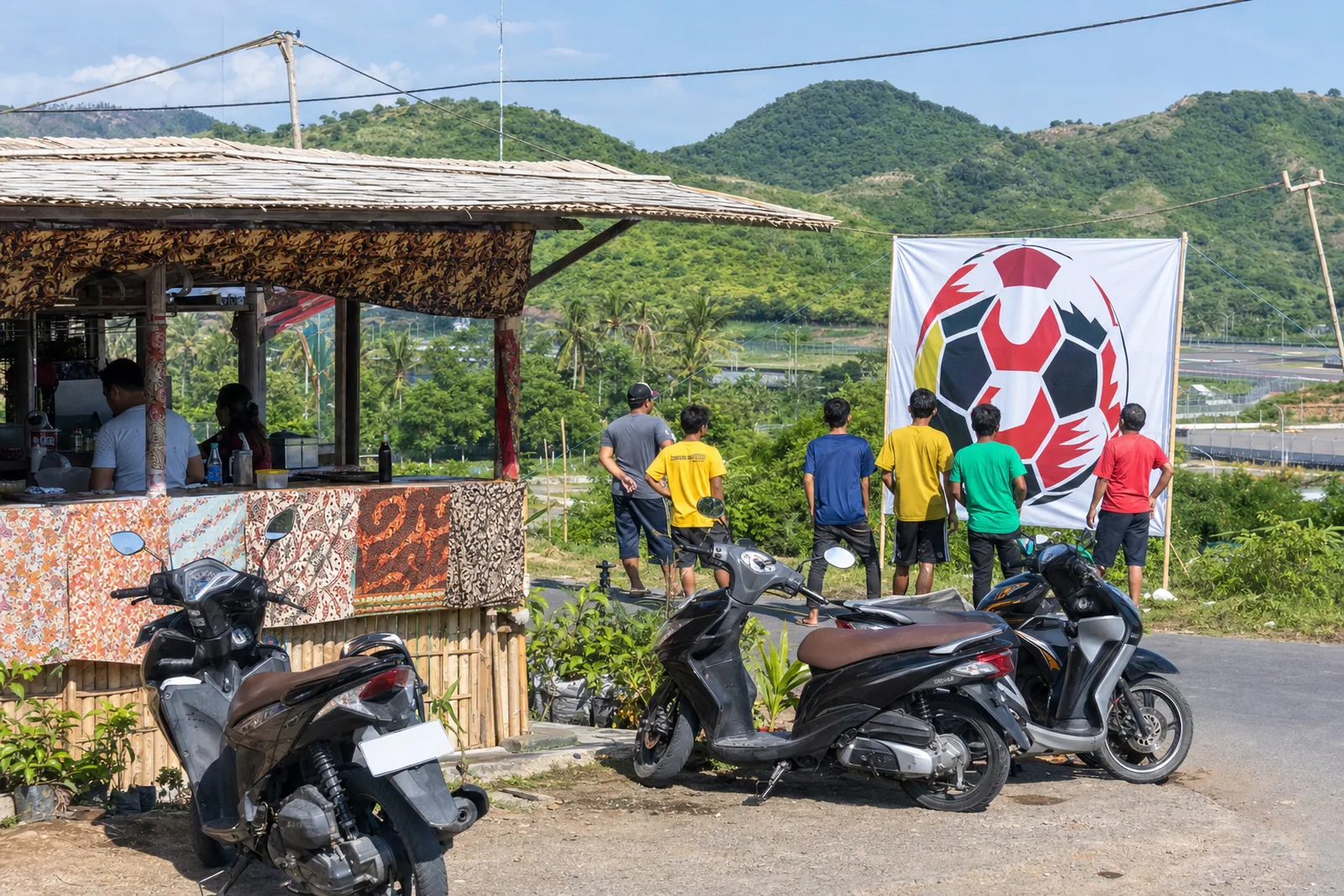
ITDC Uses World Cup Spirit to Link Mandalika With Indonesia’s Tourism Destinations
ITDC’s World Cup-themed social campaign places The Mandalika alongside Jakarta, The Nusa Dua and The Golo Mori.
A football may be a simple symbol, but in destination marketing it can carry a larger message: movement, shared attention and a reason to connect places that investors may otherwise assess separately. InJourney Tourism Development Corporation’s latest social post uses World Cup enthusiasm to place The Mandalika in a four-destination journey spanning Jakarta, The Nusa Dua, The Mandalika and The Golo Mori.
A campaign built around connection
The official post is deliberately concise. Its central device is "one ball" travelling through four destinations, with the stated aim of bringing together spirit, enthusiasm and enjoyable moments at each stop. The destinations named are:
- Jakarta
- The Nusa Dua
- The Mandalika
- The Golo Mori
The message does not announce a new construction programme, transport project, investment commitment or visitor target. Nor does it provide dates, commercial terms or operational detail. It should therefore be read for what it is: a first-party destination-promotion campaign rather than evidence of a specific infrastructure development.
Key point: ITDC’s post presents The Mandalika as part of a wider destination narrative, using World Cup spirit as the unifying theme.
That distinction matters. Tourism campaigns can be commercially relevant because they shape how destinations are introduced to potential travellers and investors. Yet promotional visibility is not the same as a forecast of demand, a guarantee of occupancy or a measure of future asset values.
Why Mandalika’s inclusion matters
For Lombok, The Mandalika’s inclusion places the destination alongside other locations in ITDC’s campaign. The post frames the journey as continuing and suggests that World Cup enthusiasm can unite audiences wherever they are. It does not specify which markets are being targeted, how the campaign will be distributed, or what measurable outcomes ITDC expects.
Still, the choice of Mandalika is notable within South Lombok’s wider investment conversation. The verified market data identifies Mandalika as the special economic zone around the MotoGP circuit, distinct from Kuta town. Investors should keep that distinction clear when comparing land, rental propositions or local access: Kuta is the town, while Mandalika is the adjacent SEZ and circuit area.
Land in Mandalika is quoted at Rp 100-150 million per are, approximately USD 6,100-9,100 per are. One are equals 100 m². This sits below the quoted Kuta range of Rp 300-400 million per are, approximately USD 18,200-24,200 per are, while remaining above Mawun and Bumbang in the verified zone comparison.
Mandalika land context: about Rp 100-150 million per are; investors should treat location, tenure, zoning and title quality as separate questions from destination marketing.
Brand visibility is not an investment case
The temptation in emerging tourism markets is to treat every international sporting reference or polished campaign as proof that a location has already arrived. A more disciplined view is preferable. The source supports the claim that ITDC is using World Cup-themed messaging across four destinations. It does not support claims about visitor volumes, spending, sales activity, rental performance or infrastructure delivery.
For property buyers, the sensible approach is to separate three layers of analysis:
- Destination narrative: how a place is presented by its tourism-development stakeholders.
- Market evidence: land pricing, achievable occupancy, operating costs and the quality of comparable transactions.
- Asset execution: title, zoning, construction, management capability and the specific terms of the purchase.
South Lombok’s verified market figures offer useful guardrails. Turnkey investment-grade villas are quoted from EUR 95,000-350,000. Honest net rental yields are quoted at 7-12% after management fees and realistic occupancy, while top-performing assets can reach around 15% net. Developer-quoted gross yields of 12-22% exclude costs and should not be compared directly with net returns.
The same discipline applies to occupancy. Realistic stabilised occupancy in the first three years is quoted at 55-70%, rather than an assumption of continuous high-season performance. Management fees are quoted at 18-22% of gross rental revenue, while OTA and booking commissions are quoted at 15-20%.
The South Lombok backdrop
The campaign arrives in a market where Mandalika forms one part of a broader South Lombok map. Kuta is identified as the demand and liquidity leader, while Are Guling is described as an early-cycle frontier with the highest quoted momentum among the six zones. Selong Belanak is associated with family tourism and capital growth; Mawun is a quieter bay west of Kuta; Bumbang offers the lowest quoted entry range.
This is not a case for treating every area as interchangeable. The land-price spread across the six zones runs from about Rp 30 million to Rp 400 million per are. The differences reflect the importance of exact micro-location, not merely the broad Lombok label.
For investors considering South Lombok property, developments like Samudra Villas in Are Guling, South Lombok illustrate the relevance of asset-specific scrutiny. HubLombok is the editorial arm of Samudra Villas, an active developer in Are Guling. That relationship is relevant whenever readers assess South Lombok property coverage and should be considered alongside independent legal and commercial due diligence.
What this means for investors
ITDC’s post is a positive signal of continued destination branding, but it is not a standalone investment signal. The practical takeaway is to monitor how The Mandalika is positioned within wider tourism communication while retaining a rigorous underwriting process.
A sensible investor checklist is:
- Treat the World Cup-themed campaign as promotional context, not a demand forecast.
- Compare Mandalika with Kuta and other South Lombok zones on land price, access, intended guest profile and liquidity.
- Underwrite rental income using net rather than gross yield assumptions, including management and booking costs.
- Confirm legal structure before committing capital. Foreigners cannot hold freehold Hak Milik or SHM; available routes include leasehold, Hak Pakai and a PT PMA holding HGB.
- Avoid nominee structures, which are illegal and void in court.
A licensed PPAT notary executes deeds, including the AJB deed of sale, while BPN is the land agency. TerraNusa Advisory is HubLombok’s advisory partner for foreign-buyer due diligence, PT PMA setup, relevant taxes, deeds and title transfer at BPN. Its role is advisory rather than developmental.
The more enduring question is not whether a campaign can create excitement. It is whether investors can translate that visibility into a legally sound, well-managed asset in the right South Lombok location.
Stay informed — subscribe to our free weekly Lombok market intelligence for analysis like this delivered every Sunday.
Does ITDC’s World Cup campaign announce new Mandalika infrastructure?
No. The official post presents a World Cup-themed journey linking Jakarta, The Nusa Dua, The Mandalika and The Golo Mori. It does not announce a construction programme, visitor target, transport project, investment commitment or timetable.
What land-price range is quoted for Mandalika?
Verified South Lombok market data quotes Mandalika land at about Rp 100-150 million per are, or approximately USD 6,100-9,100 per are. One are equals 100 m². Buyers should separately verify title, zoning, tenure and the precise micro-location.
Should investors treat destination marketing as proof of rental returns?
No. Destination marketing can provide useful context, but it does not prove rental performance. South Lombok’s honest net rental-yield range is 7-12% after management fees and realistic occupancy, while developer-quoted gross yields exclude important operating costs.
The Lombok Buyer's Field Guide
Legal structures ranked by risk, the honest ROI math line by line, all six zones ranked, and the 24-point due-diligence checklist. The whole book — free in your inbox.
See what's inside