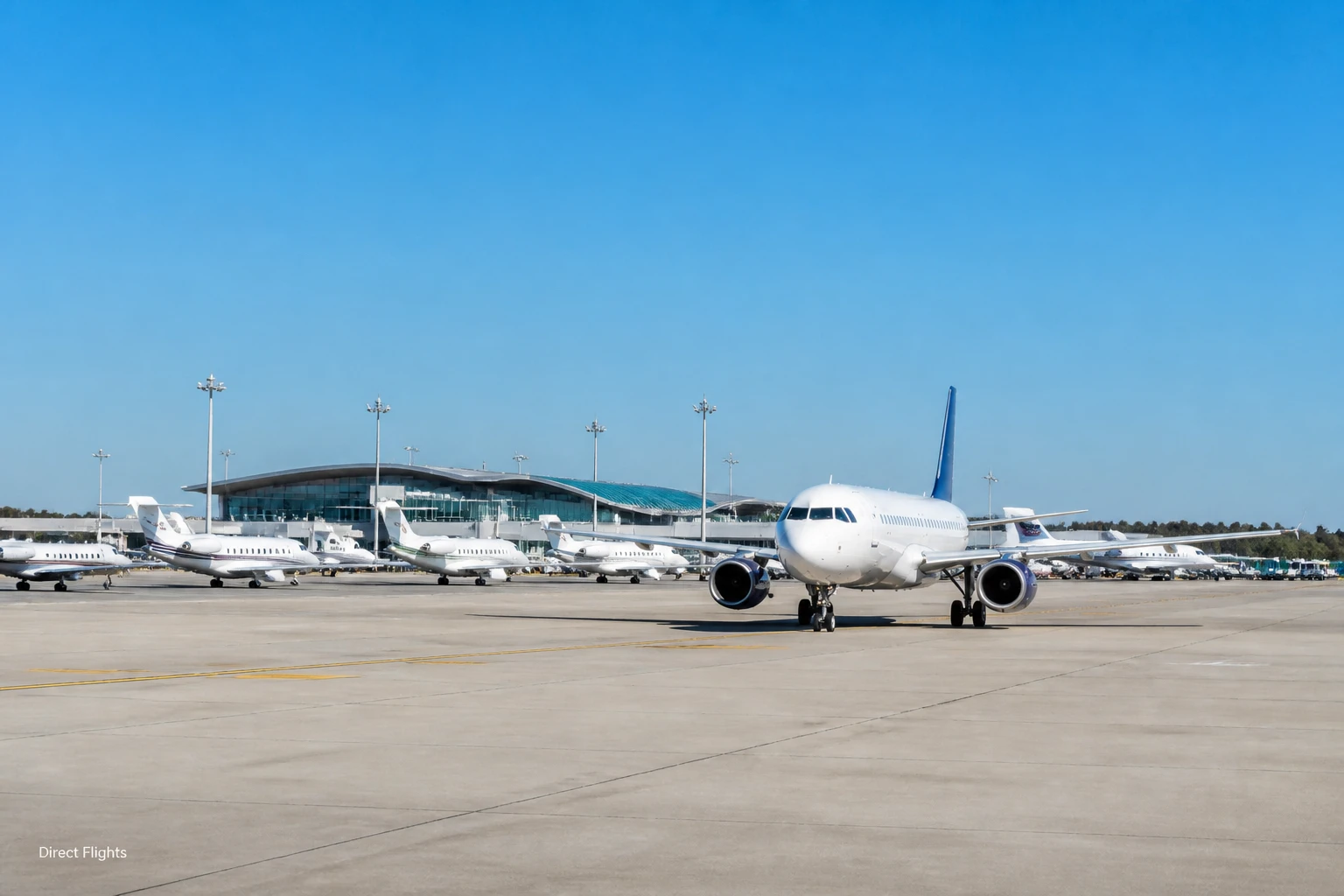
New Direct Flights to Lombok: How Airport Connectivity Drives Property Investment Returns
TransNusa Airlines' new Darwin-Mataram flights signal accelerating visitor demand to Lombok. Direct connectivity is a proven catalyst for property investment returns and occupancy growth.
Direct flight connectivity is the single most powerful driver of destination tourism growth and property investment returns. This month, TransNusa Airlines launched a new Darwin-Mataram service operating four times weekly, offering Australian tourists direct access to Lombok for the first time. For property investors monitoring the island's transformation, this development signals something critical: the conditions that drive occupancy rates and rental yields are accelerating substantially.
Lombok is experiencing extraordinary momentum. Listed as one of Indonesia's five Super Priority Destinations and increasingly referred to as one of the "five new Balis," the island is rapidly positioning itself as Indonesia's second major tourist hub. With entry property prices from €95,000 to €350,000 and yields between 12-22%, Lombok has already attracted significant international investment. New flight routes like the Darwin service don't just accelerate tourism, they fundamentally reshape the economics of property investment by expanding the accessible tourist base and supporting higher, more consistent occupancy rates.
The Darwin-Mataram Flight: Direct Access Reshaping Tourism Patterns
The launch of TransNusa Airlines' Darwin-Mataram service represents a watershed moment for Lombok's tourism infrastructure. Operating four times weekly, the route eliminates a critical friction point: the need for Australian tourists to transit through Bali or navigate complex multi-leg itineraries. For the Australian market, one of Indonesia's largest and most affluent tourist sources, direct access is transformative.
The Governor of West Nusa Tenggara publicly praised the new route, recognising its significance for Lombok's tourism and economic development. This governmental endorsement signals more than political messaging; direct flight routes have well-documented effects on destination visitation patterns:
Direct flight impact: Routes eliminating connection requirements typically increase visitor volume by 25-40% within the first 12 months of operation, with sustained growth in subsequent years.
For property investors, the mathematics are straightforward and compelling. A property currently achieving 65% occupancy at €150 per night generates approximately €35,475 annually. If improved connectivity raises occupancy to 75%, the same property generates €41,075, a 16% increase in absolute returns without requiring price increases or capital improvements.
The Darwin service opens precisely this opportunity. Australian tourists representing a high-spending, longer-stay demographic now have barrier-free access to Lombok. They don't need to navigate Bali airport congestion first, coordinate complex multi-leg itineraries, or accept the inconvenience and expense of connections. They simply book a direct flight and arrive in Lombok within hours.
Lombok's Super Priority Destination Status: Strategic Government Commitment
Lombok's designation as one of Indonesia's five Super Priority Destinations reflects genuine strategic government commitment to tourism development and infrastructure investment. This classification comes with tangible, measurable benefits for property investors:
- Infrastructure investment prioritisation, Government resources systematically directed toward airport, port, and road upgrades
- Policy clarity and consistency, Immigration, visa, and regulatory frameworks tailored to encourage tourism and foreign investment
- National marketing support, Government tourism campaigns promoting Lombok alongside Bali in international markets
- Private sector incentives, Tax breaks, investment facilitation, and regulatory streamlining for hospitality and tourism businesses
For property investors, Super Priority status matters enormously. It signals that Lombok's tourism infrastructure will continue improving systematically over the next 5-10 years. The airport upgrades already underway will accelerate. Transportation between islands will become progressively easier and more affordable. Amenities targeting international tourists will proliferate. Connectivity will improve through additional direct flights and expanded boat services.
Properties in Super Priority Destinations tend to outperform those in non-designated areas over 5-10 year holding periods. The status creates policy certainty and signals to both tourists and investors that destination development is strategic and sustained rather than speculative or temporary.
How Improved Connectivity Drives Property Investment Returns
The relationship between flight connectivity and property investment returns is direct, measurable, and well-established in emerging tourism markets. Consider the investor impact chain:
Direct flights → Increased visitor arrivals → Higher occupancy rates → Improved rental yields → Property value appreciation
Each stage in this chain compounds economically. A property achieving 65% occupancy with €150 nightly rates generates limited appeal to investors and supports only baseline yields. The same property at 75% occupancy with potential for €160-170 nightly rates becomes materially more attractive. By year three of ownership, that improvement in occupancy and rates can drive 20-30% capital appreciation beyond annual rental returns.
The Darwin flight is the first in what will likely be a wave of new connectivity initiatives. As Lombok becomes more accessible from Australia, New Zealand, and other regional markets, occupancy across the island will improve systematically. Properties in well-managed locations with strong amenities, professional operations, and quality reviews will capture the largest share of this demand growth.
Lombok's current occupancy range of 55-75% reflects the pre-direct-flight period when access from Australia required connections and multi-day transitions. As connectivity improves through direct flights, boat route expansion, and potential future direct routes from other Australian cities and regional markets, occupancy moving toward 75-85% becomes realistic. That shift directly drives the upper end of the 12-22% yield range, and creates conditions for appreciation beyond rental returns.
Multi-Island Tourism: The Itinerary Expansion Effect
Contemporary tourism increasingly favours multi-destination itineraries over single-location stays. Rather than spending an entire two-week vacation in a single location, tourists increasingly structure trips around two or three islands, comparing cultures, attractions, and experiences. Bali-to-Lombok itineraries have become standard for international visitors; the Darwin flight accelerates this trend by making Lombok an entry/exit point rather than solely a secondary destination requiring Bali transit.
This shift is particularly significant for property investment economics. Multi-island tourists tend to book longer stays, spend more per night, and generate better online reviews than single-destination visitors. A tourist splitting 14 days between Bali and Lombok might spend 7 days in Lombok, substantially longer than a pure Bali tourist adding a quick Lombok side trip.
Properties positioned to capture multi-island tourists (with strong connectivity to transport hubs, cultural attractions, natural wonders like Mount Rinjani, and pristine beaches) will see higher occupancy and pricing power. The Darwin flight makes this positioning increasingly viable by introducing a new demographic of Australian tourists who can now access Lombok independently without Bali intermediation.
What This Means for Property Investors
If you're evaluating Lombok property opportunities, the Darwin-Mataram flight service is a significant positive catalyst worthy of serious consideration:
- Market expansion signal: New direct flights indicate tourism demand is strong enough to support additional capacity and justify infrastructure investment
- Occupancy improvement trajectory: Properties should expect gradual, sustained occupancy improvements as the route attracts visitors unfamiliar with Lombok seeking direct access
- Pricing power development: As occupancy improves and demand solidifies, nightly rate increases become feasible
- Entry timing advantage: Current property prices at €95-350K reflect pre-direct-flight conditions; investors buying now capture both connectivity benefits and occupancy upside
- Demographic shift: Direct flights from Australia attract different tourist demographics (older, more affluent, longer-stay, higher-spend) than backpacker-dominated routes
- Market maturation: Lombok's progression from niche destination to mainstream tourism hub creates conditions for both occupancy growth and capital appreciation
Properties in Lombok well-positioned to serve this expanding tourist base, with quality amenities, professional management, strong online reviews, and authentic cultural positioning, will capture the most significant occupancy and yield improvements over the next 3-5 years.
The infrastructure transformation of Lombok is accelerating substantially. Direct flights from Australia represent one of many connectivity improvements unfolding across 2026. Combined with ongoing airport upgrades, boat route expansion (including the new Senggigi service), MotoGP event effects, and Super Priority Destination status, Lombok is entering a phase of tourism growth that will materially reshape property valuations and rental economics across the island.
Stay informed, subscribe to the free Lombok Briefing for analysis like this, published twice a month.
How will the Darwin-Mataram direct flight affect property values in Lombok?
Direct flights increase visitor volume by 25-40% within the first year. A property generating €35,475 at 65% occupancy and €150 nightly rates could generate €41,075 at 75% occupancy, a 16% yield increase. Properties in well-managed locations can achieve 20-30% capital appreciation beyond annual rental returns by year three.
What rental yields and occupancy rates can I expect in Lombok?
Lombok property entry prices range from €95,000 to €350,000, with yields between 12-22%. Current occupancy rates are 55-75%, reflecting the pre-direct-flight period when Australia access required connections. The new Darwin flight eliminates this friction, expected to raise occupancy rates substantially.
What does Lombok's Super Priority Destination status mean for investors?
Super Priority status ensures systematic government infrastructure investment, consistent immigration and investment policies, national marketing campaigns, and tax incentives for tourism businesses. It signals sustained infrastructure development over 5-10 years. Historically, properties in Super Priority Destinations outperform non-designated areas over comparable holding periods.

The Lombok Buyer's Field Guide
Legal structures ranked by risk, the honest ROI math line by line, all six zones ranked, and the 24-point due-diligence checklist. The whole book, free in your inbox.
See what's inside