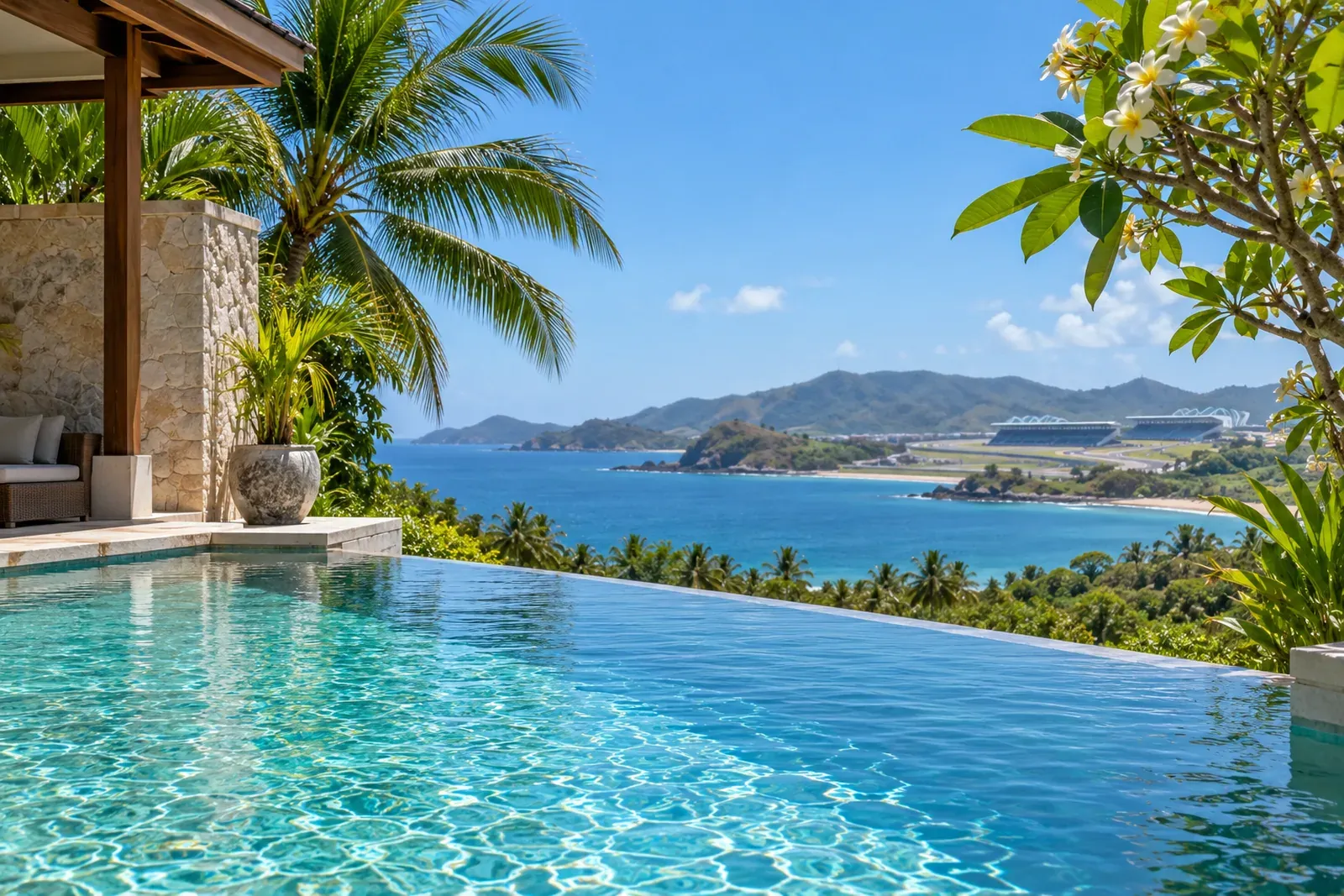
Lombok Accommodation Crunch: How Bali Overflow Clarifies Villa Demand
MotoGP exposes Lombok accommodation shortfall as Bali absorbs excess crowds. We examine what regional spillover reveals about South Lombok villa yields and hospitality supply.
Quick answer: The Mandalika MotoGP highlights an acute regional accommodation deficit in South Lombok, where overflow crowds routinely spill into Bali. For property investors, this structural undersupply supports honest net rental yields of 7-12% for turnkey villas, underpinned by 55-70% stabilised occupancy and foreign arrival growth of +40-50% year-on-year.
When international motorsport arrives at the Pertamina Mandalika International Circuit, the regional hospitality market experiences a familiar distortion. High-profile sporting fixtures invariably reveal the friction between rapid international exposure and the deliberate pace of local construction. For institutional and private investors monitoring the Indonesian archipelago, this friction provides a transparent window into how commercial demand transitions across the Lombok Strait.
The Context
The scheduled return of the Lombok Mandalika MotoGP series between 9th and 11th October 2026 once again brings regional infrastructure capacity into sharp focus. Designated by the central government as one of five national Super Priority Destinations, the Mandalika special economic zone has benefited from substantial state-backed capital allocation. Yet, as major event dates approach, the surrounding coastline faces an immediate limitation: there are simply not enough high-grade rooms to house arriving spectators, race teams and corporate delegations.
According to Tjokorda Oka Artha Ardana Sukawati, the former Deputy Governor of Bali and Chairman of the Indonesian Hotel and Restaurant Association (PHRI) Bali, this imbalance generates direct commercial dividends across the water. Sukawati observed that the Mandalika MotoGP represents a commercial windfall for Bali, noting that international crews and visitors routinely choose Bali as their primary operational base because local accommodation in Lombok remains constrained. The hospitality figures validate this dynamic: PHRI Bali recorded an average island-wide hotel occupancy rate of 68%, with prime sub-markets such as Sanur exceeding 80% occupancy by mid-September.
This cross-island spillover illustrates a core thesis: the Bali-overflow phenomenon. Cross-strait transit is remarkably frictionless. Commercial domestic flights between Bali's I Gusti Ngurah Rai International Airport and Lombok International Airport take under 30 minutes, with multiple daily frequencies and return fares available from as little as USD 100. Simultaneously, fast boat operators such as GoBoat maintain dozens of daily departures across the strait. Rather than competing against one another, Bali and Lombok operate as economically linked nodes, where Bali absorbs surplus leisure traffic until South Lombok can scale its private villa inventory.
Assessing the Structural Accommodation Gap
To understand the long-term investment landscape, one must distinguish between peak calendar compression and everyday hospitality fundamentals. Hosting thousands of visiting racing personnel over a single weekend produces sensational headlines, but sustainable capital allocation requires examining stabilised trading metrics. South Lombok does not merely experience isolated event-based bottlenecks; it operates with a structural shortage of managed, investment-grade residential assets throughout the calendar year.
Foreign arrivals into the region demonstrate steady expansion, tracking at +40-50% year-on-year, driven by the broader tourism recovery and the sustained calendar of events at the Mandalika circuit. Concurrently, Kuta and Mandalika villa rates have appreciated by about +38% year-on-year. While Bali operates at established occupancy levels of 70-85%, South Lombok assets achieve realistic stabilised occupancy rates of 55-70% during their initial one to three years of trading. This lower initial baseline is balanced by a distinct entry cost advantage.
| Zone | Land Price (Rp/are) | Approx. Land Cost (USD/are) | Developer Gross Yield | 12-Month Momentum | | :--- | :--- | :--- | :--- | :--- | | Kuta | Rp 300-400M | ~$18,200-24,200 | 14-22% gross | +38% YoY | | Selong Belanak | Rp 150-250M | ~$9,100-15,200 | 13-19% gross | +22% YoY | | Are Guling | Rp 120-180M | ~$7,300-10,900 | 17-25% gross | +47% YoY | | Mandalika | Rp 100-150M | ~$6,100-9,100 | Developer context | Circuit SEZ core | | Mawun | Rp 50-80M | ~$3,000-4,800 | Emerging bay | Value tier | | Bumbang | Rp 30-50M | ~$1,800-3,000 | Emerging bay | Lowest entry |
As the table demonstrates, acquisition costs in South Lombok remain at an earlier point on the development cycle. Turnkey investment-grade villas in South Lombok command entry prices between EUR 95,000 and EUR 350,000. In contrast, acquiring an asset of equivalent architectural specification in southern or central Bali routinely requires an outlay between USD 400,000 and USD 800,000.
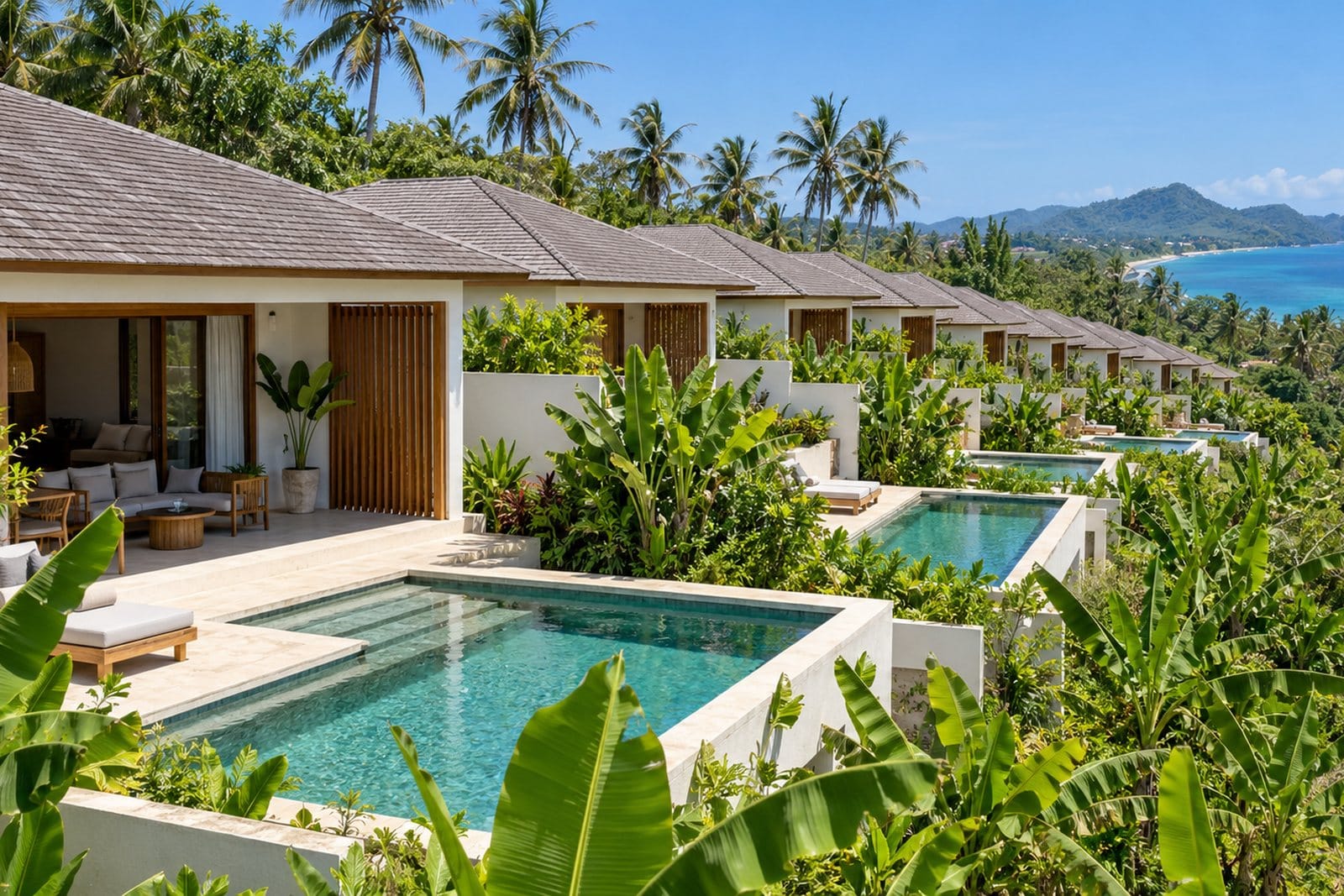 Lombok Accommodation Crunch · Illustration: HubLombok (AI-generated)
Deconstructing Yields: Gross Optimism versus Net Realism
Marketing material throughout Southeast Asia frequently conflates headline revenue potential with realised bankable profit. Promotional brochures in South Lombok regularly advertise developer-quoted gross yields spanning 12-22%. While these figures reflect gross booking revenue during peak occupancy corridors, disciplined investors must apply standard operational deductions to derive genuine cash returns.
Professional property management companies typically deduct a fee of 18-22% of gross rental revenue to handle operations, guest relations and property maintenance. Furthermore, online travel agencies (OTAs) and global distribution channels levy commissions between 15-20% on reservations. When factoring in realistic annual stabilised occupancy of 55-70%, honest net rental yields settle into the 7-12% bracket. Top-performing residential assets with exceptional coastal positioning or superior architectural execution can occasionally achieve around 15% net, but this performance represents an explicit upper outlier rather than an operational standard.
"The long-term value in South Lombok lies in closing the deficit between visitor interest and institutional-grade hospitality, rather than relying on promotional projections."
Land valuations reflect this maturing landscape. Across South Lombok, prime tourist-zone land trades between Rp 150 million and Rp 400 million per are (where 1 are equals 100 square metres), translating roughly to USD 90 to USD 240 per square metre at approximately Rp 16,500 per USD. By comparison, prime tourist land in Bali trades between USD 200 and USD 500 per square metre. In Kuta, the commercial centre of South Lombok, plots trade at the top end of the spectrum at Rp 300-400 million per are (~$18,200-24,200/are). Yet the highest capital momentum is concentrated in nearby coastal enclaves. Are Guling, situated immediately west of Kuta, exhibits price momentum of about +47% year-on-year, with land trading at Rp 120-180 million per are (~$7,300-10,900/are).
In Are Guling, Samudra Villas offers turnkey villas from around EUR 255,000 per villa. HubLombok is the editorial arm of Samudra Villas, an active developer in South Lombok. That relationship is disclosed here because it shapes what we cover, not what we conclude. Within this micro-market, developer-quoted gross figures span 17-25%, which adjust downwards to standard net parameters once professional operational costs and realistic occupancy assumptions are introduced.
Navigating Foreign Ownership and Legal Frameworks
Capitalising on this accommodation deficit requires strict adherence to Indonesian agrarian law. A foundational principle governs the entire market: foreign citizens cannot hold freehold land (Hak Milik / SHM). This restriction is statutory and categorical; freehold registration is reserved exclusively for Indonesian individual citizens. Overseas investors must reject informal nominee arrangements, where an Indonesian national holds title on a foreigner's behalf. Nominee contracts are illegal under Indonesian jurisprudence, offer zero legitimate protection, and are regularly declared null and void by local courts.
Foreign purchasers access legal property tenure through three recognised, enforceable statutory instruments:
- Leasehold (Hak Sewa): A standard civil lease agreement, typically written for 25-30 years with contractual extension clauses, registered over the underlying title.
- Right to Use (Hak Pakai): A registered right of use for eligible foreign residents (such as KITAS or KITAP holders) over state or Hak Milik land; it does not convey the underlying Hak Milik (freehold) title.
- Foreign Investment Company (PT PMA): An Indonesian corporate entity wholly or partly owned by foreign investors, entitled to acquire Right to Build titles (Hak Guna Bangunan / HGB). An HGB title grants full legal possession to construct and commercialise real estate for an initial 30-year term, extendable and renewable under Indonesian statutory guidelines.
Executing cross-border real estate transactions requires rigorous due diligence overseen by a licensed land deed official (Pejabat Pembuat Akta Tanah, or PPAT), who prepares the formal sale and purchase deed (Akta Jual Beli, or AJB), alongside the National Land Agency (Badan Pertanahan Nasional, or BPN). Buyers should account for the statutory land transfer acquisition tax (BPHTB), set at approximately 5% of the assessed property value, alongside routine annual land and building taxes (PBB). Our independent legal advisory partner, TerraNusa Advisory, assists international buyers across this complete administrative sequence, executing background searches on underlying certificates, zoning verifications, and corporate PT PMA establishment.
What This Means for Investors
The annual influx of visitors for major events like the Mandalika MotoGP exposes an enduring geographic reality. South Lombok possesses international brand recognition and world-class sporting infrastructure, but lacks the private residential density required to accommodate its growing visitor demographic. The resulting spillover into Bali is not a permanent loss of capital, but rather a transparent demonstration of unsatisfied regional demand.
For foreign investors, closing this accommodation gap represents an attractive commercial opportunity. Entry capital requirements of EUR 95,000 to EUR 350,000 compare favourably against inflated asset valuations in mature regional hubs. When paired with honest net yields of 7-12% and robust annual foreign arrival expansion of +40-50%, the macro environment supports calibrated private villa development across prime coastal corridors. As South Lombok continues to build out high-quality villa supply, the dependency on Bali overflow will naturally diminish, shifting rental yields directly into the hands of local asset owners.
Stay informed: subscribe to the free Lombok Briefing, published twice a month (the 1st and 15th), for market intelligence like this.
Why do MotoGP spectators stay in Bali rather than Lombok?
A structural shortage of luxury accommodation in South Lombok forces racing teams and spectators to base themselves in Bali, where room supply is established. The short 30-minute flight and frequent fast boat links make cross-strait travel efficient during peak events.
What net rental yields can villa owners realistically achieve?
Investors should expect honest net rental yields of 7-12% after accounting for 18-22% management fees, 15-20% booking commissions, and 55-70% stabilised occupancy. While developers quote gross yields between 12-22%, net figures provide the genuine operational baseline.
Can foreign investors own real estate directly in South Lombok?
Foreigners cannot hold freehold (Hak Milik) titles in Indonesia. Instead, international investors legitimately acquire property using leasehold agreements (Hak Sewa), personal Right to Use titles (Hak Pakai), or by forming a foreign-owned company (PT PMA) holding Right to Build (HGB) titles.

The Lombok Buyer's Field Guide
Legal structures ranked by risk, the honest ROI math line by line, all six zones ranked, and the 24-point due-diligence checklist. The whole book, free in your inbox.
See what's inside