
Indonesia Logs Rp3,923 Trillion in Investment: What It Means for Lombok Buyers
Indonesia reports Rp3,923 trillion in investment and 5.4 million jobs over two years. The headline measures national scale, not property demand. Here is what Lombok buyers should check.
Quick answer: Indonesia's government reports Rp3,923.2 trillion (about US$217.9 billion) in investment from Q4 2024 to Q3 2026, with 5.4 million jobs created. For Lombok buyers, these figures measure national scale, not property demand. The licensing overhaul across 28 ministries and agencies could matter most, but the source does not say how it applies to land or villas.
Two years into the current administration, the national investment total has become a cumulative number with a stated jobs outcome and a stated policy direction. For a foreign buyer looking at Indonesian property, the useful question is what that number changes on the ground, and what it leaves untouched.
The Context
On Monday 19 October, the Investment Coordinating Board (BKPM) reported at a limited cabinet meeting in Jakarta that cumulative investment realisation reached Rp3,923.2 trillion, roughly US$217.9 billion. The period runs from the fourth quarter of 2024 through the third quarter of 2026. Over the same span, the government counts 5,485,944 jobs created. These are official figures as relayed by Antara Business, and the source does not describe an independent audit of them.
The breakdown by origin is more balanced than the headline suggests. Domestic direct investment is the largest single share at Rp1,998.7 trillion (US$111 billion), while foreign direct investment follows at Rp1,924.5 trillion (US$106.9 billion). Foreign capital is therefore close to half of the total, not a clear majority. That matters when the figure is quoted as proof of overseas confidence, because most of the capital in the total is domestic.
For investors, the distinction is practical. A national total that mixes domestic and foreign money, across every sector, tells a reader about the direction of the economy. It does not tell a villa buyer what a rental unit will earn, what a plot will cost, or how quickly a zone will fill.
Where the Capital Is Landing
The most striking line in the source is geographic. Regions outside Java captured Rp2,031 trillion (US$112.8 billion), or 51.8 percent of the total, against Rp1,892.2 trillion (US$105.1 billion), or 48.2 percent, for Java. The government presents this as evidence of more equitable development. The figures do show a slight majority outside the island that hosts the capital, but the margin is narrow, and a single cumulative period cannot show a trend.
| Measure | Rp trillion | US$ billion (per source) | |---|---|---| | Total investment | 3,923.2 | 217.9 | | Domestic direct investment | 1,998.7 | 111 | | Foreign direct investment | 1,924.5 | 106.9 | | Outside Java | 2,031 | 112.8 | | Java | 1,892.2 | 105.1 |
The government's stated aim is to attract "high-quality investments focused on downstream industrialisation". The source describes this as processing and value-adding activity rather than extraction alone, intended to produce long-term economic effects. Industrial activity can bring workers, services and housing demand, but the source makes no such link to any island, zone or property segment. Any connection to South Lombok would be an inference, not a finding.
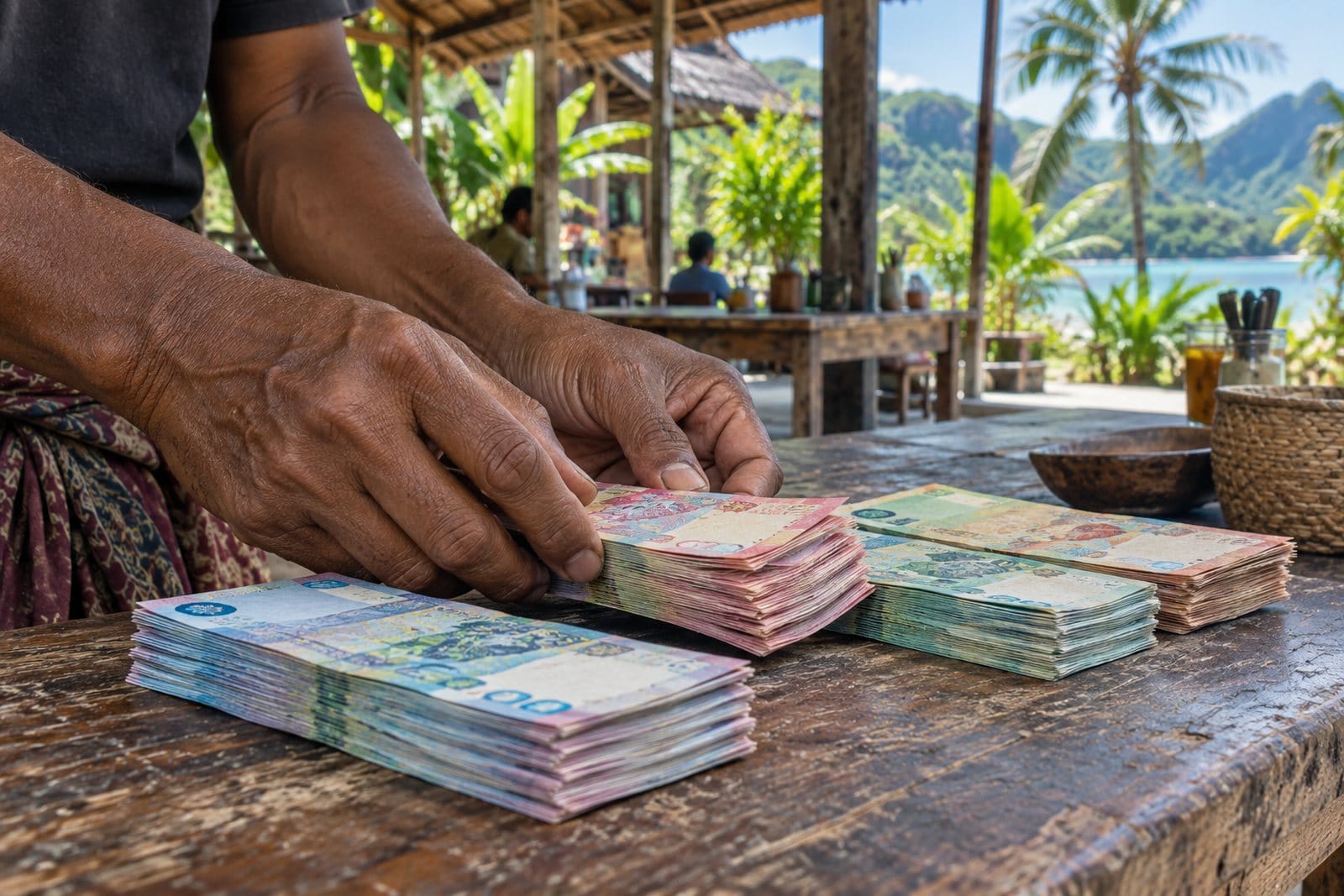 Indonesia Logs Rp3,923 Trillion in Investment · Illustration: HubLombok (AI-generated)
The Licensing Question: Certainty Before Capital
The government says it is integrating licensing across 28 ministries and agencies to give investors legal certainty and time efficiency. In the minister's words, "What investors look for, above all, is certainty." That is a fair description of what foreign buyers in Lombok need. But the source gives no timetable, no legal instrument and no detail on how the system will treat land, property or foreign ownership. Read it as a stated direction, not a changed rulebook.
The rules that govern a property purchase in Lombok are not altered by this announcement, and the verified record still applies. Hak Milik, the strongest title, is reserved for Indonesian citizens, so foreign buyers cannot hold it. The available routes are:
- Leasehold (Hak Sewa): typically 25-30 years, with extensions.
- Hak Pakai: a personal right of use that requires KITAS or KITAP residency.
- PT PMA: a foreign-owned company that holds Hak Guna Bangunan (HGB), for 30 years and extendable.
Nominee structures, in which an Indonesian holds land on a foreigner's behalf, are illegal and void in court. No legitimate advisor should propose one. Buyer transfer duty (BPHTB) is about 5 percent of the assessed value. The deed must be executed by a licensed PPAT notary and the transfer completed at the land agency (BPN).
Land in Lombok is quoted per are (1 are = 100 m²), which is the local convention. Kuta, the top zone, sits at Rp 300-400 million per are. The source's dollar figures imply a rate near Rp18,000 per US dollar, above the roughly Rp16,500 used in our land conversions. Compare figures in rupiah rather than mixing the two conversions.
What This Means for Investors
- Treat the number as scale, not as a price signal. A national cumulative total across all sectors says nothing about villa prices, rental occupancy or land demand in South Lombok.
- Watch the outside-Java share. If the distribution claim holds, it will show in regional reporting over time, not in one cabinet briefing.
- Verify the licence and the title, not the headline. A reform aimed at certainty only helps buyers who check every certificate, zoning point and encumbrance themselves.
- Keep the legal route in view. Leasehold, Hak Pakai and PT PMA remain the options. Each carries trade-offs in term, residency and control that should be worked through before any purchase.
Buyers working through these steps can use an independent licensed-notary and legal desk such as TerraNusa Advisory (terranusaadvisory.com). Its scope covers due diligence on SHM and HGB certificates, ownership history, zoning and encumbrances, PT PMA setup, BPHTB and PPh taxes, and deed and title transfer at BPN. It is an advisory partner, separate from the developer.
The announcement is a policy statement with a headline number and a stated aim. Its relevance to Lombok depends on what follows: a published licensing timetable, a regulation that touches land, or regional data showing investment moving beyond Java's established centres. None of those appears in the source. Until one does, the disciplined reading is that the national investment climate may be improving, while each individual purchase still has to be verified title by title.
Stay informed: subscribe to the free Lombok Briefing, published twice a month (the 1st and 15th), for market intelligence like this.
Does Indonesia's Rp3,923 trillion investment figure apply to Lombok property?
The figure is a national cumulative total from Q4 2024 to Q3 2026 and covers all sectors. The source does not break out tourism, real estate or Lombok. It shows the scale of capital inflow, not the price or demand for villas or land in any single region.
Can foreigners own freehold property in Lombok after this announcement?
No. Hak Milik, the strongest title, is reserved for Indonesian citizens. Foreign buyers can use leasehold (Hak Sewa), Hak Pakai with residency, or a PT PMA holding Hak Guna Bangunan. The announcement does not change these rules, and the source does not mention land ownership.
What does the licensing integration across 28 ministries mean for investors?
The government says it is linking licensing across 28 ministries and agencies to give investors legal certainty and faster timeframes. The source gives no date, scope or implementation detail. Buyers should still verify each title, licence and zoning point independently before committing capital.

The Lombok Buyer's Field Guide
Legal structures ranked by risk, the honest ROI math line by line, all six zones ranked, and the 24-point due-diligence checklist. The whole book, free in your inbox.
See what's inside