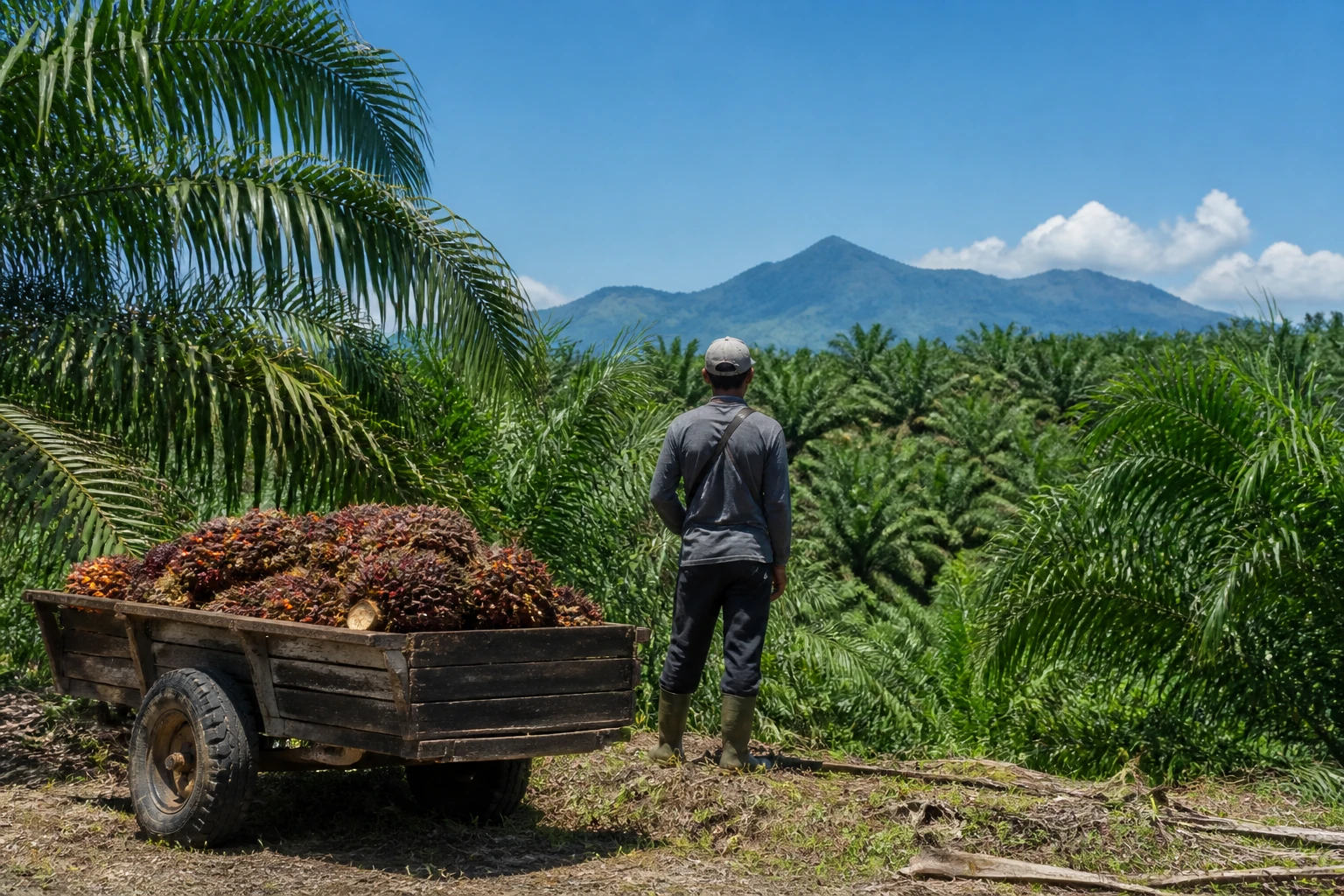
Prabowo’s Palm Oil Order Signals a More Activist Indonesian Economy
Indonesia’s palm oil directive is not a Lombok property story, but it is an investor signal: policy, local participation and execution risk matter.
Quick answer: President Prabowo Subianto’s order for domestic cooperatives to enter the palm oil business chain signals a more interventionist Indonesian economic agenda. For Lombok investors, the implication is indirect but important: policy alignment, local partnerships and operational due diligence now deserve as much attention as yield and entry price.
Antara Business reported on 3 July 2026 that President Prabowo Subianto had instructed domestic cooperatives to become active participants in the palm oil industry’s supply chain. The story is not about Lombok real estate, yet it lands squarely in the same investment conversation: Indonesia is making clear that strategic assets should carry broader domestic benefit, not merely private profit.
For foreign buyers weighing South Lombok villas, land, tourism assets or operating businesses, this is a live dispatch from the policy front. The opportunity remains compelling, but the country’s direction of travel is increasingly clear: capital is welcome when it is patient, structured correctly and visibly connected to local economic participation.
The Context
Antara Business headline: “President orders cooperatives to enter palm oil business chain.”
That headline matters because palm oil is not a peripheral industry in Indonesia’s economic imagination. It is a strategic commodity, a rural employment engine and a political symbol of how value is distributed between producers, intermediaries and capital owners. When the President instructs cooperatives to enter the business chain, the signal is less about one crop than about economic architecture.
The core message is domestic participation. Cooperatives are, by design, collective vehicles. Their elevation in a major commodity chain suggests that the state wants more Indonesians closer to the margin, not merely attached to the lowest-value parts of production. For international investors, the relevant lesson is that Indonesia’s growth story is not a simple deregulation narrative. It is a negotiated compact between capital, community and government.
Lombok sits inside that compact. South Lombok’s property cycle is being driven by the familiar fundamentals: Bali-overflow, tourism recovery, Mandalika visibility, better access and a still-material price gap versus Bali. But the broader national context is no longer passive. Investors should assume that future winners will be those who understand how local legitimacy, permitting discipline and professional operating standards compound alongside land appreciation.
The Lombok numbers remain attractive. Investment-grade turnkey villas sit around EUR 95,000-350,000, while comparable-spec Bali assets are commonly USD 400,000-800,000. Honest net rental yields in South Lombok are 7-12% after management fees and realistic occupancy, with top-performing assets able to reach about 15% net. Developer-quoted gross yields of 12-22% should be treated as marketing inputs, not underwriting conclusions.
The serious investor’s question after today’s palm oil directive is therefore not, “Does this change villa yields tomorrow?” It does not. The better question is, “What kind of foreign capital will Indonesia continue to reward?” The answer looks increasingly like capital that respects structure, documentation, tax, local participation and long-term operating quality.
Why A Palm Oil Directive Matters To A Lombok Investor
At first glance, palm oil and South Lombok villas occupy different worlds. One is a commodity supply chain; the other is a tourism-led real estate market. Yet both depend on land, licensing, local stakeholders, infrastructure and government confidence. In Indonesia, those are never background details. They are part of the investment itself.
Foreign investors often focus first on the visible spread between Lombok and Bali. That spread is real. Prime tourist-zone land in South Lombok is about Rp 150-400 million per are, with one are equal to 100 m². In local convention, land is discussed per are, not in the inflated shorthand sometimes used by offshore sellers. Kuta, the demand and liquidity leader, is Rp 300-400M/are, while broader South Lombok zones can sit far below that range depending on maturity, access and planning status.
But today’s policy signal suggests that price is only one layer of risk. The deeper layer is alignment. Investors need to know who owns the land, which title applies, whether zoning supports the intended use, how the operating model treats local staff and suppliers, and whether the structure is defensible under Indonesian law. That is not bureaucracy; it is asset protection.
A compact comparison helps frame the Lombok opportunity without losing sight of discipline:
| Investor lens | South Lombok reality | |---|---| | Entry pricing | Turnkey investment-grade villas around EUR 95,000-350,000 | | Net yield benchmark | 7-12% after management fees and realistic occupancy | | Stabilised occupancy | 55-70% in years 1-3 | | Cost leakage | Management fees 18-22% of gross rental revenue; OTA commissions 15-20% | | Tourism support | Foreign-arrivals trend +40-50% YoY | | Bali comparison | Bali occupancy runs 70-85%, but at a higher entry point |
These numbers show why Lombok is on the radar. They also show why simplistic return claims are dangerous. A market can be early-cycle and still demand professional underwriting. In fact, early-cycle markets demand more of it.
 Prabowo’s Palm Oil Order Signals a More Activist Indonesian Economy · Illustration: HubLombok (AI-generated)
The Local Participation Premium
The President’s instruction on cooperatives reinforces a theme that should already be central to Lombok investment: local participation is not cosmetic. It is a practical advantage. Projects that treat local relationships as a postscript may still transact, but they carry hidden friction. Projects that embed local employment, credible suppliers, transparent documentation and professional management are better placed to survive scrutiny.
This matters in tourism real estate because the asset is only partly physical. A villa earns income through service, reputation, access, maintenance and distribution. In South Lombok, realistic stabilised occupancy of 55-70% in years 1-3 depends on far more than architecture. It depends on the operator’s ability to price rooms, manage guests, control costs, maintain the asset and participate credibly in the destination’s growth.
The Bali-overflow thesis remains persuasive. Bali’s higher pricing and congestion are pushing attention eastward, while South Lombok offers beaches, lower land costs and a more open development curve. Kuta and Mandalika have seen villa rates rise by about +38% YoY, while the wider Mandalika effect continues to give South Lombok a recognisable international anchor through MotoGP and the special economic zone narrative.
Yet the palm oil directive is a reminder that Indonesia is not merely selling access. It is shaping access. The state wants domestic economic channels to matter. In palm oil, that means cooperatives entering the business chain. In property and tourism, the equivalent investor lesson is to avoid extractive models: thinly documented land deals, nominee arrangements, unrealistic gross-yield promises and operations that do not leave enough value in the local economy.
The legal point is non-negotiable. Foreigners cannot hold freehold title, known as Hak Milik or SHM. Available routes include leasehold, typically 25-30 years with extensions; Hak Pakai for qualifying residents; and a PT PMA holding HGB, which runs 30 years and is extendable. Nominee structures are illegal and void in court. Any investor still being offered an Indonesian nominee to hold freehold “on their behalf” should treat that as a red flag, not a shortcut.
Professional process is therefore part of the return stack. Due diligence through a licensed PPAT notary, review at BPN, proper deed execution through AJB, and clean treatment of BPHTB transfer duty at about 5% of assessed value are not administrative afterthoughts. They are what make the investment bankable, financeable and saleable.
What This Means for Investors
For European, Australian and American investors, today’s dispatch should sharpen the Lombok checklist. The headline is not that palm oil policy will directly reprice villas. It will not. The headline is that Indonesia’s economic policy mood favours domestic participation and formal structures. Investors who adapt early will be better positioned.
The practical implications are clear:
- Treat local alignment as a risk-control measure, not a public-relations exercise.
- Underwrite net yield, not gross yield; 7-12% net is the honest South Lombok range.
- Stress-test occupancy at 55-70% for the first operating years.
- Separate land appreciation from rental performance in your model.
- Use local price conventions: land per are, with Kuta at Rp 300-400M/are and prime tourist-zone land broadly about Rp 150-400M/are.
- Reject nominee structures outright.
- Prefer operators and developers who can explain ownership, permits, management costs and exit liquidity in plain English.
This is also a moment to reassess what “premium” means in Lombok. Premium does not only mean infinity pools and refined materials. It means clean title, disciplined management, credible tax treatment, transparent cost assumptions and a location thesis that can be explained without exaggeration. The investor who buys those fundamentals is buying resilience.
The broader macro signal from Jakarta is that Indonesia wants more domestic value capture from its growth engines. Palm oil is today’s named chain. Tourism, land and hospitality sit in the same national economy, and foreign capital should expect rising scrutiny of how value is structured. That is not a reason to step back from Lombok. It is a reason to invest with more precision.
South Lombok remains one of the more interesting early-cycle property markets in the region: cheaper than Bali, supported by tourism recovery, aided by the 2025-26 airport expansion backdrop, and increasingly visible through Mandalika. But the quality gap between professional and speculative projects is likely to widen. Today’s policy signal makes that distinction more, not less, important.
For investors, the dispatch is simple: the opportunity is still there, but the easy story is no longer enough. Lombok capital should be patient, lawful, locally literate and operationally serious. That is how a frontier market becomes an investable market.
Stay informed, subscribe to the free Lombok Briefing for market intelligence like this, published twice a month.
Does the palm oil order directly change Lombok property yields?
No. The directive does not directly reprice South Lombok villas or land. Its relevance is policy signalling: Indonesia is emphasising domestic participation in strategic sectors, so foreign investors should pay closer attention to legal structure, local partnerships and operational credibility.
What net yield should Lombok investors use for underwriting?
Use **7-12% net** after management fees and realistic occupancy, not developer gross yield. Gross yield quotes of **12-22%** can exclude meaningful costs, including management fees and OTA commissions, so they should not be treated as bankable returns.
Can foreigners buy freehold land in Lombok?
No. Foreigners cannot hold **Hak Milik** or **SHM** freehold title. Common legal routes include leasehold, **Hak Pakai** for qualifying residents, or a **PT PMA** holding **HGB**. Nominee freehold structures are illegal and void in court.
The Lombok Buyer's Field Guide
Legal structures ranked by risk, the honest ROI math line by line, all six zones ranked, and the 24-point due-diligence checklist. The whole book, free in your inbox.
See what's inside