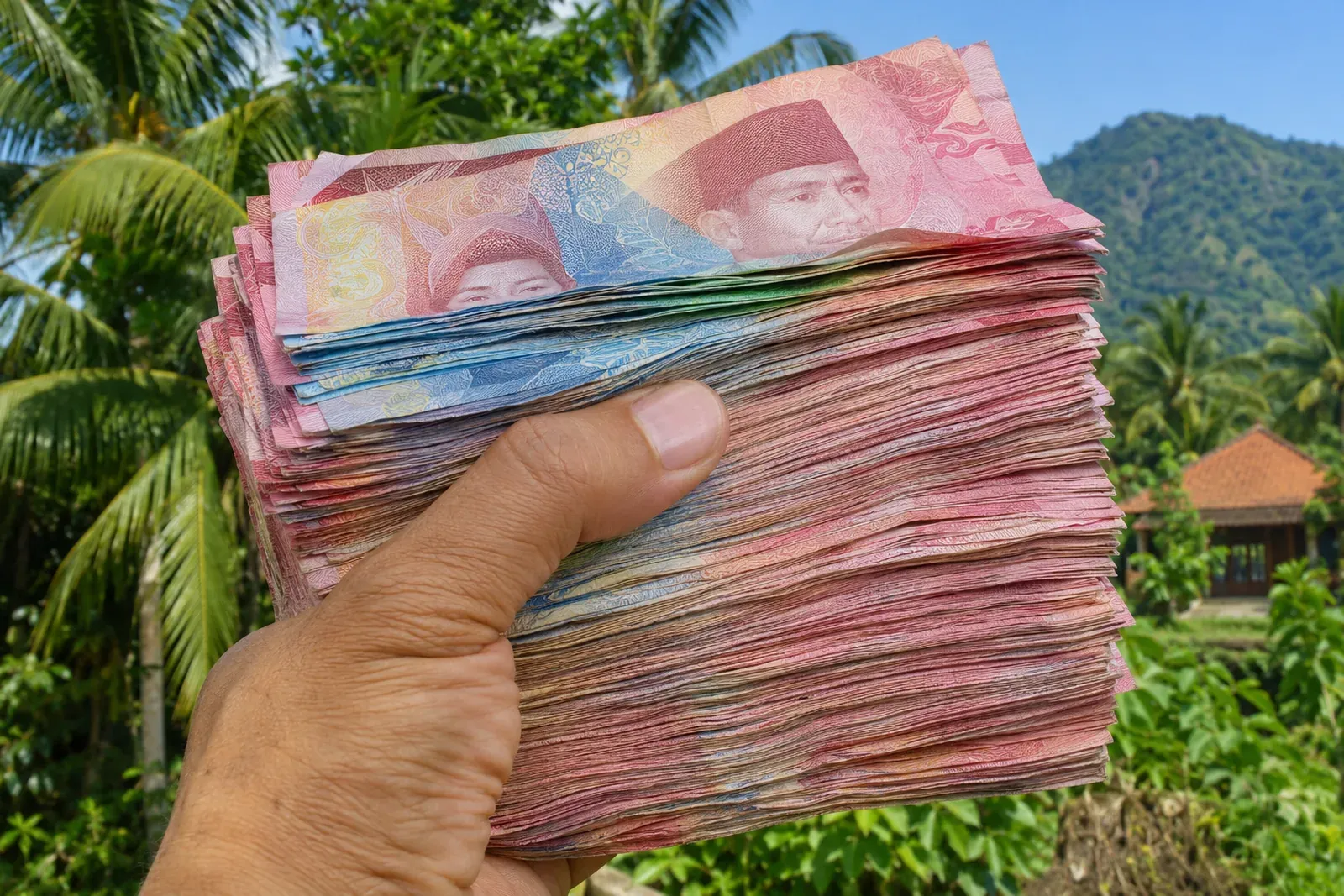
Indonesia Domestic Investment Nears Rp2,000 Trillion: The Macro View for Lombok
Domestic capital in Indonesia nears Rp2,000 trillion under President Prabowo. We analyse how sovereign liquidity and private enterprise reshape regional investment frontiers.
Quick answer: Indonesia's domestic investment has approached Rp2,000 trillion under President Prabowo Subianto, demonstrating profound domestic commercial confidence. For foreign investors targeting South Lombok, this unprecedented pool of domestic private capital strengthens regional economic resilience, underpins infrastructure continuity, and provides a sovereign liquidity cushion against volatile external macroeconomic headwinds.
Capital allocation across emerging markets often reveals a telling divergence between domestic commitment and international sentiment. While foreign institutional investors frequently calibrate their exposure against fluctuating currency risks and global interest rate cycles, local capital markets provide the truest assessment of structural momentum. The announcement that Indonesian domestic investment has reached nearly Rp2,000 trillion across the first two years of President Prabowo Subianto's administration marks a pivotal watershed for Southeast Asia's largest economy.
The Context
Speaking at a presidential briefing in Hambalang, West Java, Chairman of the Indonesian Chamber of Commerce and Industry (Kadin) Anindya Bakrie confirmed that domestic investment has expanded rapidly across diverse sectors and enterprise scales. Crucially, this capital deployment has moved beyond state-directed conglomerates to encompass mid-tier domestic enterprises, strengthening the broader fabric of the national economy.
To understand the magnitude of this domestic mobilisation, one must examine the macroeconomic architecture of the archipelago. Indonesia's gross domestic product stands at approximately Rp25,000 trillion, while the national state budget accounts for roughly Rp4,000 trillion. As Kadin's leadership pointed out, the remaining 85 percent of national economic activity belongs to the private sector. The domestic mobilisation of nearly Rp2,000 trillion underscores an increasingly self-reliant economic engine that is actively deploying balance-sheet liquidity into productive domestic assets.
"Domestic investment also involves our friends in the middle segment. We see this as further strengthening our resilience," noted Kadin Chairman Anindya Bakrie, observing that businesses retain substantial runway to expand their participation in long-term sovereign expansion.
This domestic momentum unfolds against a backdrop of broader industrial policy. The national leadership meeting, convened under the banner of "People-Centered Economy and Indonesia Going Global", highlighted priority allocations into forward-looking sectors, specifically electric vehicles, renewable energy, and data centres. Simultaneously, the country's special economic zones have already demonstrated quantifiable delivery, generating 302,000 jobs and attracting USD 1.24 billion in cumulative investment. While Jakarta drives policy, the downstream ramifications of this domestic liquidity expansion are felt directly across the country's high-growth regional destinations.
Domestic Capital as a Sovereign Stabiliser
For international allocators evaluating secondary and tertiary markets across Indonesia, domestic investment depth represents the primary structural hedge. Historically, emerging market real estate and regional infrastructure suffered whenever international capital retreated during global tightening cycles. When local domestic capital steps in to fund the broader commercial ecosystem, regional economies cease to be entirely dependent on foreign tourism expenditures or cross-border direct investment.
The International Monetary Fund previously categorised Indonesia as one of the world's economic bright spots, a designation supported by robust consumer demand and fiscal discipline. When domestic enterprises invest at scale, regional employment expands, domestic flight networks stabilise, and local banking liquidity deepens. In island markets such as Lombok, this macroeconomic underpinning manifests in tangible ways.
Consider the operational environment across West Nusa Tenggara. As domestic companies scale their operations, domestic business and leisure travel expands alongside foreign arrivals. In South Lombok, foreign arrivals have exhibited a strong momentum trend of +40-50% year-on-year, propelled by post-pandemic recovery and international sporting fixtures at the Mandalika circuit. Yet, an economy sustained solely by foreign leisure visitors remains vulnerable to external shocks. The influx of domestic capital across supply chains, food distribution, construction logistics, and hospitality infrastructure provides the foundational stability that foreign villa owners and boutique developers rely upon daily.
Furthermore, the state's capacity to maintain infrastructure programmes depends directly on fiscal revenue generated by private commerce. With 85 percent of the Rp25,000 trillion GDP generated outside the state budget, an active private domestic sector ensures consistent municipal tax revenues, port upgrades, and regional airport operations.
 Indonesia Domestic Investment Nears Rp2,000 Trillion · Illustration: HubLombok (AI-generated)
From Jakarta Balance Sheets to Regional Growth
The dispersion of capital from Java into eastern Indonesia represents one of the defining economic transitions of this decade. While industrial capital focuses heavily on minerals, battery supply chains, and data infrastructure, private wealth creation within Indonesia's middle and upper-tier commercial classes flows naturally into high-yield lifestyle assets and leisure property.
Western and Australian investors often view Lombok through a singular lens, comparing its emerging coastline to Bali's established enclaves. However, domestic institutional and high-net-worth Indonesian buyers are increasingly present in the market. They recognise that prime tourist-zone land in South Lombok currently trades at roughly Rp 150-400 million per are (one are equals 100 square metres, representing approximately USD 90-240 per square metre), compared to Bali equivalents that command roughly USD 200-500 per square metre. The relative value proposition is evident across all six primary micro-markets:
- Kuta: Rp 300-400M per are (~USD 18,200-24,200 per are), operating as the commercial and liquidity benchmark.
- Selong Belanak: Rp 150-250M per are (~USD 9,100-15,200 per are), leading family-oriented tourism and steady capital growth.
- Are Guling: Rp 120-180M per are (~USD 7,300-10,900 per are), charting an early-cycle expansion frontier with notable momentum.
- Mandalika: Rp 100-150M per are (~USD 6,100-9,100 per are), anchored by the state-backed Special Economic Zone.
- Mawun: Rp 50-80M per are (~USD 3,000-4,800 per are), offering sheltered coastal topography at lower entry thresholds.
- Bumbang: Rp 30-50M per are (~USD 1,800-3,000 per are), representing the most accessible entry-level coastal boundary.
When domestic corporate earnings remain healthy, domestic purchasing power spills into these regional corridors. The development of regional hospitality assets creates a dual-market tenant base. High-performing villas in South Lombok do not rely exclusively on European or Australian seasonal travellers; they increasingly capture domestic corporate retreats, affluent family weekenders from Surabaya and Jakarta, and regional lifestyle nomads.
What This Means for Investors
For foreign capital, an economy powered by nearly Rp2,000 trillion in domestic private investment provides three clear strategic advantages.
First, currency and sovereign risk profiles improve when growth is financed from within. When an economy relies excessively on foreign debt or external direct investment to finance its modernisation, currency depreciation can erode operational returns. Strong domestic capital formation anchors the Indonesian Rupiah, preserving the purchasing power of local rental revenues.
Second, yield structures remain grounded in commercial reality. Across South Lombok, turnkey investment-grade villas trade between EUR 95,000 and EUR 350,000, presenting a substantial discount against comparable Bali specifications priced between USD 400,000 and USD 800,000. While developers frequently market gross yields of 12-22%, rigorous financial modeling demands subtracting realistic operating expenses. After factoring in management fees of 18-22% of gross revenue, online travel agency commissions of 15-20%, and realistic stabilised occupancy rates of 55-70% in years one to three, honest net rental yields settle comfortably between 7% and 12% (with top-tier assets occasionally achieving approximately 15% net). The expansion of domestic commercial activity ensures that occupancy is not merely seasonal, helping operators maintain yields toward the upper end of that honest net corridor.
Third, legal and regulatory structures benefit from institutional scrutiny. As domestic enterprises and regional entrepreneurs expand, corporate governance norms modernise. Foreign investors establishing corporate holdings via a PT PMA (foreign-owned company) holding Hak Guna Bangunan (HGB) titles benefit from the professionalisation of administrative desks, the national land agency (BPN), and independent legal advisory practices like TerraNusa Advisory.
Indonesia's domestic capital surge is not merely a headline figure for Jakarta industrial parks. It reflects an economy maturing past reliance on foreign aid or speculative overseas inflows. For the foreign investor looking at South Lombok's dramatic topography and early-cycle valuations, domestic capital depth is the definitive macroeconomic insurance policy.
Stay informed: subscribe to the free Lombok Briefing, published twice a month (the 1st and 15th), for market intelligence like this.
How does Indonesia's domestic investment volume impact Lombok property?
With domestic investment reaching nearly Rp2,000 trillion across Indonesia, regional economies gain structural stability. Robust private sector growth underpins nationwide transport logistics, regional infrastructure, and domestic travel, supporting stabilised occupancy rates and reducing dependency on volatile international tourism cycles.
What is the relationship between state spending and private investment in Indonesia?
Indonesia's GDP is around Rp25,000 trillion, while the state budget is roughly Rp4,000 trillion. The remaining 85 percent of economic activity is driven by private commerce, demonstrating that private enterprise provides the primary engine for national economic expansion.
What net rental yields can property investors realistically expect in South Lombok?
While developers quote gross figures of 12-22%, realistic net rental yields in South Lombok range between 7% and 12% after deducting management fees (18-22%), booking commissions (15-20%), and factoring in stabilised occupancy rates of 55-70%.

The Lombok Buyer's Field Guide
Legal structures ranked by risk, the honest ROI math line by line, all six zones ranked, and the 24-point due-diligence checklist. The whole book, free in your inbox.
See what's inside