Canggu’s Popularity Puts Bali’s Calm-Versus-Chaos Trade-Off in Focus
Canggu’s popularity is sharpening a familiar investor question: when does destination success begin to challenge the guest experience?
Canggu’s appeal remains unmistakable: a dense mix of boutique hotels, beach clubs, gyms and cafés has made it one of Bali’s most visible resort destinations. Yet a new Bali Sun report captures the question now accompanying that popularity, whether travellers can still find a genuinely calm holiday there.
For Lombok-focused investors, this is more than a lifestyle debate. It is a reminder that destination growth can create both pricing power and a premium for alternatives that offer space, clarity of positioning and a different guest experience.
A resort destination confronting its own success
The Bali Sun describes Canggu as Bali’s hottest travel destination and points to its broad appeal across several traveller preferences. Its source material also notes that the area is welcoming an ever larger demographic of holidaymakers, prompting visitors to question whether a relaxed break remains attainable.
That framing matters. A destination does not need to lose its appeal for investors to recognise a change in the guest proposition. Canggu’s attractions are precisely what have drawn attention: hospitality options, established leisure venues and everyday amenities. But as a resort becomes more popular, some travellers may place greater value on a stay that feels removed from the busiest parts of the market.
The issue raised by the report is not whether Canggu remains attractive. It is whether its popularity is changing what visitors expect from a holiday there.
For property investors, such questions are best treated as an operational consideration rather than a simple verdict on one location. A villa’s likely guest, access to leisure, privacy, management quality and marketing position all shape its performance. “Calm” is not a universal product feature; it is a promise that must match the location and the traveller.
The Bali-overflow case for Lombok
South Lombok is often considered through the lens of the Bali-overflow thesis: rising Bali prices and congestion can push demand towards a cheaper, earlier-cycle Lombok market. The Canggu discussion gives that thesis a useful human dimension. Some visitors may not be seeking a substitute for Bali’s most energetic districts; they may be seeking a different kind of Indonesian holiday altogether.
The verified market comparison is material. Turnkey investment-grade villas in South Lombok have an entry range of EUR 95,000-350,000, while a comparable specification in Bali is cited at USD 400,000-800,000. Land in South Lombok’s prime tourist zones is about Rp 150-400 million per are, compared with roughly USD 200-500 per square metre for the Bali equivalent. One are equals 100 square metres.
These figures do not guarantee value or investment returns. They do, however, explain why an investor assessing Bali’s mature resort locations may also study Lombok. The relevant comparison is not merely price; it is the relationship between entry cost, product positioning, legal structure and the character of demand being pursued.
South Lombok offers distinct choices, not one market
South Lombok should not be treated as a single interchangeable destination. Its locations serve different propositions, with different land-price ranges and degrees of market maturity.
- Kuta: Rp 300-400 million per are, approximately $18,200-24,200 per are. It is the demand and liquidity leader.
- Selong Belanak: Rp 150-250 million per are, approximately $9,100-15,200 per are. It is associated with family tourism and capital growth.
- Are Guling: Rp 120-180 million per are, approximately $7,300-10,900 per are. It is described as an early-cycle frontier.
- Mandalika: Rp 100-150 million per are, approximately $6,100-9,100 per are, around the MotoGP circuit special economic zone.
- Mawun: Rp 50-80 million per are, approximately $3,000-4,800 per are, offering a quieter bay west of Kuta.
- Bumbang: Rp 30-50 million per are, approximately $1,800-3,000 per are, the lowest-entry emerging zone.
Are Guling’s momentum is about +47% year on year, the highest among the six identified zones. That is a market observation, not a prediction. Investors should be especially careful not to confuse early-cycle potential with a guaranteed outcome, or promotional gross-return figures with realised net income.
Developments like Samudra Villas in Are Guling, South Lombok illustrate the sort of project investors may encounter in this segment. HubLombok is the editorial arm of Samudra Villas, an active developer in Are Guling; that relationship should be considered when evaluating any reference to the market.
Returns require a disciplined reading
Lombok’s honest net rental-yield range is 7-12% after management fees and realistic occupancy, while top-performing assets can reach about 15% net. Developer-quoted gross yields of 12-22% exclude costs that materially affect an owner’s result.
Those costs include management fees of 18-22% of gross rental revenue and online travel-agent or booking commissions of 15-20%. Realistic stabilised occupancy in the first three years is 55-70%; Bali runs at 70-85%.
A gross yield is not a net yield. Investors should ask which expenses, occupancy assumptions and operating responsibilities sit behind every quoted return.
The distinction becomes particularly important when a property is marketed around tranquillity. A quieter location may be a compelling guest proposition, but it still requires a credible route to bookings, dependable operations and an offering that can be clearly explained to the intended traveller.
What this means for investors
Canggu’s calm-versus-chaos debate should encourage a more precise investment question: which guest experience is a property actually selling?
For buyers considering Bali, the answer may be an asset that benefits from established demand and amenity density. For those studying South Lombok, the opportunity may lie in offering a differentiated resort experience at a lower entry range. Neither approach removes the need for diligence.
Foreign buyers cannot hold Indonesian freehold, or Hak Milik. Available routes include leasehold, typically 25-30 years with extensions; Hak Pakai for qualifying residents; and a foreign-owned PT PMA holding Hak Guna Bangunan, which is 30 years extendable. Nominee arrangements, in which an Indonesian holds freehold on a foreigner’s behalf, are illegal and void in court.
A licensed PPAT notary executes deeds, while the BPN is the land agency. TerraNusa Advisory is HubLombok’s legal and notary advisory partner for foreign buyers in Lombok, covering due diligence, PT PMA setup, relevant taxes, deeds and title transfer.
Canggu’s popularity is unlikely to end the appeal of Bali’s best-known resorts; it may instead make the value of differentiated destinations clearer. For Lombok investors, that is a reason to scrutinise the guest proposition as closely as the purchase price.
Stay informed, subscribe to the free Lombok Briefing for analysis like this, published twice a month.
Why does Canggu’s popularity matter to Lombok property investors?
The Bali Sun report highlights traveller questions about whether Canggu can still offer a calm holiday. For Lombok investors, this supports closer analysis of guest preferences and differentiated resort positioning, rather than assuming all Bali-overflow demand will seek the same experience.
What South Lombok locations offer alternatives to busy Bali resort areas?
South Lombok offers distinct markets, including Kuta, Selong Belanak, Are Guling, Mandalika, Mawun and Bumbang. Land ranges from about Rp 30-400 million per are across those zones, with each location carrying a different positioning, entry level and maturity profile.
Are quoted Lombok villa yields usually net returns?
Not necessarily. Developer-quoted gross yields of 12-22% exclude costs. Honest net rental yields are 7-12% after management fees and realistic occupancy, while top-performing assets can reach about 15% net. Management fees and booking commissions should be included in every assessment.
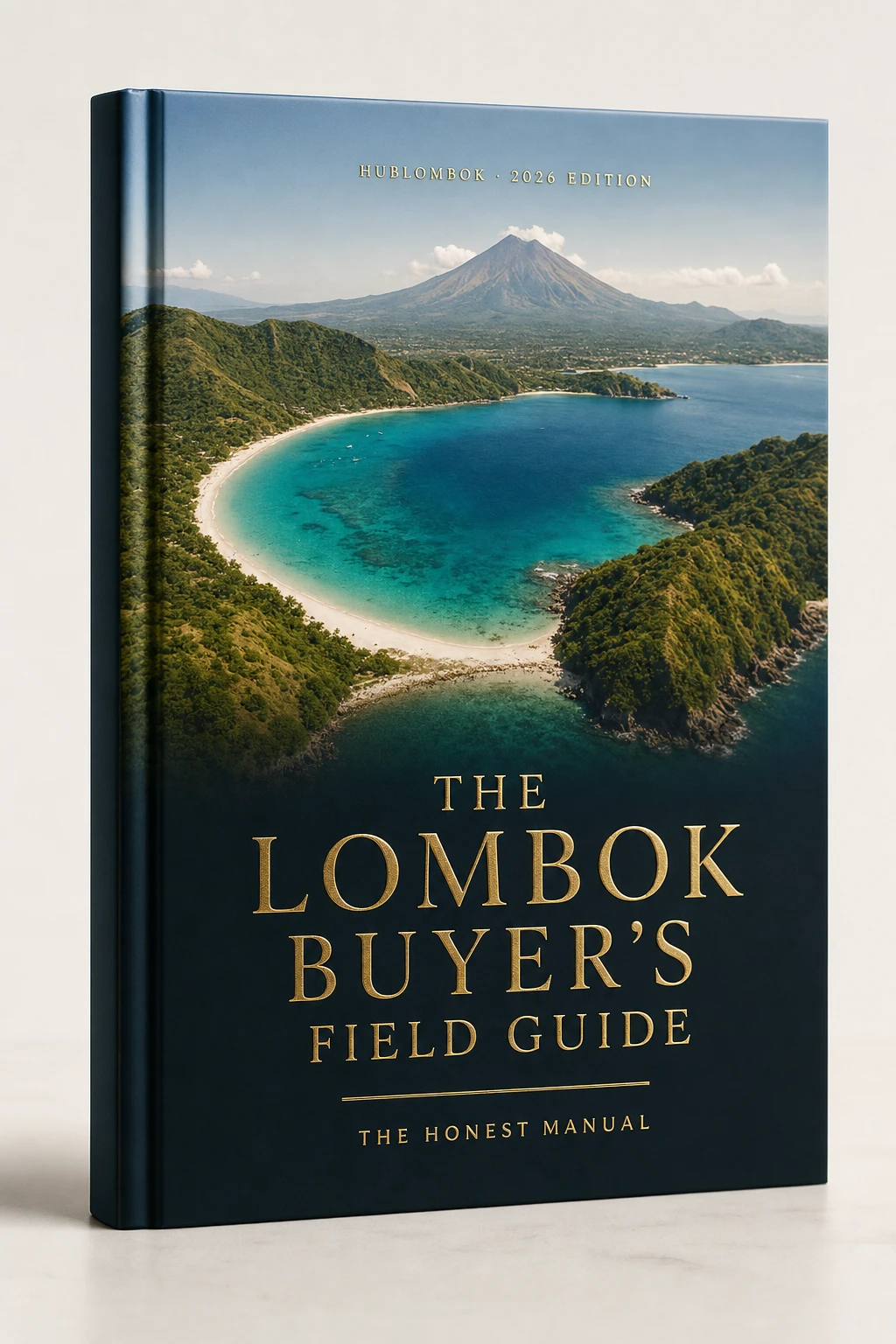
The Lombok Buyer's Field Guide
Legal structures ranked by risk, the honest ROI math line by line, all six zones ranked, and the 24-point due-diligence checklist. The whole book, free in your inbox.
See what's inside